
The first surprise about the Torito de Pucará is hidden in its name.
The ceramic bull did not originate exactly where most travelers assume it did.
The pottery tradition is historically associated with Santiago de Pupuja and surrounding communities in Puno, while Pucará became the place where the ceramic figures gained commercial visibility. According to Peru’s current official tourism inventory, potters moved toward José Domingo Choquehuanca and later Pucará partly because these towns were connected to the Puno–Cusco railway corridor. Demand eventually helped attach the name Pucará permanently to the little ceramic bull.
That detail is worth remembering when you first encounter one.
Perhaps you see two Toritos on a rooftop while traveling across the Altiplano.
Perhaps you find a turquoise one in a Cusco handicraft shop.
Or someone tells you that the red Torito means protection, the yellow one brings prosperity and the green one represents health.
Some of those associations are widely used today.
But the history is more complicated.
The Torito de Pucará is not simply a collection of colors with fixed meanings. It is the product of centuries of cultural adaptation, livestock rituals, pottery knowledge, colonial influence and contemporary artistic interpretation.
To understand the colors, you first have to understand the bull.
Is the Torito de Pucará an ancient Inca symbol?
No.
This is one of the easiest misconceptions to encounter in Peru.
The bull itself could not have been part of pre-Hispanic Inca culture because cattle were introduced into the Andes after the Spanish conquest.
What happened next is much more interesting.
Andean communities already maintained complex relationships with animals, fertility, agricultural production, mountains and ceremonial offerings. When cattle entered that world, the animal gradually acquired new local meanings.
The Ministry of Culture describes traditional pottery from Checca Pupuja as evidence of cultural and artistic exchange between pre-Hispanic ceramic traditions and practices introduced during the Viceroyalty. In 2019, the knowledge, techniques and practices associated with this pottery were declared Cultural Heritage of the Nation.
The Torito therefore should not be understood as either completely Spanish or completely pre-Hispanic.
It is a product of transformation.
That is what makes it genuinely Andean.
So where does the Torito de Pucará really come from?
Think of the history as a geographical triangle:
Santiago de Pupuja → railway corridor → Pucará
The current Mincetur inventory identifies Santiago de Pupuja, in the province of Azángaro, as an important early center of production.
Artisans later moved or sold their work closer to transportation routes.
Pucará became particularly important because travelers passed through it while moving between Puno and Cusco.
Eventually, the commercial location became more famous than the precise production history.
This is not unusual.
Foods, textiles and crafts are often named after the places where outsiders encounter them rather than the communities where the tradition first developed.
The Torito is a particularly good example.
The name tells you where it became famous.
The pottery tradition tells you where you should look deeper.
Why was a ceramic bull created in the first place?
It was not originally designed simply to decorate a living room.
Traditional Toritos were connected with livestock ceremonies, especially practices associated with señalacuy or señalakuy, the marking of animals.
The Torito could also function as a vessel.
That explains the opening often visible on its back.
Official tourism documentation connects the figure with ceremonies involving Pachamama and requests for:
- fertility
- livestock reproduction
- abundance
- prosperity
- protection
The bull was therefore an active ceremonial object before becoming a familiar decorative symbol.
This is one of those details that completely changes what you see.
A small opening that looks decorative suddenly has a function.
The exaggerated tail stops looking random.
The flowers and markings begin to resemble an animal prepared for ceremony rather than a realistic farm bull.
Why does the Torito look so exaggerated?
Look at one from the side.
The proportions are strange.
The eyes protrude.
The horns are prominent.
The tongue may extend from the mouth.
The tail curls sharply upward.
Circular decorations cover the body.
The Torito is not trying to win an anatomical accuracy competition.
Its visual language relates to ceremonial livestock and the symbolic qualities assigned to the animal.
Official descriptions of current traditional production identify elements including:
Rosetones
Circular decorative motifs placed on the body and currently associated with prosperity or wealth.
Gualco
An element that represents cords or chains used around the animal.
Enjalmita
A decorative representation associated with the covering placed on the bull.
Raised tail
One of the most immediately recognizable characteristics of the figure.
Horns
Visually reinforce the animal’s strength.
These details are still manually added during traditional production rather than simply being painted onto a generic bull-shaped object.
What does the Torito de Pucará symbolize today?
The interpretations that appear most consistently in official and cultural sources are:
- protection
- fertility
- prosperity
- abundance
- family well-being
- good fortune
During the March 2026 National Day celebrations, Peru’s Ministry of Culture again described the Torito as an Andean symbol of protection, fertility and prosperity.
That is a useful foundation.
Things become less certain when someone begins assigning extremely specific spiritual meanings to every eye, stripe, spiral and color.
Some of those interpretations are well established in contemporary culture.
Others are more recent.
And artisans themselves continue creating new meanings.
The Torito is not a frozen dictionary of ancient symbols.
Why are Toritos placed in pairs?
You may first notice the tradition while traveling through Puno.
Then you start seeing it elsewhere.
Two ceramic bulls sit above a roof.
Sometimes they appear beside a cross.
Sometimes other small figures accompany them.
Today, Toritos are commonly placed in pairs as symbols of protection and prosperity for the household. Mincetur’s current documentation notes their use on roofs, gates, walls and corrals, generally in pairs and associated with well-being, fertility and family prosperity.
The paired arrangement is also widely connected with ideas of complementarity and balance.
But that does not mean a traveler must buy two.
If you want to reproduce the symbolic domestic arrangement, a pair makes sense.
If you simply appreciate one exceptional artisan piece, one is enough.
Cultural symbolism should help you understand an object.
It should not become a sales technique.
What color was the traditional Torito de Pucará?
This is where online explanations often contradict one another.
You may read that the original Torito was red.
Elsewhere, you may see cream and brown described as traditional.
The current official Mincetur inventory provides a useful reference: it specifically identifies cream and ochre as traditional tones, while noting that modern production has expanded toward more intense colors.
That means the highly saturated turquoise, yellow, orange and blue Toritos you see today belong largely to the expanding contemporary visual language of the craft.
But contemporary does not automatically mean fake.
A brightly colored Torito can still be handmade by an experienced artisan.
And an earthy brown Torito can still be a mass-produced decorative object.
Color is not proof of authenticity.
Provenance is more important.
What do the colors of the Torito de Pucará mean?
Modern interpretations have become increasingly standardized.
In March 2026, Peru’s state news agency Andina published the following contemporary associations for the most common colors.
| Torito color | Common contemporary interpretation |
|---|---|
| Blue | Harmony and celestial protection |
| Yellow | Abundance and prosperity |
| Red | Protection and security |
| Green | Health and well-being |
| Orange | Joy and happiness |
| White | Peace and tranquility |
| Black | Protection from negative energies |
These interpretations are useful.
But they need one important footnote:
they should not be treated as an immutable pre-Hispanic color code.
Even sources explaining the color symbolism acknowledge that modern Toritos have expanded far beyond their earlier palette.
Artisans choose colors for symbolic reasons, aesthetic reasons, customer preferences and personal creativity.
In other words:
you can choose a blue Torito because you associate it with harmony.
You can also choose it because blue looks good in your house.
Both are legitimate.
What does a blue Torito de Pucará mean?
Blue is currently associated with:
- harmony
- tranquility
- celestial protection
It has become one of the most visually appealing contemporary choices because intense blues contrast beautifully with white, yellow and gold details.
But blue is not evidence that the Torito follows an ancient blue-bull tradition.
It is part of today’s expanded color vocabulary.
Best choice for
Travelers who prefer a calmer visual style or want the Torito primarily as home decoration.
What does a yellow Torito mean?
Yellow is commonly associated with:
- abundance
- prosperity
That interpretation fits particularly well with the broader meaning of the Torito itself, which has long been linked with fertility and material well-being.
Yellow Toritos also tend to be visually dominant.
If you are placing two differently colored Toritos together, yellow works especially well as the brighter of the pair.
What does a red Torito mean?
Red is currently associated with:
- protection
- security
- strength
It is also one of the colors travelers most readily associate with traditional Andean crafts.
Do not assume, however, that every red Torito has been specifically produced as a protection amulet.
The artisan may simply have chosen red as the principal decorative color.
Meaning depends partly on context.
What does a green Torito mean?
Green is commonly interpreted today as representing:
- health
- well-being
It also naturally evokes agriculture and the landscape, so it is frequently connected informally with growth and fertility.
Green can be particularly attractive when combined with cream or earth-toned decoration rather than highly contrasting colors.
What does an orange Torito mean?
Orange is commonly linked with:
- joy
- happiness
It is one of the more obviously contemporary-looking choices, especially in highly saturated versions.
Orange Toritos make an interesting case study in how the tradition changes.
An object does not need to look centuries old to remain connected with a historical craft.
What does a white Torito mean?
White is generally associated with:
- peace
- tranquility
Some older interpretations also connect white with purity and protection.
A predominantly white Torito can also make the molded details easier to appreciate because the visual effect depends less on strong color contrasts.
For travelers interested in the actual ceramic form rather than bright decoration, it can be one of the better choices.
What does a black Torito mean?
Black is among the more complicated colors because interpretations vary.
Current Andina and PromPerú-style explanations commonly associate it with protection against negative energies.
Older published interpretations have sometimes assigned other meanings to black.
That inconsistency is exactly why color symbolism should be approached as living cultural interpretation rather than rigid historical fact.
If two sources give different meanings, that does not necessarily mean one artisan is wrong.
It may mean the symbolism has changed.
Traditional colors vs contemporary colors
The difference can be dramatic.
| Traditional tendency | Contemporary tendency |
| Cream | Turquoise |
| Ochre | Bright blue |
| Brownish earth tones | Yellow |
| Mineral-looking pigments | Orange |
| Subtle contrasts | Metallic gold |
| Glazed earth colors | Pink and multicolor designs |
Traditional production may incorporate pigments such as nogalina, copper oxides and manganese oxides, while today’s artisans can also use industrial pigments to produce a much wider spectrum.
That evolution is worth celebrating rather than automatically treating it as loss.
If artisans had never adapted, the Torito itself would never have existed.
How is a traditional Torito de Pucará made?
This is where the object becomes considerably more impressive.
According to the current official tourism inventory, traditional production may involve several stages.
Preparing the clay
Local clay is selected and worked until sufficiently homogeneous.
Creating the basic form
Plaster molds may be used to establish the initial body.
Hand modeling
Artisans manually add:
- horns
- tail
- rosettes
- decorative ornaments
Polishing
The surface is finished manually using simple tools.
Drying
Pieces remain in the sun for several days.
First firing
Traditional kilns can reach roughly 800°C to 1,000°C.
The first firing may last around eight hours.
Painting
Natural and industrial pigments can then be applied.
Glazing
Some pieces receive a glazed finish.
Second firing
Glazed Toritos may return to the kiln for another four to five hours.
That is a substantial process for an object that many travelers initially evaluate in thirty seconds.
What should a handmade Torito look like?
Not necessarily imperfect.
This is an important distinction.
Travelers sometimes assume:
“Uneven means handmade.”
It can.
But experienced artisans can produce remarkably consistent work.
Look instead at the combination of:
- molded details
- brushwork
- horn construction
- surface finish
- glaze
- base
- symmetry
- small variations
A small irregularity can reveal hand finishing.
A large crack is simply a crack.
Do not romanticize poor workmanship.
How can you recognize a better-quality Torito?
Pick it up.
Turn it over.
Most buyers only examine the front.
Look at these areas:
| Area | What to check |
| Horns | Clean shape and secure attachment |
| Tail | No visible structural cracking |
| Base | Stable and reasonably even |
| Rosettes | Defined modeling |
| Paint | Intentional brushwork |
| Glaze | Consistent with the intended finish |
| Body | No major firing cracks |
| Provenance | Artisan or workshop identifiable when possible |
Then ask:
Who made this?
That question is much more useful than:
Is this authentic?
Why is Checca Pupuja important?
Because cultural heritage is not only about objects.
In 2019, Peru’s Ministry of Culture formally recognized the knowledge, techniques and practices associated with traditional ceramic production in Checca Pupuja as Cultural Heritage of the Nation.
The declaration emphasizes the interaction between pre-Hispanic and colonial pottery practices and the continuing social and ceremonial role of ceramics within the community.
Notice what the government protected:
not a particular color.
not one decorative pattern.
not one commercial version of the Torito.
It recognized the knowledge behind ceramic production.
That distinction explains why simply copying the shape is not the same as preserving the tradition.
Why does March 18 matter?
Because Peru now has a national day dedicated to the Torito de Pucará.
Law 31492, published in June 2022, officially declares March 18 of every year as the National Day of the Torito de Pucará.
The date has become increasingly useful for travelers interested in seeing the tradition outside a souvenir-market context.
And 2026 provided a particularly good example.
What happened in Pucará in 2026?
The March 2026 celebrations expanded significantly.
The Ministry of Culture reported a program involving an artisan fair and traditional dances, while describing the Torito as a continuing symbol of Andean identity.
Pucará also organized its First Major Indigenous Dance Competition at the Kalasaya Archaeological Complex.
More than 45 dance groups ultimately participated in the March 18 event.
And there was another development especially relevant to the subject of color.
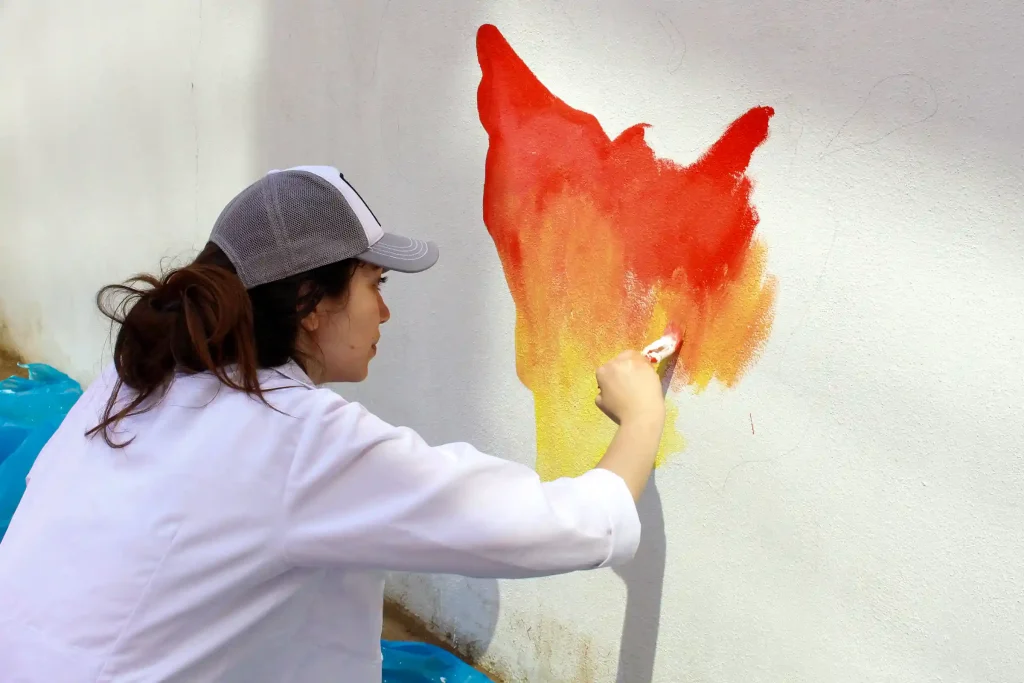
In 2026, Pucará invited people to paint the Torito themselves
From March 15 through March 17, the municipality organized Pinta Tu Torito de Pucará.
The competition included:
| Date | Category |
| March 15 | Children aged 9–12 |
| March 16 | Local open category |
| March 17 | National category |
The activity preceded the National Day celebrations on March 18.
This is important because it demonstrates something easily overlooked:
modern color experimentation is not occurring only in tourist shops.
Creative reinterpretation is also appearing within contemporary cultural programming in Pucará itself.
A turquoise Torito therefore does not automatically represent the destruction of tradition.
It may represent one of the ways the tradition continues evolving.
Is there really a legend about the Torito bringing water?
Yes, a popular legend circulates about drought and a bull whose horn caused water to emerge from rock.
Versions differ.
The essential story usually involves a community suffering from severe drought, a bull taken toward a rocky location and water miraculously appearing after the animal strikes or interacts with the rock.
It is an appealing story.
But travelers should distinguish legend from documented historical origin.
The historical explanation is grounded more securely in:
- colonial introduction of cattle
- regional livestock ceremonies
- Pupuja pottery traditions
- ritual transformation
- subsequent commercialization
The legend belongs to the cultural storytelling surrounding the Torito.
It should not replace the historical evidence.
Both can coexist.
One explains what people remember and tell.
The other explains what researchers can document.
Where should Toritos be placed at home?
Traditionally, you will often see them:
- on rooftops
- above entrances
- on walls
- around corrals
Today, they also appear inside:
- homes
- hotels
- restaurants
- offices
- galleries
If you are taking a pair home, there is no strict international rule about where they must go.
A doorway or elevated shelf makes visual sense if you want to reference their protective role.
A bookshelf is equally acceptable if you primarily value them as art.
Traditions move.
That movement is already part of the Torito’s history.
Is one Torito enough?
Yes.
But two carry additional symbolism.
A pair is particularly appropriate if your interest is:
- household prosperity
- protection
- complementarity
- family well-being
One is appropriate if your interest is:
- artisan craftsmanship
- collecting
- decoration
- a specific artist
- remembering your trip
Do not buy a second mediocre Torito simply to obey a rule somebody invented at the cash register.
One exceptional artisan piece is better than two anonymous ones.
Should you buy a Torito in Cusco or Puno?
Both are possible.
The difference is access to provenance.
Cusco
Advantages:
- enormous selection
- easy to compare styles
- convenient for travelers
- contemporary designs widely available
Limitation:
You may need to ask more questions to determine where the piece was actually produced.
Puno
Advantages:
- closer to the cultural region
- stronger connection with local artisans
- easier to contextualize the craft
Pucará and nearby production areas
Best for travelers who want the object to become part of the journey rather than simply part of the shopping.
If you are already traveling between Cusco and Lake Titicaca, consider waiting.
The Torito may mean considerably more once you encounter it closer to the places connected with its production.
What else should you see in Pucará?
This is where the timeline becomes particularly interesting.
The Pukara archaeological culture is much older than the ceramic Torito.
Visiting the archaeological context helps prevent one of the most common misunderstandings: assuming everything called Pucará belongs to the same historical period.
The Museo Lítico de Pukara, at Jr. Lima s/n, contains archaeological material related to the ancient regional culture.
The Ministry of Culture has listed regular visiting hours as Tuesday through Sunday, 8:30 a.m. to 5:30 p.m., although travelers should always reconfirm operational hours before visiting.
A useful order is:
archaeological site → museum → ceramic workshops → Torito
You begin with ancient Pukara culture.
You finish with a much later tradition shaped by colonial and modern history.
That chronology prevents several centuries from collapsing into one vague idea of “ancient Peru.”
When is the best time to visit Pucará?
If the Torito itself is your main motivation, two periods stand out.
Around March 18
Best for cultural programming.
March 18 is the National Day of the Torito de Pucará, and 2026 demonstrated how substantial the festivities can become.
The trade-off:
March is still part of the wetter Altiplano season.
May through September
Better for generally drier road conditions and clearer travel days.
The trade-off:
cold.
Pucará sits at approximately 3,887 meters above sea level, according to the current official tourism inventory.
A sunny day can feel pleasant.
Then a cloud blocks the sun.
The temperature can seem to change instantly.
What should you wear in Pucará?
Layers matter more than one very heavy jacket.
A practical combination is:
- lightweight base layer
- fleece
- compact insulated jacket
- wind-resistant or waterproof shell
- comfortable trousers
- walking shoes
- sunglasses
- sunscreen
- hat
- light gloves during cold dry-season mornings
For travelers buying equipment before the trip, a Patagonia Nano Puff or equivalent lightweight insulated jacket is useful because it compresses easily.
A Columbia Watertight II or similar shell is adequate for light rain and wind.
For footwear, a Merrell Moab 3 or Salomon X Ultra 4 makes sense if you combine cultural visits with archaeological walking.
You do not need mountaineering clothing.
The more important trick is being able to remove layers quickly when the sun returns.
How do you transport a ceramic Torito safely?
The vulnerable parts are predictable:
horns → ears → tail
Do not simply wrap the entire Torito in one thick layer.
Protect those points individually first.
A safer packing method is:
- wrap both horns separately
- cushion the ears
- protect the tail
- wrap the body
- place everything inside a rigid box
- fill any empty space
- keep it in hand luggage when practical
A traveler can protect the body perfectly and still arrive home with a one-horned Torito.
Pressure points matter more than overall softness.
Traditional or contemporary Torito: which one should you choose?
There is no universal winner.
| If you want… | Consider… |
| Older regional aesthetics | Cream or ochre Torito |
| Strong symbolism | Choose a color whose contemporary meaning matters to you |
| Modern home decoration | Bright contemporary piece |
| Collectible craftsmanship | Named artisan |
| Cultural provenance | Puno-produced piece |
| Personal memory | Paint your own |
| Household symbolism | Pair of Toritos |
| Minimalist decoration | Monochrome contemporary design |
A traditional-looking piece tells one part of the story.
A contemporary one tells another.
Both can be legitimate.
The most important thing to understand about Torito colors
The colors are meaningful.
But color is not the oldest or most important part of the Torito’s story.
The deeper tradition is found in:
- ceramic knowledge
- livestock ceremonies
- regional identity
- family transmission
- cultural adaptation
- the relationship between artisans and their environment
Blue, yellow, red and green interpretations add another layer.
They do not replace the history underneath.
That matters when buying one.
Do not ask only:
“What does this color mean?”
Also ask:
“Who made it?”
“Where was it produced?”
“How was it fired?”
“Is this design traditional or contemporary?”
Those questions turn shopping into cultural research.
Torito de Pucará in 2026: tradition without standing still
Perhaps the most interesting thing about the Torito de Pucará is that it survives through contradiction.
The animal came from Europe.
The symbolism became Andean.
The ceramic tradition developed around Pupuja communities.
The object became famous through Pucará.
Railway travelers helped spread its name.
Traditional pieces used restrained colors.
Modern artists introduced increasingly intense palettes.
A ceremonial vessel became a household protector.
A rural craft became an international symbol.
And in March 2026, children and adults were gathering in Pucará to paint entirely new versions of it.
That is not a tradition standing still.
It is a tradition continuing to negotiate what it wants to keep and what it is willing to change.
So when you next see a Torito de Pucará—cream, red, blue, green or impossibly turquoise—look beyond its color.
The more interesting question is not simply what that color means.
It is how a small ceramic bull managed to carry so much Andean history while continuing to change its appearance from one generation to the next.