
You arrive in Peru.
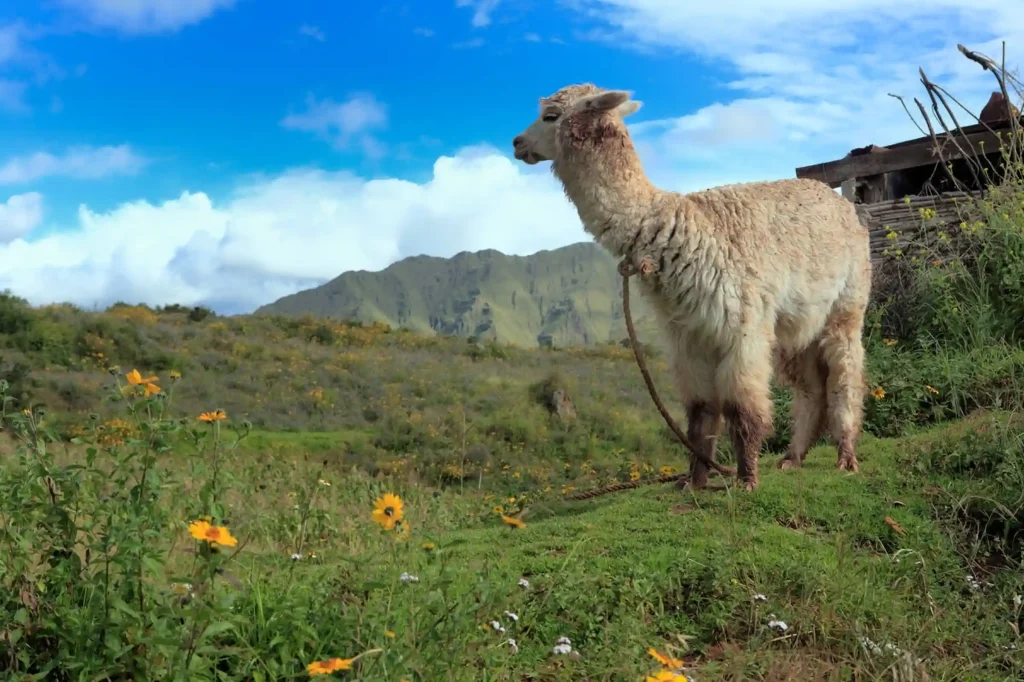
You see a fluffy animal.
You say:
“Look, a llama!”
There is a reasonable chance it is an alpaca.
Then somebody points toward a smaller brown animal and says it is a vicuña.
And just when you think you understand the system, somebody introduces the guanaco.
Fortunately, there is one rule that makes the entire subject much easier:
Llamas and alpacas are domestic.
Vicuñas and guanacos are wild.
That is the most useful starting point.
All four belong to the South American camelid family, but they are not simply different sizes of the same animal.
They differ in:
- domestication
- body shape
- ears
- face
- fiber
- typical color
- traditional use
- natural distribution
And once you know what to look for, they become surprisingly easy to distinguish.
The fastest comparison
| Animal | Domestic or wild? | Relative size | Ears | Face | Coat/color | Best-known association |
|---|---|---|---|---|---|---|
| Llama | Domestic | Largest domestic type | Long, curved “banana” ears | Longer face | Many colors, often less uniformly fluffy | Pack animal |
| Alpaca | Domestic | Smaller and compact | Shorter, straighter ears | Shorter, rounder face | Dense fleece, many colors | Fine fiber |
| Vicuña | Wild | Smallest | Small pointed ears | Delicate, slender | Cinnamon/tan with white underside | Extremely fine fiber |
| Guanaco | Wild | Large and lean | Pointed | Longer, darker/grayish face | Reddish-brown with pale underside | Wild ancestor closely related to llama |
If you only remember the visual shortcut:
big + long banana ears = llama
small + fluffy teddy-bear face = alpaca
small + elegant + tan/white = vicuña
large + wild + reddish-brown + lean = guanaco
That will solve most traveler confusion.
What family do they belong to?
All four are South American camelids.
They are relatives of:
- camels
- dromedaries
but evolved in South America without humps.
The four species are usually classified as:
- Llama — Lama glama
- Alpaca — Vicugna pacos
- Vicuña — Vicugna vicugna
- Guanaco — Lama guanicoe
There is an elegant pattern here.
The genus Lama contains:
llama + guanaco
The genus Vicugna contains:
alpaca + vicuña
That relationship is not accidental.
Which ones are domesticated?
Two.
Llama
Domestic.
Alpaca
Domestic.
Humans have selectively bred these animals in the Andes for thousands of years.
They became central to highland economies.
Vicuña
Wild.
Guanaco
Wild.
That distinction is culturally important.
A vicuña standing behind a fence at a specialized center is still a wild species.
It should not be treated as an unusually expensive pet alpaca.
Which one is the biggest?
The llama is the largest of the two domestic species and one of the largest South American camelids.
The guanaco is also large but has a more athletic wild body shape.
Alpacas are smaller and more compact.
Vicuñas are the smallest and most delicate-looking.
Size helps.
But it should not be your only identification method because:
- age varies
- individual animals vary
- perspective is misleading
- young llamas can be smaller than adult alpacas
Look at the head and ears too.
How do you recognize a llama?
Start with the ears.
This is the easiest trick.
Llamas typically have:
long curved ears often described as banana-shaped.
Their head and face also tend to look longer and less compact than an alpaca’s.
Other clues:
- taller body
- long legs
- long neck
- less uniformly woolly face
- many possible colors
- more obvious pack-animal proportions
A llama often looks like it was built to travel.
That is appropriate.
For centuries, llamas have been used as pack animals in the Andes.
What were llamas used for?
Transportation is the famous answer.
Before horses, mules and donkeys arrived with Europeans, llamas were one of the Andes’ most important pack animals.
They carried goods through highland routes.
They were also valued for:
- fiber
- meat
- manure
- ritual significance
The important detail is what they did not do.
Llamas were not ridden like horses.
They are pack animals, but their carrying capacity is limited.
Trying to turn them into miniature camels for tourists misunderstands their anatomy and traditional use.
Do people still use llamas as pack animals?
Yes.
And Cusco has an interesting modern example.
The Llama Pack Project in the Sacred Valley works with high-Andean llama farmers to recover and strengthen the traditional use of llamas as native pack animals.
The project currently offers llama treks and works with hundreds of local farmers and families.
This makes the llama more than a photo prop.
It remains a working animal connected with mountain mobility and rural economies.
How do you recognize an alpaca?
Imagine compressing the general camelid shape.
The alpaca is:
- smaller
- more compact
- more heavily fleeced
- rounder in the face
The ears are usually:
shorter and straighter than a llama’s
rather than dramatically curved.
The forehead often looks fluffy.
The muzzle looks shorter.
The overall effect is why tourists frequently describe alpacas as looking like teddy bears.
That is not a scientific criterion.
But it is surprisingly useful.
What are alpacas mainly raised for?
Fiber.
This is the big difference from llamas.
Alpacas have been intensively selected for their fleece.
Peru has the world’s largest alpaca population and remains the global center of alpaca fiber production.
The fiber can be used for:
- sweaters
- scarves
- coats
- blankets
- knitwear
- luxury textiles
But there is one shopping term travelers constantly misunderstand.
Does “baby alpaca” mean the fiber came from a baby animal?
Not necessarily.
This is one of the most useful shopping facts in Cusco.
Baby Alpaca is a commercial fiber-finness category.
Current PromPerú market documentation classifies Baby Alpaca by micron range, roughly around the high teens to low 20s depending on the standard being used.
That means a label saying:
100% Baby Alpaca
primarily tells you about the fineness of the fiber.
It does not automatically mean the garment was made by shearing a newborn alpaca.
This matters when shopping in Cusco because “baby alpaca” is often treated as if it were simply a poetic marketing phrase.
It is a recognized quality category.
Huacaya vs Suri alpaca
There are two main alpaca types.
Huacaya
The one most travelers recognize.
Its fleece grows:
- dense
- fluffy
- crimped
- outward from the body
It creates the classic teddy-bear appearance.
Suri
Its fleece grows in:
- longer
- silky
- hanging locks
A Suri can confuse travelers because it looks dramatically different from the alpaca they expected.
The species is still alpaca.
The fleece type is different.
How do you recognize a vicuña?
The vicuña looks like somebody removed all unnecessary weight from an alpaca.
It is:
- smaller
- slender
- elegant
- long-legged
- fine-boned
The color pattern is one of the strongest clues.
Typical vicuñas are:
cinnamon, tan or light reddish-brown above
with:
white on the chest and underside.
The head is small.
The ears are pointed.
The body is not covered in the huge colorful fleece you see on many domestic alpacas.
If the animal looks delicate, uniform in color and extremely alert, you may be looking at a vicuña.
Why is vicuña fiber so expensive?
Because it is extraordinarily fine and the animal is wild.
That combination changes everything.
Alpacas can be bred and managed as domestic livestock.
Vicuñas require a conservation-based management system.
Their fiber is among the finest animal fibers used commercially.
Historically, vicuñas suffered severe population pressure from hunting.
Modern management in Peru includes conservation and controlled fiber harvesting.
That is why a genuine vicuña garment exists in a completely different price category from ordinary alpaca.
If somebody offers you a “100% vicuña” scarf for the price of dinner, skepticism is appropriate.
Can you pet a vicuña?
Do not assume you should.
Vicuñas are wild animals.
Even at an educational center where they are visible at close distance, visitor interaction should follow the facility’s rules.
The fact that an animal resembles an alpaca does not transform its behavior or conservation status.
This is another reason Awana Kancha can be useful.
You can compare the species visually while understanding that they are managed differently.
How do you recognize a guanaco?
The guanaco is the species travelers are least likely to identify correctly in Peru.
It is wild and larger than the vicuña.
Think:
lean wild llama
rather than fluffy alpaca.
Typical clues include:
- tall, athletic build
- long neck
- long legs
- reddish or light brown body
- pale or white underside
- darker or grayish face
- pointed ears
The guanaco does not have the domestic llama’s enormous variety of coats and colors.
Its appearance is much more consistent.
Why do fewer travelers see guanacos in Peru?
Because the species is much more strongly associated with the southern part of South America.
Large guanaco populations occur in places such as:
- Argentina
- Chile
- Patagonia
Peru does have wild guanacos, but they are much less commonly encountered on mainstream Cusco itineraries than llamas, alpacas or even vicuñas.
That makes seeing all four species in one educational center particularly useful.
Which one is the ancestor of the llama?
The llama is closely related to and descended largely from the guanaco.
That helps explain their physical similarity.
The domestic llama often looks like a more variable, heavier and differently selected version of the basic guanaco body plan.
Which one is related to the alpaca?
The alpaca is closely connected genetically with the vicuña.
This is reflected in modern classification placing the alpaca in the genus Vicugna.
Thousands of years of domestication and later crossbreeding make the evolutionary history more complicated than a simple one-line family tree, but the pairing is still useful:
guanaco → llama relationship
vicuña → alpaca relationship
Can the four species interbreed?
South American camelids are genetically close enough that hybrids can occur.
The most familiar domestic example is a llama–alpaca cross commonly called a huarizo.
This creates another complication for travelers trying to identify animals purely by appearance.
Not every domestic camelid fits perfectly into the most obvious llama or alpaca stereotype.
What is a huarizo?
A huarizo is generally a llama–alpaca hybrid.
It may combine:
- llama body shape
- alpaca-like fleece
- intermediate ears
- intermediate size
So if an animal seems to break every rule you just learned, it may not be your fault.
Biology has not read the tourist identification guide.
Which one has the finest fiber?
Vicuña.
Then high-quality alpaca occupies another premium category.
Llama fiber is generally coarser overall, although quality varies by animal and fiber type.
Guanaco fiber can also be fine and valuable but is much less familiar to ordinary tourists in Peru.
The simple tourism-market hierarchy often looks like:
vicuña → very fine alpaca → ordinary alpaca → llama
but real textile quality depends on:
- micron diameter
- fiber selection
- processing
- garment construction
The animal name alone does not guarantee a good sweater.
Llama fiber vs alpaca fiber
Llama
Often:
- coarser
- strong
- useful for durable products
Alpaca
Generally:
- finer
- softer
- more associated with clothing next to the skin
However, both species produce different fiber qualities across different parts of the body and between individuals.
A high-quality llama fiber product can be excellent.
A badly processed alpaca garment can be disappointing.
Does alpaca wool contain lanolin?
Alpaca fiber is commonly described as containing very little or no lanolin compared with sheep’s wool.
That is one reason some people find it comfortable.
But do not turn this into a guarantee that every person with wool sensitivity will tolerate every alpaca garment.
Dyes, blends and finishing materials also matter.
If you have sensitive skin, touch the garment before buying it.
Why do llamas and alpacas come in so many colors?
Domestication.
Humans selected animals for different characteristics over generations.
Domestic camelids can appear:
- white
- cream
- tan
- brown
- gray
- black
- mixed
- spotted
Wild vicuñas and guanacos have much more consistent natural color patterns.
This gives you another identification shortcut:
wild species = relatively standardized color
domestic species = much greater variety
Which one has banana-shaped ears?
Llama.
This is the single best quiz answer.
Llama
Long, curved inward.
Alpaca
Shorter and more spear-like.
Vicuña
Small, pointed.
Guanaco
Pointed and upright.
If the ears look like two long curved bananas, start with llama.
Which one has the fluffiest face?
Usually the alpaca, especially a Huacaya alpaca with substantial fleece on the head.
But grooming changes appearance.
Tourist alpacas may be trimmed.
Llamas can also be woolly.
So use the face together with:
- ears
- body size
- proportions
not by itself.
Which one spits?
All of them can.
Spitting is not a llama-exclusive talent.
Camelids commonly use spitting in social communication, particularly toward one another.
A human may receive the message if:
- the animal is stressed
- annoyed
- competing for food
- being handled poorly
Do not tease animals just to obtain the classic “llama spit” video.
Are llamas aggressive?
Not inherently.
Domestic llamas can be calm and manageable when properly handled.
But they are large animals with:
- teeth
- strong legs
- individual temperaments
Do not treat them like oversized plush toys.
Respect the instructions of farmers or animal handlers.
Where can you see all four near Cusco?
One of the easiest places is Awana Kancha, on the road between Cusco and Pisac.
The center’s own history explains that it began with llamas and alpacas and later obtained permission to include vicuñas and guanacos.
That makes it unusually useful for travelers who want to compare the animals side by side.
Current listings place Awana Kancha around kilometer 23 on the Cusco–Pisac road, with daily visitor hours around 8:00 a.m.–5:00 p.m.
It can be combined naturally with a Sacred Valley day.
What should you do at Awana Kancha?
Do not rush directly to the textile shop.
Spend time comparing the animals.
Ask yourself:
Which one has curved ears?
Llama.
Which looks most compact and woolly?
Alpaca.
Which is small and cinnamon-colored?
Vicuña.
Which looks like a wild athletic llama?
Guanaco.
Then move to the textile demonstrations.
The fiber discussion makes much more sense once you know which animal produced it.
Can you see llamas at Machu Picchu?
Yes, llamas are one of the most photographed animals around Machu Picchu.
But do not use the Machu Picchu population as your only identification lesson.
You may be concentrating more on the ruins than the ears.
For deliberate comparison, an educational camelid center is better.
Where can you see alpacas in the Cusco region?
Alpacas are common across highland communities and tourism centers.
You may encounter them around:
- Sacred Valley camelid centers
- high-altitude communities
- textile demonstrations
- rural roads
- trekking routes
They become increasingly common in landscapes above the agricultural valley floors.
Where can you see wild vicuñas?
Vicuñas are more associated with high puna environments and protected or managed wild populations.
They should not be approached as domestic roadside animals.
A controlled educational center can be the easiest way for a first-time traveler to see one closely.
Seeing genuinely wild vicuñas requires the right high-altitude habitat and good luck.
Where can you see guanacos?
This is harder around Cusco.
Awana Kancha is particularly useful because it has historically included guanacos in its camelid exhibition.
For large wild guanaco populations, southern South America—especially Patagonia—is much more famous.
Which camelid will you see most often in Cusco?
Probably llama and alpaca.
Which one appears more depends on where you go.
In the city, llamas and alpacas may appear with people offering photographs.
In higher rural areas, alpaca herds become common.
In trekking culture, llamas have renewed importance as pack animals.
Should you take photos with decorated llamas or alpacas in Cusco?
You can, but treat it as a paid service.
Ask the price before taking the photograph.
This avoids awkward arguments afterward.
Also look at the animal.
Avoid supporting interactions where an animal appears:
- distressed
- overloaded
- handled roughly
- kept in unsafe conditions
A photograph is optional.
Animal welfare is not.
How can you identify real alpaca fiber in a Cusco shop?
This is harder than identifying the animal.
Price alone is not enough.
Ask:
- What percentage is alpaca?
- Is it Baby Alpaca?
- Is it blended?
- What is the fiber composition label?
- Where was it made?
A suspiciously inexpensive “100% baby alpaca” garment deserves scrutiny.
Synthetic blends are common in tourist markets.
That does not make them bad products.
The problem is when they are sold as something they are not.
Is vicuña clothing legal to buy?
Legal vicuña fiber products come from regulated conservation and management systems and should have traceable documentation.
Because the fiber is extremely valuable, genuine products are expensive.
Do not buy wildlife fiber of unclear origin from an informal seller.
If a supposed vicuña product is dramatically cheaper than expected, assume you need more information.
Why are these animals so important in the Andes?
Because they are not simply wildlife attractions.
Camelids have supported Andean societies through:
- transport
- fiber
- meat
- fertilizer
- trade
- ritual
- status
- adaptation to high-altitude environments
Their padded feet are also well suited to fragile highland ground compared with hard hooves.
This is one reason renewed use of llamas as pack animals has conservation relevance in parts of the Andes.
Llama vs alpaca: the easiest side-by-side test
| Look at… | Llama | Alpaca |
| Size | Bigger | Smaller |
| Ears | Long and curved | Short and straighter |
| Face | Longer | Shorter and rounder |
| Fleece | Often less dense overall | Dense and woolly |
| Traditional main role | Packing | Fiber |
| Personality stereotype | Alert, tall | Compact, fluffy |
You can identify most animals using only:
size + ears + face
Vicuña vs guanaco: the easiest wild-species test
| Look at… | Vicuña | Guanaco |
| Size | Smaller | Larger |
| Build | Very delicate | Lean but more substantial |
| Color | Cinnamon/tan | Reddish-brown |
| Face | Small, light | Often darker/grayish |
| Fiber fame | Extremely fine | Fine but less famous in Peru |
| Peru tourism visibility | More familiar | Less common |
If it looks like a small elegant wild alpaca:
vicuña.
If it looks like a tall wild llama:
guanaco.
Which species is on Peru’s national coat of arms?
The vicuña.
It represents the animal kingdom and Peru’s natural wealth.
That makes the vicuña much more than a luxury-fiber animal.
It is a national symbol.
Which one should you remember if you are buying textiles?
Alpaca and vicuña.
But for completely different reasons.
Alpaca
Widely available.
Many quality grades.
Reasonable to buy as:
- sweater
- scarf
- hat
- blanket
Vicuña
Rare.
Highly regulated.
Extremely expensive.
If a street market seller offers both for almost the same price, something is wrong.
Which one should you remember if you are hiking?
Llama.
Native pack-animal projects are increasingly demonstrating why llamas remain useful for trekking and rural transport.
A llama can carry equipment without needing to become a riding animal.
That traditional role is one of the most interesting ways to encounter the species.
The one-minute camelid identification game
When you see an animal, ask:
1. Is it domestic-looking and multicolored?
Probably llama or alpaca.
2. Is it tall?
Move toward llama.
3. Are the ears long and curved?
Llama.
4. Is it smaller, extremely fluffy and round-faced?
Alpaca.
5. Is it wild-looking, small and cinnamon with white below?
Vicuña.
6. Is it wild-looking, larger and reddish-brown?
Guanaco.
That is enough for most travelers.
Common mistakes
“Every fluffy camelid is a llama”
No.
Often alpaca.
“Alpacas are baby llamas”
No.
Separate domestic species.
“Vicuñas are wild alpacas”
Too simple.
They are a separate wild species, though closely related.
“Guanacos are another type of llama”
Also too simple.
The guanaco is a separate wild species closely related to the llama.
“Baby Alpaca means baby animal”
Not necessarily.
It is primarily a fiber-quality category.
“Only llamas spit”
No.
Camelids can spit.
“Llamas are for riding”
No.
Their traditional value is mainly as pack animals rather than riding animals.
Which is your best chance to learn the difference in Cusco?
Visit a place where you can see them side by side.
Awana Kancha is especially useful because its stated purpose includes South American camelid education and it has kept llamas, alpacas, vicuñas and guanacos.
Give yourself at least 30–45 minutes rather than treating it solely as a shopping stop.
Look first.
Read the signs.
Compare the ears.
Then visit the textile section.
Suddenly the words:
alpaca
baby alpaca
vicuña
mean something more precise.
Final comparison
Llama
Remember:
big + banana ears + pack animal
Alpaca
Remember:
small + fluffy + fiber
Vicuña
Remember:
small + wild + cinnamon + finest fiber
Guanaco
Remember:
large + wild + lean + reddish-brown
That is the entire system in four lines.
And once you know it, something funny happens.
You begin correcting other travelers.
Someone points at an alpaca.
“Nice llama.”
You look at the short ears and fluffy forehead.
And suddenly you are the expert.
Just try not to become unbearable about it.
The animals do not care what you call them.
But understanding the difference makes the Andean landscape—and the textiles you see throughout Cusco—far more interesting.
Editor’s note: Animal access, visitor hours and handling rules can change at camelid centers. Wild vicuñas and guanacos should always be observed under the rules of the responsible facility or wildlife-management authority rather than treated like domestic photo animals.