

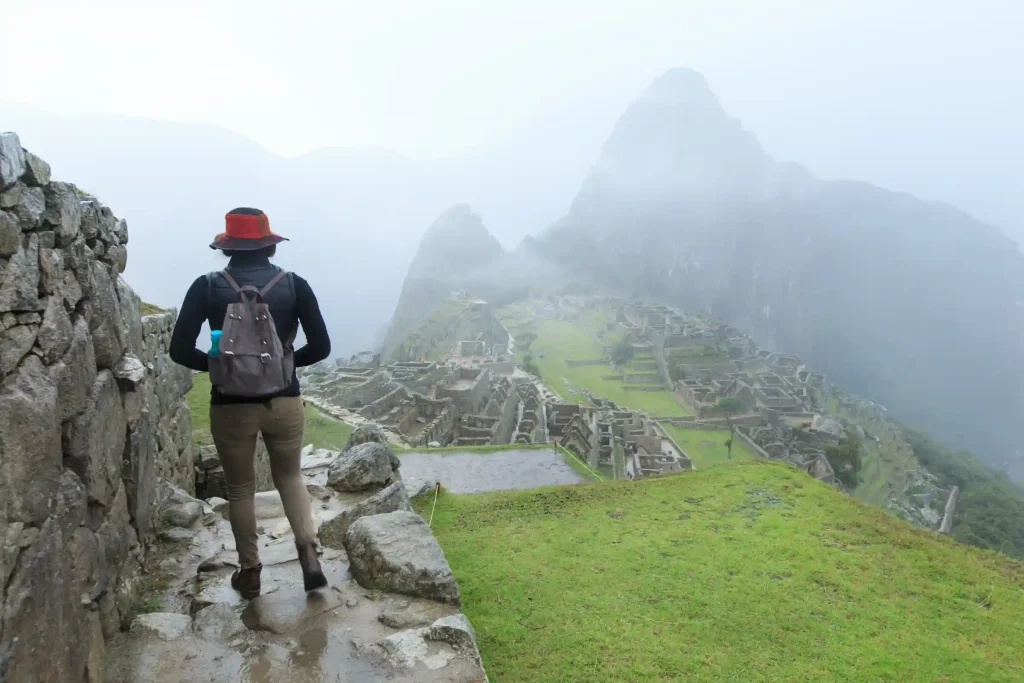
Amazing trip, thoughtful logistics, and a guide who made Machu Picchu unforgettable.
Thi W TripadvisorCity Tour Cusco
Slogan Here

OVERVIEW
Trip Overview
You can walk around Cusco for a week and see a great deal without understanding much of it. The Cathedral is large. Sacsayhuamán is impressive. The stone walls in the city center are clearly old and clearly precise. But without context, the pieces don’t connect.
The City Tour Cusco by Andeara is the afternoon that changes that.
Six sites in five hours. A professional bilingual guide who links the Inca and colonial histories into a single coherent story. And a route that moves from the center of the old capital – the Cathedral, the Qoricancha – up into the hills above the city, where the scale of what the Inca built starts to become clear in a way that photographs from guidebooks never quite prepare you for.
The tour departs in the afternoon deliberately. Your morning is for resting, adjusting to 3,400 meters, drinking coca tea, and letting your body find its footing. Your afternoon is for understanding the city you’re standing in.
After this tour, everything else you see in Cusco will have somewhere to land.
Itineraries & Prices
Accomodation
Accommodation
Up to 12 people
Group size
15,090 feet (4,600 meters)
Max. altitude
Easy
Difficulty
by Bus
Transport
1B, 1L, 1D
Meals
Trip Details
- Tour name: City Tour Cusco
- Duration: 5 hours
- Pickup time: Between 1:00 and 1:30 p.m. from your hotel
- Return time: Approximately 6:00 p.m. at the Plaza de Armas
- Meeting point: Hotel pickup from the Cusco historic center
- Languages: Spanish / English
- Service type: Shared group (private option available – see pricing)
- Difficulty: Easy to moderate – walking on cobblestone and irregular terrain, with a short ascent at Sacsayhuamán
- Maximum altitude: 3,600 m.a.s.l. (Tambomachay area)
- Transport: On foot for the city center sites / tourist bus to the hilltop sites
- Price: From USD 10 per person
- Recommended for: First or second day in Cusco
Day by Day Schedule
Highlight of the day: Six sites, two civilizations, and one afternoon that organizes everything you’ll see in Cusco from this point forward
Pickup is between 1:00 and 1:30 p.m. from your hotel. The afternoon departure is deliberate – Cusco’s altitude hits hardest in the first morning, and a slow start gives your body time to settle before you spend five hours on foot and on a bus.
- Terrain: Cobblestone streets in the city center, stone and gravel paths at the hilltop sites, some uneven and sloped ground at Sacsayhuamán and Q’enqo
- Total walking distance: Approximately 3 to 4 km across the full afternoon
- Transport: On foot from pickup to Qoricancha / Tourist bus from Qoricancha to Sacsayhuamán and subsequent sites
- Return transport: Tourist bus back to Cusco, drop-off at Plaza de Armas
Plaza de Armas – The Start (brief orientation stop)
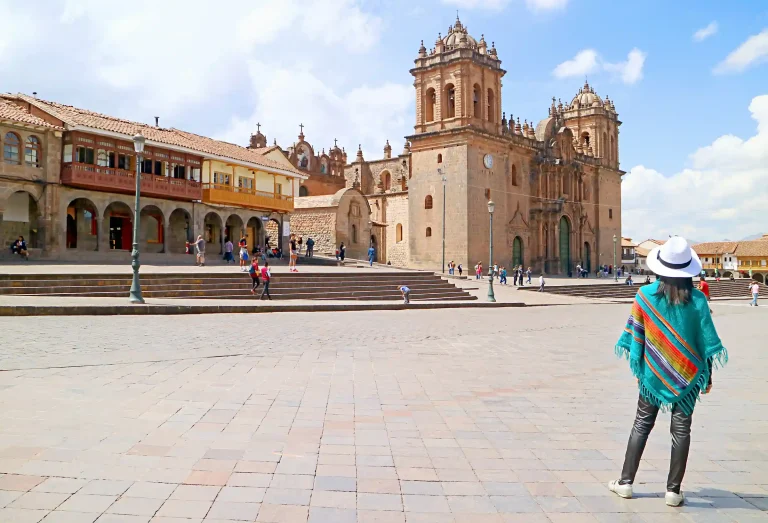
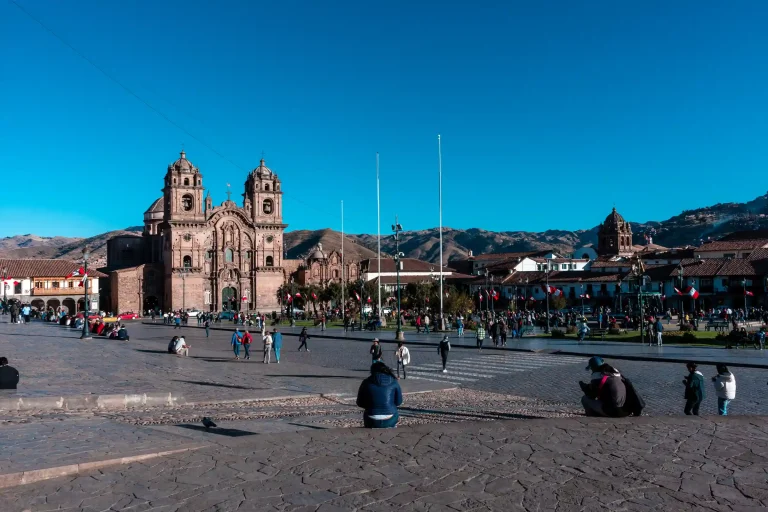
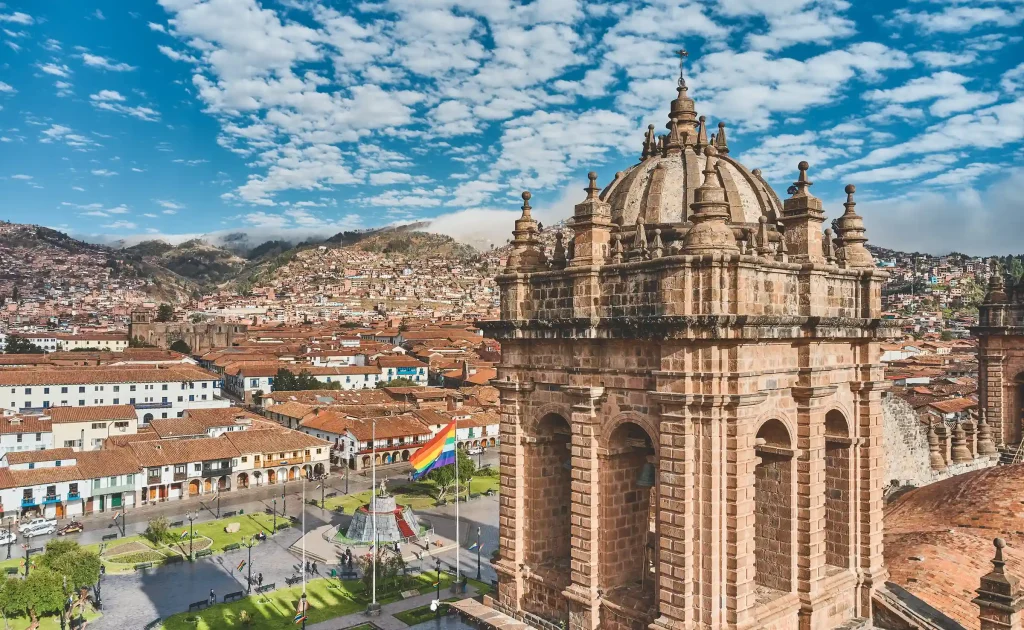
The tour begins with a short orientation at the Plaza de Armas, which was the great Inca ceremonial plaza Huacaypata before the Spanish redesigned it into the colonial square you see now. Your guide sets the scene – what this space was, what replaced it, and how the rest of the afternoon will follow that same pattern of one civilization layered on top of another.
First Stop – Cathedral of Cusco (approx. 45 minutes) | 3,399 m.a.s.l.
Construction started in 1560, on top of the palace of Inca Wiracocha, and took nearly a century to finish. The facade is the kind of scale that takes a moment to absorb. Inside – if you have the entrance ticket – over 600 paintings from the Cusco School of Art line the walls. This was the colonial period’s most significant regional art movement: indigenous and mestizo artists trained in European baroque technique who quietly embedded Andean imagery into Catholic iconography.
Your guide points out the details that casual visitors miss: the guinea pig on the table in the Last Supper painting in the sacristy. The Andean plants replacing Mediterranean ones in the background of religious scenes. The indigenous faces where European saints would normally appear. The Cusco School is visible throughout the Cathedral, and it says things that the official iconography doesn’t acknowledge.
The silver and gold works, the carved wooden choir stalls, the bells in the towers – your guide covers all of it in a way that makes the 45 minutes feel shorter than it is.
- Entrance fee: S/ 40 per person – not included, paid on-site in cash
- Photography: No flash photography permitted inside
- Terrain: Stone floor, level
Second Stop – Qoricancha, Temple of the Sun (approx. 30 to 40 minutes) | 3,399 m.a.s.l.
From the Cathedral, the walk to Qoricancha takes about ten minutes through the city center streets. The contrast between the two buildings sets up the whole rest of the afternoon.
Qoricancha was the most sacred building in the Inca Empire. At its peak, the outer walls were covered in sheets of gold – hundreds of them, angled to reflect the sun during Inca ceremonies. The Spanish stripped every piece of gold within years of the conquest. Then they built the Convent of Santo Domingo directly on top of the Inca foundations.
The result is one of the most visually striking places in Cusco: Inca stonework of extraordinary precision rising from the ground floor, Dominican colonial construction sitting on top of it. The curvature of the original Inca walls is still visible in the building’s exterior. Inside the complex, the contrast is even more pronounced.
Your guide covers both what this building was – its function, its place in Inca cosmology, what the gold actually looked like and why it mattered – and what happened to it, in the blunt terms the history deserves.
- Entrance fee: S/ 15 per person – not included, paid on-site in cash
- Photography: Confirm flash restrictions on-site
- Terrain: Flat courtyard, stone floor
Board the Tourist Bus (short transfer uphill)
From Qoricancha, the group boards the tourist bus for the ascent to the hilltop sites. The drive takes 10 to 15 minutes. The city drops away below you as you climb, and by the time you reach Sacsayhuamán you’re 200 meters above the Plaza de Armas.
Third Stop – Sacsayhuamán (approx. 35 to 45 minutes) | ~3,700 m.a.s.l.
Three massive zigzagging walls of cut stone, each row set slightly back from the one below. The largest individual stones weigh over 128 tons and stand up to nine meters tall. They were moved from quarries several kilometers away, dressed with a precision that eliminates the gaps between them, and stacked without mortar. The engineering required to do this is not fully understood. Your guide covers the main theories, the history of the site’s construction, the 1536 battle between Manco Inca’s forces and the Spanish that took place here, and the systematic dismantling of the upper structures that followed.
The panoramic view of Cusco from the upper section of Sacsayhuamán is the widest available from any accessible point near the city. The red-tiled rooftops, the Cathedral visible in the center, the ring of mountains on every side. At this hour of the afternoon, the light is moving toward the golden end of the spectrum.
- Boleto Turístico required: Partial BTC covers this site (S/ 70 foreigners, S/ 40 students with ISIC card)
- Terrain: Stone paths, some uneven ground and moderate inclines between the wall sections
- Cold: At 3,700 m.a.s.l. with afternoon wind, a jacket layer matters here
Fourth Stop – Q’enqo (approx. 20 minutes) | ~3,580 m.a.s.l.
Q’enqo means labyrinth in Quechua, and the name is earned. This ceremonial center was dedicated to Pachamama – the earth – and features carved rock channels, an amphitheater-like formation, and underground passages cut directly into the natural limestone. The channels were used to channel liquids during ceremonies – chicha, blood, water – and the carved rock formations throughout the site reveal a degree of spiritual and technical sophistication that the site’s small size doesn’t immediately suggest.
Your guide walks you through both the visible structure and the ceremonial logic behind it. Q’enqo is one of the stops that rewards attention more than most, and the guide makes sure you leave with an understanding of what you actually saw.
- Boleto Turístico required: Covered by the same Partial BTC as Sacsayhuamán
- Terrain: Earth and gravel paths, some uneven ground
Fifth Stop – Puca Pucara (approx. 15 to 20 minutes) | ~3,600 m.a.s.l.
Puca Pucara – the Red Fortress – is a compact military control point that served as a rest station and surveillance post for Inca troops moving on the royal road system. The iron content in the stone gives the walls a distinctive reddish color that deepens significantly in the late afternoon light. At this hour, the stone catches the low sun and earns the name.
Your guide covers the military and administrative function of the site within the Inca road network – how control points like this one allowed the Inca state to monitor movement through the region and manage troop logistics across an empire that stretched thousands of kilometers.
- Boleto Turístico required: Covered by the same Partial BTC
- Terrain: Flat stone paths around the complex
Sixth Stop – Tambomachay (approx. 20 minutes) | ~3,600 m.a.s.l.
The final stop is Tambomachay – the Baths of the Inca – and it’s the one that tends to stay with people after the afternoon ends.
A series of stone-cut aqueducts and fountains built into the hillside, still carrying clean water through the same channels the Inca carved more than five centuries ago. The hydraulic engineering required to maintain consistent flow through a multi-tiered stone channel system, at this altitude, across 500-plus years of weather and seismic activity – your guide explains how it was done and why it still works.
The site was dedicated to the ritual veneration of water as a sacred element in Inca cosmology. The precision of the stonework here is finer than at most of the other hilltop sites – smaller scale, more detailed work, the kind of craftsmanship that the Inca applied to everything that mattered to them.
The water is still cold and still running. Most people touch it.
- Boleto Turístico required: Covered by the same Partial BTC
- Terrain: Flat stone platforms and paths
Return to Cusco
The bus returns to Cusco, arriving at the Plaza de Armas at approximately 6:00 p.m. The city in the early evening, after five hours of context, looks different than it did when you were picked up.

Inclusions
What’s Included
- Hotel pickup from the Cusco historic center (between 1:00 and 1:30 p.m.)
- Professional bilingual guide (Spanish/English) for the full 5-hour tour
- Guided visit on foot to the Plaza de Armas orientation stop
- Guided visit to the Cathedral of Cusco (exterior orientation and interior visit with entrance ticket)
- Guided visit to Qoricancha – Temple of the Sun (exterior and interior with entrance ticket)
- Tourist bus transport from Qoricancha to the hilltop sites and back to Cusco
- Guided visit to Sacsayhuamán archaeological complex
- Guided visit to Q’enqo ceremonial center
- Guided visit to Puca Pucara
- Guided visit to Tambomachay
- Return transport to the Plaza de Armas (approximately 6:00 p.m.)
What’s Not Included
- Boleto Turístico Parcial (required for Sacsayhuamán, Q’enqo, Puca Pucara, Tambomachay):
- Foreigners: S/ 70 per person
- Students with ISIC card: S/ 40 per person
- Paid on-site in cash
- Cathedral of Cusco entrance: S/ 40 per person – paid on-site in cash
- Qoricancha entrance: S/ 15 per person – paid on-site in cash
- Food and drinks
- Tips for the guide
- Personal expenses
More Tour Information
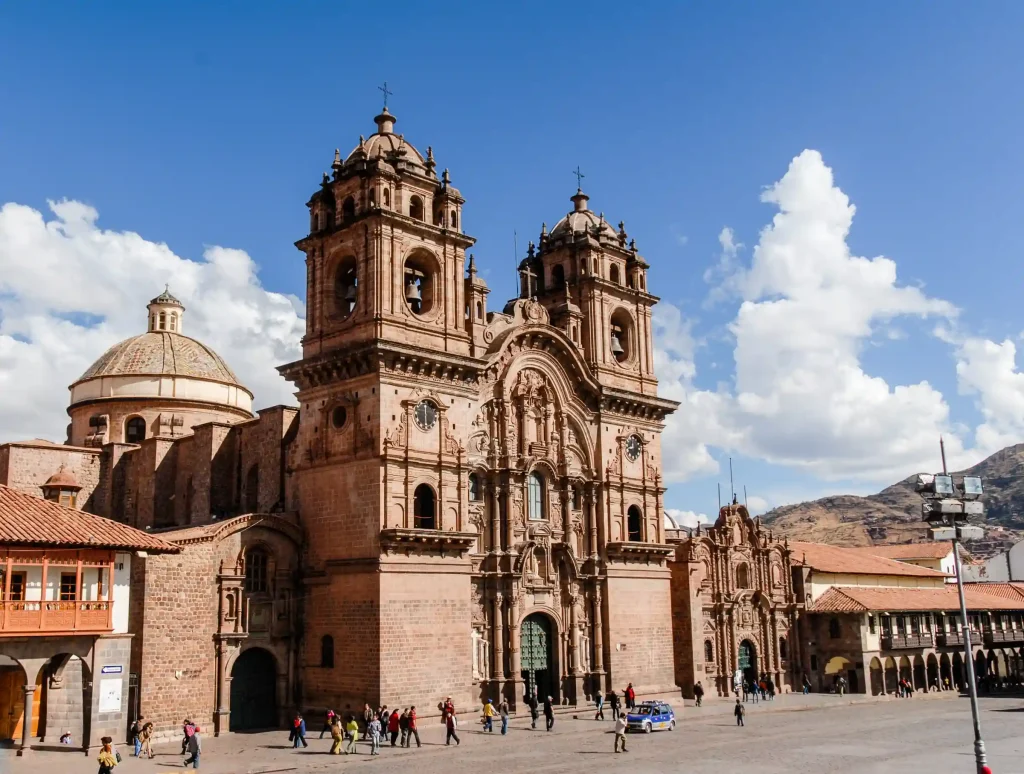
- The Cathedral of Cusco – built on an Inca palace, decorated with everything the colonial world had – Construction began in 1560 on top of the palace of the Inca Wiracocha and took nearly a century to complete. Inside: more than 600 paintings from the Cusco School of Art, silver and gold works, and a body of art that quietly carries Andean symbolism inside Catholic imagery. Your guide points out exactly where to look.
- Qoricancha – the most sacred building in the Inca world – The Temple of the Sun, dedicated to Inti, with walls that were once covered in sheets of hammered gold. The Spanish stripped the gold and built the Convent of Santo Domingo directly on the Inca foundations. The result is a single building that holds both civilizations in the same space, and the contrast between the Inca stonework below and the colonial construction above is visible in every wall.
- Sacsayhuamán – three rows of massive zigzagging walls that engineers still can’t fully explain – The largest stones weigh over 128 tons and stand up to nine meters tall. They were cut, transported, and fitted together without mortar, with a precision that leaves no light between the joints. From the top of the complex, the full panorama of Cusco opens up below you. The view alone is worth the afternoon.
- Q’enqo – the ceremonial labyrinth – Q’enqo means labyrinth in Quechua. This is a ceremonial center dedicated to Pachamama with carved rock channels, underground passages, and an altar space cut directly into the limestone. The sophistication of what was done here is harder to read than at Sacsayhuamán, but your guide walks you through it.
- Puca Pucara – a military post that turns red at sunset – Puca Pucara means “Red Fortress” in Quechua – the iron content of the stone gives it a distinctive reddish tone that intensifies in the late afternoon light. This was a control point and rest station for Inca troops moving through the region. The afternoon timing of the tour is not accidental: the stone at this hour is at its best.
- Tambomachay – water channels that have been running for 500 years – Dedicated to the cult of water, this site features aqueducts and stone-cut fountains that still carry clean water through the same channels the Inca carved more than five centuries ago. It’s a small site and a large statement about Inca hydraulic engineering. Your guide gives it the attention it deserves.
Hotel Pickup
Pickup is from your hotel in the Cusco historic center between 1:00 and 1:30 p.m. Your exact pickup time within that window is confirmed the day before. The vehicle collects travelers from multiple hotels in sequence – be ready at the confirmed time, as the bus cannot wait.
For hotels on very narrow streets where the vehicle cannot access directly, your guide will confirm a nearby meeting point within easy walking distance.
The tour returns to the Plaza de Armas at approximately 6:00 p.m.
Entrance Tickets
All entrance fees are paid individually by each traveler on-site in cash. Andeara does not collect or manage entrance fees. Have your soles ready before each site.
The Boleto Turístico Parcial can also be purchased in advance at the COSITUC office, Avenida El Sol 103, Cusco. This saves time at the gate and is worth doing if you arrive in Cusco the day before the tour.
Payment Conditions
- Tour price is confirmed at booking
- Entrance fees are separate and paid on-site
- For private group bookings, a deposit may be required at reservation
Availability
The City Tour Cusco runs daily throughout the year.
Booking in advance is recommended, particularly during the high-travel months of June, July, and August, when afternoon tour departures fill quickly. Same-day and next-day bookings are possible when spots are available – contact Andeara’s reservations team by phone or WhatsApp to confirm.
For private group bookings, contact Andeara directly at least 48 hours in advance to confirm guide and vehicle availability for your preferred departure time.
Documents
- Passport or national ID – required for tourist ticket purchase
- ISIC student card if applicable (for the reduced S/ 40 BTC student rate)
- Travel insurance documentation
Clothing & Footwear
- Comfortable, closed-toe walking shoes with non-slip soles
- Layered clothing: light base layer, mid-layer fleece or wool, windproof shell
- Hat or sun cap for the open-air hilltop sites
- Sunglasses with UV protection
- Light rain layer or compact poncho – especially useful between November and March
Personal Items
- Sunscreen – SPF 50 or higher
- Lip balm – altitude and afternoon sun dry lips quickly
- Personal medication, including altitude medication if your doctor has recommended it
Cash
- Soles for all entrance fees: plan for at least S/ 125 per person (BTC + Cathedral + Qoricancha)
- Extra soles for tips and any small purchases
- No cards accepted at ticket counters
Gear
- Small daypack for water, jacket layer, sunscreen, camera, and cash
- Reusable water bottle – carry and drink throughout the afternoon
- Camera or smartphone with charged battery – the panorama from Sacsayhuamán and the light at Puca Pucara in the late afternoon are both worth a charged battery
Special requirements: If you travel with mobility equipment, have a specific medical condition that affects physical activity at altitude, or carry professional photography gear, notify Andeara’s reservations team before confirming your booking.
Tourist Ticket – BTC
The Boleto Turístico del Cusco (BTC) Partial Circuit covers Sacsayhuamán, Q’enqo, Puca Pucara, and Tambomachay. For this tour, the Partial Circuit III is the relevant option.
- Foreigners: S/ 70 per person
- Students with ISIC card: S/ 40 per person
- Children under 10 with school ID: Reduced rate – confirm on-site
- Payment: Cash only, Peruvian soles
- Where to buy: At the COSITUC office (Av. El Sol 103, Cusco) or at the entrance of the first site you visit
The Cathedral and Qoricancha operate separate entrance tickets, not covered by the BTC:
- Cathedral: S/ 40 per person
- Qoricancha: S/ 15 per person
Transport
- City center portion: On foot between hotel pickup, Plaza de Armas, Cathedral, and Qoricancha
- Hilltop sites: Tourist bus from Qoricancha to Sacsayhuamán, Q’enqo, Puca Pucara, and Tambomachay
- Return: Tourist bus from Tambomachay to Cusco, drop-off at Plaza de Armas
Accommodation in Cusco
The City Tour departs from and returns to the Cusco historic center. Staying in the historic center puts you within pickup range and gives you the easiest access to the Plaza de Armas orientation stop at the start of the tour. If you need accommodation suggestions for any budget range, contact Andeara’s reservations team.
Travel Restrictions & Important Notes
Strikes and Demonstrations
Strikes and demonstrations are common in Peru and can affect road access to the hilltop sites or access to the Plaza de Armas. In the event of disruptions, Andeara will make every effort to run the tour as planned. If the tour must be adjusted or canceled, our operations team will coordinate directly with you. Your safety is the priority in all decisions.
Lost Objects
Keep your belongings with you at all six sites and on the tourist bus. You are solely responsible for your personal items during the tour. The Plaza de Armas, the Cathedral interior, and the hilltop sites all have significant foot traffic – keep bags closed and close to your body.
Photography Restrictions
- No flash photography inside the Cathedral of Cusco
- No flash photography inside Qoricancha
- Photography is generally permitted at the outdoor hilltop sites – confirm any specific restrictions with your guide at each stop
Health Considerations
This tour is rated easy to moderate and is suitable for most travelers in reasonable health. The altitude is the primary consideration.
The city center stops (Cathedral, Qoricancha) are at 3,399 m.a.s.l. The hilltop sites reach 3,600 to 3,700 m.a.s.l. – a meaningful increase above the city center that becomes noticeable on the uphill paths at Sacsayhuamán.
- The afternoon departure is intentional – your morning rest matters
- Walk slowly and breathe steadily at the hilltop sites
- Drink water throughout the afternoon, even when you don’t feel thirsty
- Coca tea (mate de coca) is widely available in Cusco and helps with mild altitude discomfort – worth having in the morning before the tour
- Tell your guide immediately if you feel unwell at any site – the tour can pause
- Avoid alcohol the morning of the tour – altitude amplifies its effects significantly
- If you have a heart condition, respiratory condition, or prior high-altitude difficulties, consult your doctor before booking and inform Andeara at the time of reservation
The walking involved across the six sites is not strenuous. The challenge is altitude, not terrain or distance. In reasonable health, with appropriate clothing and hydration, this tour is manageable for most adult travelers and older children.
Require More Information
Select a departure date
Pick a month, then choose your start date. Return date is calculated using the tour duration.
Upcoming departures
Contact Us
Let our local experts help you choose the perfect Peruvian adventure.
Related Tours

Traveler Reviews