
The Torito de Pucará carries an unusual contradiction.
It looks ancient.
Its symbolism feels deeply Andean.
Its name evokes the archaeological civilization of Pukara.
Yet the bull itself could not have existed in the pre-Hispanic Andes.
Cattle arrived with the Spanish.
What happened afterward is the real story.
Rather than simply adopting a European animal, communities of the Peruvian Altiplano incorporated the bull into existing Andean ideas about livestock, fertility, agriculture, protection and offerings. Over generations, ceramic artisans transformed it into something that no longer looked completely European or pre-Hispanic.
The result was the Torito de Pucará, one of the clearest examples of cultural transformation in southern Peru.
And there is another surprise.
Despite its famous name, the tradition is historically connected especially with Santiago de Pupuja and surrounding communities such as Checca Pupuja in Puno, rather than originating simply as a product of the town of Pucará.
According to Peru’s Ministry of Culture, by the middle of the twentieth century this type of glazed pottery was being produced in communities including Antasana, Antaña, Checca Pupuja, Llallahua and Kojgra. Pucará became a major commercial point because travelers encountered the ceramics around its railway station.
That small ceramic bull has therefore traveled through several histories at once:
Andean ritual → colonial transformation → rural pottery → railway commerce → national cultural symbol.
Understanding that sequence makes the Torito far more interesting than the souvenir it can initially appear to be.
Where did the Torito de Pucará really come from?
To understand the Torito, you have to separate three places that are frequently mixed together:
Pucará, Santiago de Pupuja and Checca Pupuja.
They are connected, but they are not interchangeable.
The current official tourism inventory identifies the Torito as an Andean ceramic tradition initially developed by artisans from Santiago de Pupuja, in the province of Azángaro.
Those artisans later moved or commercialized their work through locations better connected with transportation, including José Domingo Choquehuanca and Pucará.
Pucará had one enormous advantage:
the Puno–Cusco railway corridor.
Travelers encountered the ceramic bulls there.
Demand increased.
The name stuck.
The official inventory notes that Pucará is around 108 kilometers north of the city of Puno, while José Domingo Choquehuanca and Santiago de Pupuja lie only a few kilometers from Pucará.
This produces an interesting lesson in how cultural objects acquire names.
The place where something becomes famous is not necessarily the place where its story began.
Why did the bull become an Andean symbol?
Because Andean culture has historically been exceptionally good at absorbing new elements without simply abandoning older systems of meaning.
The Spanish introduced cattle.
But the animal entered a landscape where ritual relationships between humans, livestock, mountains, water and agricultural fertility already existed.
Eventually the bull became part of ceremonies surrounding livestock.
It acquired associations with:
- fertility
- reproduction
- agricultural abundance
- healthy animals
- household protection
- prosperity
- strength
- ceremonial offerings
The Ministry of Culture describes the traditional ceramic production of Checca Pupuja precisely as an example of exchanges between pre-Hispanic pottery practices and techniques introduced during the Viceroyalty.
So calling the Torito simply “Spanish” misses half of its history.
Calling it an “ancient Inca bull” misses the other half.
It is a product of encounter.
Is the Torito de Pucará actually related to the ancient Pukara civilization?
Indirectly.
This is where tourism descriptions sometimes become confusing.
The Pukara archaeological tradition developed in the northern Lake Titicaca basin long before Europeans arrived.
The Torito, however, belongs to a much later history.
Peru’s Law 31492 recognizes March 18 as the National Day of the Torito de Pucará while emphasizing the broader continuity connecting pre-Hispanic pottery traditions, colonial transformations and present-day Altiplano ceramics.
That distinction matters.
The Torito is not an archaeological artifact inherited unchanged from ancient Pukara culture.
Rather, it emerged from a region where sophisticated pottery traditions had already existed for centuries.
Then cattle arrived.
New techniques arrived.
New religious structures arrived.
And local artisans transformed all of them.
The continuity lies in ceramic knowledge and Andean cultural adaptation, not in an ancient pre-Columbian bull.
What did the Torito originally do?
It was not designed merely to look attractive on a shelf.
Traditional versions could function as ritual vessels.
That explains one detail visitors often overlook:
the opening in the Torito’s back.
Historical and official descriptions associate the ceramic bull with livestock-marking ceremonies known as señalacuy or señalakuy.
During these ceremonies, livestock could be decorated, marked and incorporated into offerings asking for fertility, protection and abundance.
Official tourism documentation records the Torito’s use as a vessel for ceremonial liquids and other ritual substances connected with offerings to Pachamama.
Once you know this, its shape suddenly stops looking arbitrary.
The Torito was an object meant to participate.
Not simply to decorate.
Why does the Torito have such exaggerated eyes and a raised tail?
A traditional Torito rarely looks like a calm farm animal.
The eyes can protrude dramatically.
The mouth opens.
The tongue extends.
The tail curls upward.
Flowers and circular decorations cover the body.
The bull seems almost agitated.
That expression relates partly to the livestock ceremonies that inspired its visual language.
Ministry of Culture documentation connects the ceramic figure with the appearance of a bull during traditional marking rituals, when the animal could move violently after being decorated and released.
Official descriptions now commonly interpret several details as follows:
| Detail | Commonly documented meaning or reference |
|---|---|
| Raised or curled tail | Strength and vigor |
| Extended tongue | Relationship with ceremonial offerings |
| Rosettes | Festive decoration and prosperity |
| Body markings | References to livestock decoration |
| Handle-like back | Connection with its use as a vessel |
| Opening | Practical ritual function |
| Powerful horns | Strength and protection |
| Exaggerated expression | Energy of the ceremonial animal |
But there is an important warning here.
Does every decoration have an ancient secret meaning?
No.
And this may be one of the most useful things to remember when hearing explanations about Andean crafts.
Tourism often prefers precise symbolism.
One color means love.
Another means money.
Three lines represent three worlds.
Every spiral means Pachamama.
Reality is usually less convenient.
Some meanings are historically documented.
Others represent local explanations.
Others have evolved recently.
Some are individual artistic decisions.
And contemporary artisans continue inventing new designs.
The Torito is a living tradition, not a code that stopped changing four hundred years ago.
When an artisan says, “This is how my family explains it,” that can be more valuable than being told that every decorative line has one universal meaning throughout the Andes.
Why are Toritos traditionally placed in pairs?
Walk through parts of southern Peru and remember one instruction:
look at the roofs.
Not just at the doors.
Above some houses you may find two ceramic bulls positioned together, sometimes accompanied by crosses or other objects.
The pair is now widely associated with:
- household protection
- prosperity
- fertility
- balance
- family well-being
- abundance
In its 2026 National Day coverage, Peru’s Ministry of Culture again described the Torito as a symbol associated with protection, fertility and prosperity in Andean culture.
This is why two bulls have become particularly popular in homes.
But travelers occasionally receive an overly rigid version of this tradition:
“You must always buy two.”
You do not.
If you want to reproduce the symbolic household arrangement, a pair makes sense.
If you want one artisan piece because you appreciate the craftsmanship, buying one is perfectly reasonable.
Tradition should provide context.
Not shopping pressure.
How is a traditional Torito de Pucará made?
This is where a small object becomes surprisingly technical.
According to the tourism inventory updated in 2026, the process can involve several distinct stages.
Clay preparation
Local clay is selected and worked until the material becomes sufficiently homogeneous.
Forming
Molds may be used to establish the basic body.
But the process does not end there.
Hand finishing
Artisans attach and model components such as:
- horns
- tails
- rosettes
- decorative elements
The surface is then manually refined.
Drying
Pieces can remain drying naturally for several days.
Rushing this stage increases the risk of cracking during firing.
First firing
Traditional kilns can reach approximately 800°C to 1,000°C, with the firing process lasting around eight hours in documented production methods.
Decoration
Pigments can include substances such as:
- nogalina
- copper oxides
- manganese oxides
- natural pigments
- industrial pigments
Glazing
Some Toritos receive a glazed surface.
Second firing
Glazed pieces can return to the kiln for another four to five hours.
Suddenly the small bull you saw for a few dollars in a market looks different.
That is what happens when you stop seeing only the finished product.
What is special about the traditional glaze?
The glossy surface of older Toritos is more than an aesthetic choice.
Historical Ministry of Culture documentation describes a regional glazed pottery technique incorporating mineral substances and a second firing at temperatures approaching 1,000°C.
Traditional firing could even use taquia—dried camelid dung—as fuel.
That is the kind of production detail visitors rarely hear.
Yet it explains why traditional pottery cannot be understood simply by looking at color.
Clay source, firing, fuel, mineral composition, inherited knowledge and finishing techniques all influence the result.
The object is ceramic.
The heritage is everything required to make it.
Why is Checca Pupuja so important today?
Because Peru officially protects the knowledge behind the ceramic tradition.
In February 2019, the Ministry of Culture declared the knowledge, techniques and practices associated with the traditional ceramic production of Checca Pupuja Cultural Heritage of the Nation.
The official declaration describes the tradition as:
- an expression of cultural exchange
- a continuation of pre-Hispanic and colonial ceramic practices
- important to social and ceremonial life
- closely connected with the surrounding environment
- central to community identity
Notice what was recognized.
Not simply the Torito.
The knowledge.
That distinction matters enormously.
A ceramic object can be reproduced.
Traditional knowledge has to be transmitted.
And that transmission is now happening inside schools
One of the most significant recent developments around this tradition did not happen in a museum.
It happened in education.
In late 2025, Peru’s Ministry of Culture and UNESCO Peru presented bilingual materials in Quechua and Spanish designed to incorporate knowledge of Checca Pupuja ceramics into schools in Puno.
The project was explicitly intended to strengthen the intergenerational transmission of ceramic knowledge and meanings.
That may matter more to the future of the Torito than international souvenir sales.
A craft survives when another generation understands:
- where the clay comes from
- how to work it
- how the kiln behaves
- why forms are created
- when the objects are used
- what their community remembers about them
Without that chain, the shape can survive while the tradition disappears.
What happened with the Torito de Pucará in 2026?
The tradition became particularly visible in March 2026.
Peru officially celebrates March 18 as the National Day of the Torito de Pucará, under Law 31492.
For the 2026 celebration, Pucará organized an expanded program involving cultural activities, artisans and traditional dance.
The municipality declared March 18, 2026, a local holiday and organized its first major Indigenous dance competition at the Kalasaya Archaeological Complex.
The Ministry of Culture later reported participation in celebrations combining traditional dances and an artisan fair.
But perhaps the most interesting event was happening during the days immediately before the celebration.
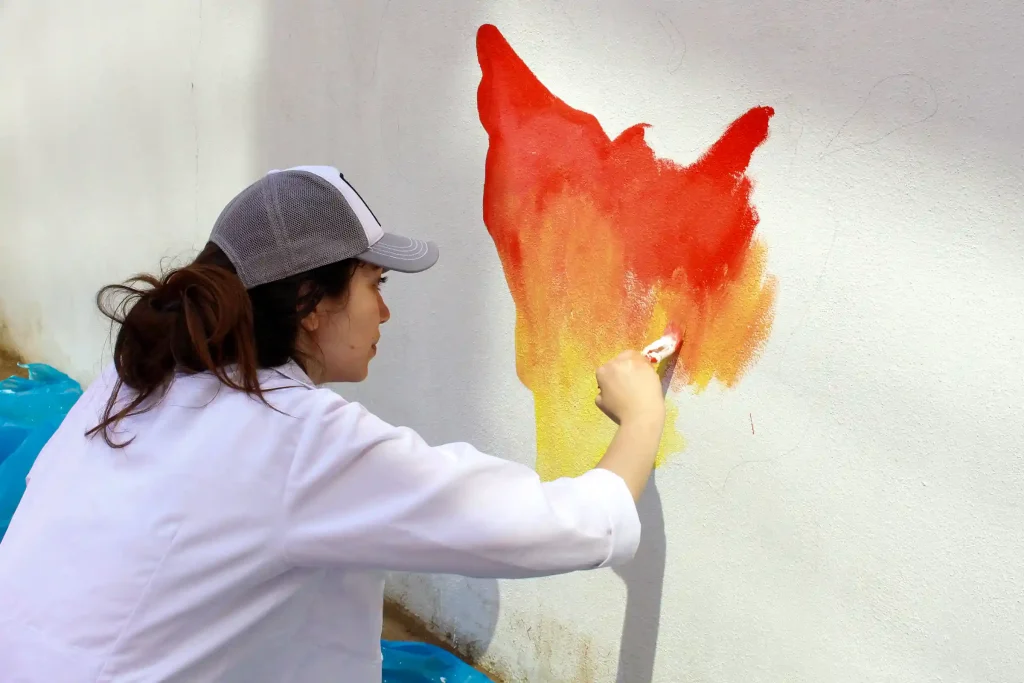
In 2026, people were not just displaying Toritos—they were painting them
From March 15 to 17, Pucará organized Pinta Tu Torito, with separate participation categories including children, local participants and a national category.
The children’s category included participants aged approximately 9 to 12.
That tells us something important about the tradition.
The Torito is not preserved solely through replication.
People reinterpret it.
A child painting one turquoise in 2026 is not necessarily destroying tradition.
They may be participating in the process through which tradition remains visible.
The cultural question therefore becomes more interesting:
How much can an object change while still remaining recognizably Torito de Pucará?
There is no simple answer.
That is precisely what makes living heritage different from archaeological conservation.
Traditional Torito vs contemporary Torito
Place an older-style Torito beside one produced for today’s decorative market and the difference can be dramatic.
| Traditional tendency | Contemporary tendency |
| Cream and ochre | Turquoise and blue |
| Brown and black | Pink, orange and yellow |
| Mineral-looking glaze | Bright polished finishes |
| Ritual references | Decorative reinterpretation |
| Regional production | Wider commercial production |
| Functional vessel heritage | Mostly decorative |
| Repeated inherited motifs | Highly individual designs |
But do not make the mistake of assuming:
old-looking = authentic
and
colorful = fake.
Contemporary artisans can produce very bright Toritos using genuine artisan methods.
Likewise, a deliberately rustic appearance can be commercially reproduced.
Provenance tells you more than color.
What should you look for when buying one?
Turn it over.
That simple movement already puts you ahead of most souvenir shoppers.
Look at:
- the base
- small imperfections
- the attachment of the horns
- decoration around the eyes
- tail construction
- glazing
- symmetry
- brushwork
Then ask questions.
Where was it produced?
Pucará?
Santiago de Pupuja?
Checca Pupuja?
Elsewhere in Puno?
Cusco?
A different region?
The answer matters.
Who made it?
A workshop name is useful.
An artisan’s name is even better.
Is it ceramic?
Tourism markets also contain decorative reproductions made from other materials.
Is it glazed?
Not every Torito needs to be.
But understanding the finish helps explain the price and production method.
Was it painted by hand?
Look closely at repeated details.
The tiny differences often answer the question before the seller does.
Does a handmade Torito need to look imperfect?
No.
This is another travel myth.
“Handmade” does not mean poorly finished.
An experienced artisan can produce extremely consistent work.
The useful distinction is not:
perfect versus imperfect.
It is:
human production versus industrial repetition.
A tiny variation can reveal manual work.
But cracks, poor firing or badly attached horns are still defects.
Do not romanticize bad craftsmanship merely because something is handmade.
How do you recognize a higher-quality Torito?
Pay particular attention to five areas.
| Area | What to examine |
| Horns | Secure attachment and clean shape |
| Base | No major firing cracks |
| Glaze | Intentional, reasonably even finish |
| Decoration | Controlled lines and thoughtful composition |
| Form | Balanced overall structure |
Then consider provenance.
A beautifully executed anonymous piece may be an excellent decorative purchase.
A documented piece from a particular artisan can have additional cultural and collectible value.
They answer different needs.
Is a cheap Torito necessarily fake?
No.
Price alone tells you very little.
A small handmade ceramic can be relatively inexpensive.
Local production costs, workshop scale, decoration, size and sales channel all influence pricing.
A larger Torito with elaborate painting and multiple firings should generally require more labor.
But expensive does not automatically mean traditional.
Before paying a premium, ask what makes the piece different.
If the only answer is:
“Very authentic.”
keep asking.
What about buying a Torito in Cusco?
You will find them everywhere.
That sometimes creates another misconception:
Toritos are not originally a Cusco craft.
Their traditional production is associated with Puno.
However, Cusco became an important market because of the historical transportation corridor connecting both regions.
Today, Toritos are sold and reinterpreted throughout Cusco’s tourism economy.
That does not make buying one in Cusco inappropriate.
It simply changes the question you should ask.
Instead of:
“Is this a Torito de Pucará?”
ask:
“Where was this particular Torito made?”
A Torito produced by a contemporary Cusco artisan can still be interesting.
It should simply be described honestly.
What does the old railway have to do with the name?
More than most travelers expect.
The railway connecting southern Peru changed how regional products reached travelers.
Pucará became an important commercial stopping point.
Ceramic bulls produced within the wider Pupuja pottery tradition were sold there to passengers and visitors.
Eventually, the market location became attached to the object.
Ministry of Culture research specifically describes Pucará as the railway stop and sales point through which the Toro de Pupuja became popularly known as the Torito de Pucará.
It is a fascinating case of tourism influencing cultural naming long before modern online tourism existed.
The traveler was already part of the story.
Why does the Torito appear on rooftops?
Because it moved from ceremonial use into domestic symbolism.
A pair of Toritos can be placed on:
- roofs
- entrances
- walls
- gates
- livestock enclosures
They are commonly used as protective objects and expressions of desired prosperity.
The official 2026 tourism inventory continues to document their contemporary placement on homes and entrances as symbols associated with well-being, fertility and family prosperity.
If you travel through rural southern Peru, this creates a small visual game.
Stop looking only at the architecture.
Look at the roofline.
You may discover that the smallest objects explain the house more clearly than its walls.
Is placing Toritos on a modern apartment respectful?
There is no rule saying the tradition can only exist on an adobe farmhouse in Puno.
Cultural symbols move.
Today, Toritos appear in:
- urban homes
- apartments
- hotels
- restaurants
- gardens
- offices
If you buy a pair because you understand their cultural context and appreciate their symbolism, using them in a contemporary home is simply another stage in the object’s long history of adaptation.
After all, adaptation is precisely how the Torito came to exist.
Can you paint your own Torito?
Yes.
And this has become increasingly popular in Cusco and elsewhere.
Visitor workshops frequently provide an undecorated ceramic Torito and allow participants to create their own design using acrylic paints.
This is not equivalent to learning traditional pottery production.
You are generally not:
- extracting clay
- preparing it
- forming the ceramic body
- operating a traditional kiln
- glazing with historic methods
You are primarily learning through decoration.
That is still useful.
The experience forces you to examine the object closely.
Try painting symmetrical rosettes around both sides of a Torito and one fact becomes obvious:
things that look simple after twenty years of practice are not simple on your first attempt.
Should you paint it traditionally?
Only if that is part of your objective.
If the workshop is educational, ask to see traditional examples first.
Notice:
- earth tones
- body decoration
- placement of rosettes
- lines around the neck
- the relationship between form and ornament
Then decide.
You can create a traditional-looking version.
Or something completely modern.
Contemporary cultural events in Pucará itself now include creative Torito-painting activities, demonstrating that reinterpretation has become part of the tradition’s public life.
Is the Torito a religious object?
The answer is more complicated than yes or no.
Its historical environment incorporates layers of:
- Andean ritual practice
- agricultural belief
- livestock ceremonies
- Pachamama offerings
- Catholic influence
- community festivities
This type of overlap is common in the Andes.
Trying to divide every practice into:
“Catholic”
or
“pre-Hispanic”
can produce misleading conclusions.
The Torito is particularly valuable because it demonstrates how both worlds became intertwined.
That is why syncretism is such an important concept when understanding it.
What is señalakuy?
The señalakuy is associated with livestock-marking traditions.
These ceremonies can involve:
- identifying animals
- decorating livestock
- sharing drink
- ritual offerings
- coca leaves
- music
- family participation
- requests for reproduction and prosperity
Historical descriptions collected by the Ministry of Culture record cattle being decorated and marked while participants performed offerings associated with Pachamama and the Apus.
The ceramic Torito became connected with that ceremonial world.
So when you look at the exaggerated animal, imagine it not on a shop shelf but within a rural livestock ritual.
Its visual language becomes easier to understand.
Why is fertility such an important theme?
Because in pastoral communities, animal reproduction is economic survival.
A healthy herd means:
- food
- wool
- trade
- income
- household security
Fertility is therefore not simply an abstract spiritual idea.
It has material consequences.
Similarly, agricultural abundance is not decorative symbolism.
It determines whether a family has enough food.
This is why concepts such as fertility, protection and prosperity repeatedly appear around traditional Andean objects.
They respond to practical uncertainties.
The Torito transforms those uncertainties into a physical object.
When is the best time to visit Pucará?
For most travelers, there are two particularly interesting options.
March 18
Choose this period if cultural events are your priority.
March 18 is the National Day of the Torito de Pucará.
The 2026 celebrations demonstrate how much programming can develop around the date, although annual programs will vary.
The disadvantage is weather.
March still falls within the wetter part of the Altiplano year.
May to September
Choose this period for easier overland travel and generally drier conditions.
The trade-off is cold.
Pucará’s official tourism inventory places the town at around 3,887 meters above sea level.
A sunny afternoon can feel comfortable.
Then the sun disappears.
The change can be surprisingly fast.
What should you wear in Pucará?
The altitude changes what “a cultural visit” means.
You are not hiking a mountain.
But you are still standing at almost 3,900 meters.
Use layers.
A practical combination is:
- lightweight base layer
- fleece
- compact insulated jacket
- wind-resistant shell
- comfortable trousers
- walking or trail shoes
- sunglasses
- sun protection
- hat
- light gloves during colder dry-season mornings
Something like a Patagonia Nano Puff works well as a compact insulation layer.
For rain protection, a Columbia Watertight II or similar lightweight shell is sufficient for most travelers.
For footwear, a Merrell Moab 3 or Salomon X Ultra 4 is useful if you combine Pucará with archaeological walking.
You do not need technical mountaineering equipment.
What you need is clothing you can remove and replace quickly.
What weather detail surprises visitors most?
Sun and cold can happen simultaneously.
At this altitude, a traveler may feel chilled by the wind while the face and hands remain exposed to strong solar radiation.
That combination is easy to underestimate.
You put on a jacket because you feel cold.
Then forget sunscreen because you do not feel hot.
Temperature is not a reliable measure of UV exposure.
For Altiplano travel, sunglasses and sunscreen belong in the same category as your jacket:
basic equipment.
Should you visit the archaeological site too?
Yes, if you have time.
But for an unexpected reason.
The archaeological site does not show you the origin of the ceramic bull.
Instead, it helps you understand how much older the region’s cultural history is.
That creates a useful chronological contrast:
Ancient Pukara culture → colonial transformation → Pupuja pottery → Torito tradition → modern artisan production
Without that chronology, visitors can easily compress everything into the inaccurate category of “ancient Andean art.”
The reality is richer because different periods remain visible.
Should you visit Pucará from Cusco or Puno?
Pucará naturally fits journeys between the two regions.
The official tourism inventory places it around 108 kilometers north of Puno, and the town has historically been tied to the transport corridor toward Cusco.
If you are already traveling overland between Cusco and Lake Titicaca, it is especially logical.
A short shopping stop will show you Toritos.
A more thoughtful visit can show you:
- the regional landscape
- archaeological context
- local pottery
- workshops
- contemporary interpretations
That is the difference between seeing a product and seeing a tradition.
Is the Torito de Pucará still an Andean tradition or has tourism transformed it?
Both things can be true.
Tourism has undoubtedly changed the Torito.
It has influenced:
- production volume
- size
- color
- marketing
- distribution
- decorative styles
- where pieces are sold
But tourism did not invent the underlying ceramic tradition.
And the object continues to have cultural meaning beyond tourists.
The events of 2026, heritage recognition, artisan production and educational programs all demonstrate that the Torito remains connected to local identity.
The challenge is not preventing the tradition from changing.
It is preventing the meaning and knowledge behind it from disappearing while the shape survives.
What is the best way for a traveler to appreciate the tradition?
Do not begin by buying.
Begin by looking.
Look at an older Torito.
Look at a contemporary one.
Compare them.
Ask where each was made.
Then, if possible:
- visit an artisan workshop
- watch the production process
- ask about firing
- ask about decoration
- learn about señalakuy
- examine how Toritos appear on houses
- paint one yourself
- purchase directly from an artisan
The sequence matters.
Understand first → buy later.
A souvenir becomes substantially more interesting when you can explain what you brought home.
Traditional vs modern: which Torito should you choose?
Neither is universally better.
Choose according to your interest.
| If you value… | Look for… |
| Historical aesthetics | Earth tones and traditional motifs |
| Artisan technique | Documented ceramic workshop |
| Contemporary design | Modern colors and individual interpretations |
| Cultural provenance | Named Puno artisan or community |
| Home decoration | The style you personally prefer |
| Collecting | Signed or documented pieces |
| Personal experience | Paint your own |
| Symbolism | Consider a pair |
There is only one recommendation that applies to almost everyone:
know what you are buying.
Why do Toritos de Pucará matter?
Because they challenge the simplest version of Peruvian history.
Peru is often presented to travelers as a sequence:
pre-Inca cultures.
Incas.
Spanish conquest.
Republic.
Modern Peru.
Objects such as the Torito show why reality is less orderly.
The Spanish introduced the bull.
Andean communities changed its meaning.
Potters transformed it into ceramics.
Ritual gave it purpose.
Railways gave it a market.
Travelers gave it a famous name.
Artisans continued modifying it.
The state eventually recognized the tradition.
Schools are now helping transmit its knowledge.
Children painted new versions during national celebrations in 2026.
The Torito is therefore not important because it has remained unchanged.
Quite the opposite.
Its ability to change is part of the tradition.
Toritos de Pucará today
It is easy to walk past them.
They are small.
They are inexpensive compared with monumental works of art.
They appear repeatedly in markets.
And repetition can make culturally important objects seem ordinary.
But pick one up.
Look at its back.
Notice the opening.
Follow the curved tail.
Look at the rosettes.
Ask why the tongue is outside.
Ask where it was produced.
Ask who made it.
Suddenly the little bull connects rural ceremonies, colonial change, Puno pottery, old railway travel, household beliefs and contemporary Peru.
That is why the Torito de Pucará remains one of the most interesting Andean craft traditions a traveler can encounter.
Not because it comes unchanged from an ancient civilization.
But because centuries of Andean history are visible in the way it changed.
And perhaps that is a more accurate definition of tradition itself:
not something that never moves,
but something a community continues choosing to carry forward.