You arrive in Peru.
You see a fluffy animal.
You say:
“Look, a llama!”
There is a reasonable chance it is an alpaca.
Then somebody points toward a smaller brown animal and says it is a vicuña.
And just when you think you understand the system, somebody introduces the guanaco.
Fortunately, there is one rule that makes the entire subject much easier:
Llamas and alpacas are domestic.
Vicuñas and guanacos are wild.
That is the most useful starting point.
All four belong to the South American camelid family, but they are not simply different sizes of the same animal.
They differ in:
And once you know what to look for, they become surprisingly easy to distinguish.
| Animal | Domestic or wild? | Relative size | Ears | Face | Coat/color | Best-known association |
|---|---|---|---|---|---|---|
| Llama | Domestic | Largest domestic type | Long, curved “banana” ears | Longer face | Many colors, often less uniformly fluffy | Pack animal |
| Alpaca | Domestic | Smaller and compact | Shorter, straighter ears | Shorter, rounder face | Dense fleece, many colors | Fine fiber |
| Vicuña | Wild | Smallest | Small pointed ears | Delicate, slender | Cinnamon/tan with white underside | Extremely fine fiber |
| Guanaco | Wild | Large and lean | Pointed | Longer, darker/grayish face | Reddish-brown with pale underside | Wild ancestor closely related to llama |
If you only remember the visual shortcut:
big + long banana ears = llama
small + fluffy teddy-bear face = alpaca
small + elegant + tan/white = vicuña
large + wild + reddish-brown + lean = guanaco
That will solve most traveler confusion.
All four are South American camelids.
They are relatives of:
but evolved in South America without humps.
The four species are usually classified as:
There is an elegant pattern here.
The genus Lama contains:
llama + guanaco
The genus Vicugna contains:
alpaca + vicuña
That relationship is not accidental.
Two.
Domestic.
Domestic.
Humans have selectively bred these animals in the Andes for thousands of years.
They became central to highland economies.
Wild.
Wild.
That distinction is culturally important.
A vicuña standing behind a fence at a specialized center is still a wild species.
It should not be treated as an unusually expensive pet alpaca.
The llama is the largest of the two domestic species and one of the largest South American camelids.
The guanaco is also large but has a more athletic wild body shape.
Alpacas are smaller and more compact.
Vicuñas are the smallest and most delicate-looking.
Size helps.
But it should not be your only identification method because:
Look at the head and ears too.
Start with the ears.
This is the easiest trick.
Llamas typically have:
long curved ears often described as banana-shaped.
Their head and face also tend to look longer and less compact than an alpaca’s.
Other clues:
A llama often looks like it was built to travel.
That is appropriate.
For centuries, llamas have been used as pack animals in the Andes.
Transportation is the famous answer.
Before horses, mules and donkeys arrived with Europeans, llamas were one of the Andes’ most important pack animals.
They carried goods through highland routes.
They were also valued for:
The important detail is what they did not do.
Llamas were not ridden like horses.
They are pack animals, but their carrying capacity is limited.
Trying to turn them into miniature camels for tourists misunderstands their anatomy and traditional use.
Yes.
And Cusco has an interesting modern example.
The Llama Pack Project in the Sacred Valley works with high-Andean llama farmers to recover and strengthen the traditional use of llamas as native pack animals.
The project currently offers llama treks and works with hundreds of local farmers and families.
This makes the llama more than a photo prop.
It remains a working animal connected with mountain mobility and rural economies.
Imagine compressing the general camelid shape.
The alpaca is:
The ears are usually:
shorter and straighter than a llama’s
rather than dramatically curved.
The forehead often looks fluffy.
The muzzle looks shorter.
The overall effect is why tourists frequently describe alpacas as looking like teddy bears.
That is not a scientific criterion.
But it is surprisingly useful.
Fiber.
This is the big difference from llamas.
Alpacas have been intensively selected for their fleece.
Peru has the world’s largest alpaca population and remains the global center of alpaca fiber production.
The fiber can be used for:
But there is one shopping term travelers constantly misunderstand.
Not necessarily.
This is one of the most useful shopping facts in Cusco.
Baby Alpaca is a commercial fiber-finness category.
Current PromPerú market documentation classifies Baby Alpaca by micron range, roughly around the high teens to low 20s depending on the standard being used.
That means a label saying:
100% Baby Alpaca
primarily tells you about the fineness of the fiber.
It does not automatically mean the garment was made by shearing a newborn alpaca.
This matters when shopping in Cusco because “baby alpaca” is often treated as if it were simply a poetic marketing phrase.
It is a recognized quality category.
There are two main alpaca types.
The one most travelers recognize.
Its fleece grows:
It creates the classic teddy-bear appearance.
Its fleece grows in:
A Suri can confuse travelers because it looks dramatically different from the alpaca they expected.
The species is still alpaca.
The fleece type is different.
The vicuña looks like somebody removed all unnecessary weight from an alpaca.
It is:
The color pattern is one of the strongest clues.
Typical vicuñas are:
cinnamon, tan or light reddish-brown above
with:
white on the chest and underside.
The head is small.
The ears are pointed.
The body is not covered in the huge colorful fleece you see on many domestic alpacas.
If the animal looks delicate, uniform in color and extremely alert, you may be looking at a vicuña.
Because it is extraordinarily fine and the animal is wild.
That combination changes everything.
Alpacas can be bred and managed as domestic livestock.
Vicuñas require a conservation-based management system.
Their fiber is among the finest animal fibers used commercially.
Historically, vicuñas suffered severe population pressure from hunting.
Modern management in Peru includes conservation and controlled fiber harvesting.
That is why a genuine vicuña garment exists in a completely different price category from ordinary alpaca.
If somebody offers you a “100% vicuña” scarf for the price of dinner, skepticism is appropriate.
Do not assume you should.
Vicuñas are wild animals.
Even at an educational center where they are visible at close distance, visitor interaction should follow the facility’s rules.
The fact that an animal resembles an alpaca does not transform its behavior or conservation status.
This is another reason Awana Kancha can be useful.
You can compare the species visually while understanding that they are managed differently.
The guanaco is the species travelers are least likely to identify correctly in Peru.
It is wild and larger than the vicuña.
Think:
lean wild llama
rather than fluffy alpaca.
Typical clues include:
The guanaco does not have the domestic llama’s enormous variety of coats and colors.
Its appearance is much more consistent.
Because the species is much more strongly associated with the southern part of South America.
Large guanaco populations occur in places such as:
Peru does have wild guanacos, but they are much less commonly encountered on mainstream Cusco itineraries than llamas, alpacas or even vicuñas.
That makes seeing all four species in one educational center particularly useful.
The llama is closely related to and descended largely from the guanaco.
That helps explain their physical similarity.
The domestic llama often looks like a more variable, heavier and differently selected version of the basic guanaco body plan.
The alpaca is closely connected genetically with the vicuña.
This is reflected in modern classification placing the alpaca in the genus Vicugna.
Thousands of years of domestication and later crossbreeding make the evolutionary history more complicated than a simple one-line family tree, but the pairing is still useful:
guanaco → llama relationship
vicuña → alpaca relationship
South American camelids are genetically close enough that hybrids can occur.
The most familiar domestic example is a llama–alpaca cross commonly called a huarizo.
This creates another complication for travelers trying to identify animals purely by appearance.
Not every domestic camelid fits perfectly into the most obvious llama or alpaca stereotype.
A huarizo is generally a llama–alpaca hybrid.
It may combine:
So if an animal seems to break every rule you just learned, it may not be your fault.
Biology has not read the tourist identification guide.
Vicuña.
Then high-quality alpaca occupies another premium category.
Llama fiber is generally coarser overall, although quality varies by animal and fiber type.
Guanaco fiber can also be fine and valuable but is much less familiar to ordinary tourists in Peru.
The simple tourism-market hierarchy often looks like:
vicuña → very fine alpaca → ordinary alpaca → llama
but real textile quality depends on:
The animal name alone does not guarantee a good sweater.
Often:
Generally:
However, both species produce different fiber qualities across different parts of the body and between individuals.
A high-quality llama fiber product can be excellent.
A badly processed alpaca garment can be disappointing.
Alpaca fiber is commonly described as containing very little or no lanolin compared with sheep’s wool.
That is one reason some people find it comfortable.
But do not turn this into a guarantee that every person with wool sensitivity will tolerate every alpaca garment.
Dyes, blends and finishing materials also matter.
If you have sensitive skin, touch the garment before buying it.
Domestication.
Humans selected animals for different characteristics over generations.
Domestic camelids can appear:
Wild vicuñas and guanacos have much more consistent natural color patterns.
This gives you another identification shortcut:
wild species = relatively standardized color
domestic species = much greater variety
Llama.
This is the single best quiz answer.
Long, curved inward.
Shorter and more spear-like.
Small, pointed.
Pointed and upright.
If the ears look like two long curved bananas, start with llama.
Usually the alpaca, especially a Huacaya alpaca with substantial fleece on the head.
But grooming changes appearance.
Tourist alpacas may be trimmed.
Llamas can also be woolly.
So use the face together with:
not by itself.
All of them can.
Spitting is not a llama-exclusive talent.
Camelids commonly use spitting in social communication, particularly toward one another.
A human may receive the message if:
Do not tease animals just to obtain the classic “llama spit” video.
Not inherently.
Domestic llamas can be calm and manageable when properly handled.
But they are large animals with:
Do not treat them like oversized plush toys.
Respect the instructions of farmers or animal handlers.
One of the easiest places is Awana Kancha, on the road between Cusco and Pisac.
The center’s own history explains that it began with llamas and alpacas and later obtained permission to include vicuñas and guanacos.
That makes it unusually useful for travelers who want to compare the animals side by side.
Current listings place Awana Kancha around kilometer 23 on the Cusco–Pisac road, with daily visitor hours around 8:00 a.m.–5:00 p.m.
It can be combined naturally with a Sacred Valley day.
Do not rush directly to the textile shop.
Spend time comparing the animals.
Ask yourself:
Llama.
Alpaca.
Vicuña.
Guanaco.
Then move to the textile demonstrations.
The fiber discussion makes much more sense once you know which animal produced it.
Yes, llamas are one of the most photographed animals around Machu Picchu.
But do not use the Machu Picchu population as your only identification lesson.
You may be concentrating more on the ruins than the ears.
For deliberate comparison, an educational camelid center is better.
Alpacas are common across highland communities and tourism centers.
You may encounter them around:
They become increasingly common in landscapes above the agricultural valley floors.
Vicuñas are more associated with high puna environments and protected or managed wild populations.
They should not be approached as domestic roadside animals.
A controlled educational center can be the easiest way for a first-time traveler to see one closely.
Seeing genuinely wild vicuñas requires the right high-altitude habitat and good luck.
This is harder around Cusco.
Awana Kancha is particularly useful because it has historically included guanacos in its camelid exhibition.
For large wild guanaco populations, southern South America—especially Patagonia—is much more famous.
Probably llama and alpaca.
Which one appears more depends on where you go.
In the city, llamas and alpacas may appear with people offering photographs.
In higher rural areas, alpaca herds become common.
In trekking culture, llamas have renewed importance as pack animals.
You can, but treat it as a paid service.
Ask the price before taking the photograph.
This avoids awkward arguments afterward.
Also look at the animal.
Avoid supporting interactions where an animal appears:
A photograph is optional.
Animal welfare is not.
This is harder than identifying the animal.
Price alone is not enough.
Ask:
A suspiciously inexpensive “100% baby alpaca” garment deserves scrutiny.
Synthetic blends are common in tourist markets.
That does not make them bad products.
The problem is when they are sold as something they are not.
Legal vicuña fiber products come from regulated conservation and management systems and should have traceable documentation.
Because the fiber is extremely valuable, genuine products are expensive.
Do not buy wildlife fiber of unclear origin from an informal seller.
If a supposed vicuña product is dramatically cheaper than expected, assume you need more information.
Because they are not simply wildlife attractions.
Camelids have supported Andean societies through:
Their padded feet are also well suited to fragile highland ground compared with hard hooves.
This is one reason renewed use of llamas as pack animals has conservation relevance in parts of the Andes.
| Look at… | Llama | Alpaca |
| Size | Bigger | Smaller |
| Ears | Long and curved | Short and straighter |
| Face | Longer | Shorter and rounder |
| Fleece | Often less dense overall | Dense and woolly |
| Traditional main role | Packing | Fiber |
| Personality stereotype | Alert, tall | Compact, fluffy |
You can identify most animals using only:
size + ears + face
| Look at… | Vicuña | Guanaco |
| Size | Smaller | Larger |
| Build | Very delicate | Lean but more substantial |
| Color | Cinnamon/tan | Reddish-brown |
| Face | Small, light | Often darker/grayish |
| Fiber fame | Extremely fine | Fine but less famous in Peru |
| Peru tourism visibility | More familiar | Less common |
If it looks like a small elegant wild alpaca:
vicuña.
If it looks like a tall wild llama:
guanaco.
The vicuña.
It represents the animal kingdom and Peru’s natural wealth.
That makes the vicuña much more than a luxury-fiber animal.
It is a national symbol.
Alpaca and vicuña.
But for completely different reasons.
Widely available.
Many quality grades.
Reasonable to buy as:
Rare.
Highly regulated.
Extremely expensive.
If a street market seller offers both for almost the same price, something is wrong.
Llama.
Native pack-animal projects are increasingly demonstrating why llamas remain useful for trekking and rural transport.
A llama can carry equipment without needing to become a riding animal.
That traditional role is one of the most interesting ways to encounter the species.
When you see an animal, ask:
Probably llama or alpaca.
Move toward llama.
Llama.
Alpaca.
Vicuña.
Guanaco.
That is enough for most travelers.
No.
Often alpaca.
No.
Separate domestic species.
Too simple.
They are a separate wild species, though closely related.
Also too simple.
The guanaco is a separate wild species closely related to the llama.
Not necessarily.
It is primarily a fiber-quality category.
No.
Camelids can spit.
No.
Their traditional value is mainly as pack animals rather than riding animals.
Visit a place where you can see them side by side.
Awana Kancha is especially useful because its stated purpose includes South American camelid education and it has kept llamas, alpacas, vicuñas and guanacos.
Give yourself at least 30–45 minutes rather than treating it solely as a shopping stop.
Look first.
Read the signs.
Compare the ears.
Then visit the textile section.
Suddenly the words:
alpaca
baby alpaca
vicuña
mean something more precise.
Remember:
big + banana ears + pack animal
Remember:
small + fluffy + fiber
Remember:
small + wild + cinnamon + finest fiber
Remember:
large + wild + lean + reddish-brown
That is the entire system in four lines.
And once you know it, something funny happens.
You begin correcting other travelers.
Someone points at an alpaca.
“Nice llama.”
You look at the short ears and fluffy forehead.
And suddenly you are the expert.
Just try not to become unbearable about it.
The animals do not care what you call them.
But understanding the difference makes the Andean landscape—and the textiles you see throughout Cusco—far more interesting.
Editor’s note: Animal access, visitor hours and handling rules can change at camelid centers. Wild vicuñas and guanacos should always be observed under the rules of the responsible facility or wildlife-management authority rather than treated like domestic photo animals.
The eucalyptus forests around Cusco look so natural in the Andean landscape that it is easy to assume they have always been there.
They have not.
Eucalyptus is not native to the Peruvian Andes.
The tree comes from Australia and was introduced into Peru as an exotic forestry species.
Historical research places the arrival of Eucalyptus globulus in the southern Peruvian highlands during the second half of the nineteenth century, while Peruvian forestry records show how dramatically plantations expanded during the twentieth century.
In the Cusco region alone, INIA documentation describes approximately 38,000 hectares of eucalyptus plantations developed from the 1960s onward.
That means the tall blue-green forests now associated visually with Cusco are actually part of a comparatively recent transformation of the landscape.
They are not Inca forests.
They are not remnants of an ancient Andean woodland.
And that fact makes walking through them more interesting.
Today you can find eucalyptus around:
Some are dense plantations.
Others are narrow stands beside fields.
Others form windbreaks or small community woodlots.
The important thing is knowing where you can visit responsibly.
For travelers, these are the most practical options:
| Area | Best for | From central Cusco | Style |
|---|---|---|---|
| Q’enqo eucalyptus sector | Closest forest atmosphere | About 15–25 min by vehicle | Dense plantation + archaeology |
| Poc Poc trail, Chinchero | Best actual walk | About 45–60 min to Chinchero | Trail through mixed vegetation |
| Piuray–Chinchero countryside | Landscape photography | About 40–50 min | Lake + fields + scattered eucalyptus |
| Poroy countryside | Quiet rural views | About 20–30 min | Plantations + agricultural landscape |
| Saqsaywaman broader park landscape | Archaeology + plantations | Very close | Cultural landscape |
If you want the easiest option:
Q’enqo.
If you want to walk:
Poc Poc.
If you want landscape photography:
Chinchero and Piuray.
Q’enqo is the obvious place to start.
The area sits immediately above the city within the broader Saqsaywaman National Archaeological Park landscape.
And here we have unusually strong documentation.
The official Saqsaywaman Master Plan 2024–2030 specifically identifies eucalyptus plantations in the Q’enqo sector and elsewhere within the archaeological park.
That means the forest is not merely something tourism companies invented for photographs.
It is a real and recognized component of the modern park landscape.
From central Cusco, the area can be reached quickly by vehicle.
Several current outdoor experiences use the Q’enqo eucalyptus forest for:
The feeling changes remarkably quickly.
Twenty minutes earlier you may have been surrounded by traffic and colonial stone.
Then you are standing among tall straight trunks with filtered light above you.
The eucalyptus plantations form part of the wider cultural landscape associated with the Saqsaywaman archaeological park.
That distinction matters.
Do not treat the area as an unrestricted municipal forest.
Archaeological and cultural-landscape rules can apply depending on the exact sector.
Stay on established routes.
Do not:
If you are organizing a professional picnic, photo session or commercial activity, use an operator that understands the permitted areas.
Yes.
Probably the best close-to-city choice.
The forest gives you:
For portraits, late morning and late afternoon usually create softer light than the middle of the day.
Cloudy weather can actually be excellent.
The forest becomes more evenly lit and the contrast between dark trunks and bright sky decreases.
The leaves contain aromatic oils.
On warm or sunny days, the smell can become especially obvious.
Travelers often associate that fragrance with the Andes after visiting Cusco.
This is another cultural irony.
A scent many people now consider “Andean” comes from an introduced Australian genus.
Landscapes acquire new identities remarkably quickly.
If you want an actual walk rather than simply visiting a forested area, the route toward Poc Poc waterfall is one of the most useful choices.
Mincetur’s tourism inventory describes the waterfall at approximately 3,418 meters above sea level.
The pedestrian route from the Chinchero market area is listed at roughly:
3.5 kilometers / about one hour on foot
The official description also specifically notes vegetation along the route including:
This is important because Poc Poc is not a pure eucalyptus plantation.
It is better.
You can compare an introduced tree against a mixed Andean landscape.
Because the Andes were not naturally dominated by eucalyptus.
Seeing queuña or other native species beside introduced eucalyptus creates a more accurate picture of the region’s ecology.
A plantation can be visually beautiful.
That does not make it native.
The Poc Poc route gives you the opportunity to notice:
introduced forestry + native vegetation + agriculture + waterfall
within the same walk.
That is a much more interesting ecological story.
Moderate rather than difficult.
The distance is manageable.
The altitude matters more.
Chinchero sits substantially above the Sacred Valley and slightly higher than central Cusco.
The trail can also become:
during the rainy season.
Wear shoes with reasonable grip.
You do not need technical hiking boots for normal dry conditions.
A trail shoe or good walking shoe is generally enough.
The waterfall and vegetation can look more dramatic because of rainfall.
The trade-off is mud.
Excellent.
The landscape remains green while rainfall begins decreasing.
Drier trails and clearer weather.
The countryside becomes more brown and gold.
Another good balance before the wetter season becomes established.
If your priority is forest color, choose the greener months.
If your priority is easy walking, choose the dry season.
You do not need a dense forest to understand the role of eucalyptus around Cusco.
The Chinchero district is a good example.
Its local development planning documents identify:
among native vegetation, while eucalyptus and pine are explicitly identified as exotic species that now form part of the district’s landscape.
Around Piuray and the surrounding agricultural areas, eucalyptus often appears as:
This is better for broad landscape photography than trying to stand inside a dense forest.
Because the lake gives scale.
A line of tall trees beside:
looks dramatically different from the same trees inside a dense plantation.
Piuray also makes it easy to combine the outing with:
But remember that Piuray is an important water source for Cusco.
Treat the shoreline carefully.
Do not wash, dump waste or use the lake as recreational infrastructure without local permission.
Poroy is usually known to travelers for transportation.
Some train services historically used the area, and the road west of Cusco passes through it.
But the district also contains extensive introduced vegetation.
Municipal planning documents for Poroy describe the area’s tree cover as strongly influenced by exotic species including:
Eucalyptus is specifically recorded for uses such as:
That tells you why these trees became common.
They were useful.
Forestry is not only about aesthetics.
For rural households, a fast-growing timber tree can become:
That economic history is one reason eucalyptus spread so widely.
Not really.
This is important.
Poroy is better understood as a district with numerous eucalyptus stands and plantations, not a single formal tourist attraction called “Eucalyptus Forest.”
Do not drive into the countryside, see trees and assume the land is public.
Many stands are on:
For a specific photo shoot or picnic, arrange access with a local operator or property owner.
The short answer is:
wood.
The longer answer includes:
Eucalyptus grows quickly in suitable highland conditions compared with many native slow-growing trees.
That made it attractive economically.
INIA documentation shows that eucalyptus plantations expanded extensively in the Cusco region during the second half of the twentieth century.
The modern landscape therefore reflects policy as much as nature.
No.
Impossible.
Eucalyptus is Australian.
It reached Peru centuries after the Inca Empire.
If someone describes a eucalyptus grove as an “ancient Inca forest,” that is a warning sign.
The archaeological site beside the trees may be Inca.
The trees are not.
This distinction matters particularly around Q’enqo and Saqsaywaman, where modern plantations and ancient archaeology occupy the same landscape.
No.
Peru’s environmental authorities classify eucalyptus and pine as introduced forestry species.
That does not mean the trees have no value.
It means ecological language should be accurate.
An introduced species can still provide:
while also creating ecological trade-offs.
The answer is not useful when reduced to one word.
Eucalyptus plantations can provide substantial economic benefits.
They can also create environmental concerns depending on:
Cusco’s own planning documents acknowledge both economic and social benefits and negative effects associated with introduced trees.
So avoid the two extremes:
“Eucalyptus is destroying everything.”
and
“Eucalyptus is perfectly natural here.”
Both are too simple.
Not like one enormous treeless desert.
High-Andean ecosystems historically included native woodland and shrub species adapted to different elevations.
Important native trees around the Cusco region include:
Remnants and restored stands of native trees are ecologically very different from eucalyptus plantations.
If you have time, try to see both.
That comparison is more useful than photographing only the tallest trees.
A traveler may find the eucalyptus forest more visually dramatic.
Ecologically, the queuña forest is the more distinctly Andean environment.
Q’enqo.
It is close to the city and already used by several current private outdoor experiences.
The tall trunks create a natural visual backdrop.
For a commercial photo session, however, confirm permissions.
Being outside does not mean photography is unrestricted, particularly inside or adjacent to protected cultural landscapes.
Poc Poc.
The route gives you:
It feels like an excursion rather than a staged stop.
A professionally arranged area near Q’enqo can work, and several current experiences use eucalyptus settings for picnics.
But do not interpret that as permission to eat anywhere inside the archaeological park.
If the picnic is your objective, use an established authorized area or a provider that has arranged access.
The archaeological sites themselves have stricter visitor rules.
Q’enqo.
You can leave central Cusco, visit the forested area, walk briefly and return without sacrificing an entire day.
This is particularly useful for:
Chinchero + Poc Poc.
A practical sequence:
Cusco → Chinchero → walk toward Poc Poc → return to Chinchero → lunch
This gives the forest a purpose.
You are walking through it rather than driving somewhere solely to photograph trees.
For Q’enqo:
For Poc Poc:
The shade inside eucalyptus can make the air feel substantially cooler than an open sunny field only minutes away.
Layers work better than one heavy coat.
Sometimes surprisingly so.
Cusco’s direct sunlight can be intense.
Then you enter dense shade.
The temperature has not necessarily collapsed, but your body suddenly loses the direct warmth of the sun.
Add wind and the difference becomes obvious.
Bring a light layer even if the Plaza de Armas felt warm when you left.
Eucalyptus forest can be beautiful in rain.
The trunks darken.
The smell becomes stronger.
The vegetation looks greener.
The problem is the ground.
Expect:
For photography, cloudy weather is excellent.
For walking, dry-season conditions are easier.
Do not.
Dry eucalyptus leaves, bark and forest litter can burn readily.
Even where there is no explicit posted prohibition, an open flame is a poor idea.
If you are planning a picnic:
The forest does not need your cooking experiment.
Do not collect plant material casually from protected or private areas.
A leaf on a path may seem irrelevant.
But cultural parks and private property have rules.
Photograph the tree.
Leave the tree there.
Not automatically.
Around Q’enqo and Saqsaywaman, you are within a protected archaeological landscape where drone use can require authorization and restrictions apply.
Do not launch simply because there is an open clearing.
For rural Chinchero or Poroy, land ownership and aviation rules still matter.
The legal question does not disappear outside the historic center.
Both, if possible.
| If you want… | Better choice |
| Tall dramatic trunks | Eucalyptus |
| Native ecology | Queuña forest |
| Close to Cusco | Q’enqo eucalyptus |
| Easy portrait photography | Eucalyptus |
| High-Andean conservation context | Native forest |
| Chinchero walk | Mixed Poc Poc vegetation |
| Rural cultural landscape | Poroy/Chinchero plantations |
The comparison tells you more than either forest alone.
Because “not native” does not mean “not part of modern life.”
Eucalyptus has been present in southern Peru long enough to become deeply integrated into:
A farmer does not need a species to be ancient for it to be useful.
That is why the modern Cusco landscape can be culturally Andean while containing trees from Australia.
Culture adapts.
So do landscapes.
If you want to build an entire relaxed day around forests and landscape rather than archaeology:
Drive toward Chinchero.
Walk through the town and surrounding agricultural landscape.
Begin the walk through mixed vegetation including eucalyptus and native species.
Take your time.
Eat in or around Chinchero.
Finish with broad landscape views.
This is a much more complete experience than simply visiting “a eucalyptus forest.”
You see how the trees actually fit into the countryside.
Best easy forest experience.
Extremely convenient and visually dramatic.
Best walking experience.
More ecological variety and a real destination at the end.
Best landscape photography.
Eucalyptus is part of a much larger rural scene.
Best for quiet rural plantations with arranged access.
Less formal as a tourist destination.
The eucalyptus forest you photograph in Cusco is not evidence of ancient Andean nature.
It is evidence of modern Andean adaptation.
The Incas did not plant those trees.
Later generations did.
They planted them because they needed:
wood,
posts,
fuel,
construction material,
and useful trees that grew quickly.
Over time, the plantations became so visually familiar that travelers now associate their smell and tall trunks with Cusco itself.
That is an interesting cultural transformation.
So visit Q’enqo.
Walk toward Poc Poc.
Look across Chinchero.
Photograph the trees.
But also look for queuña, chachacomo, molle and other native vegetation.
The real landscape becomes much more interesting once you understand which parts are ancient, which are introduced and how all of them ended up sharing the same Andean horizon.
Editor’s note: Access conditions can change around archaeological, community and privately managed land. Q’enqo and parts of the Saqsaywaman landscape are protected cultural areas; always follow current signs and local instructions rather than assuming a forested area is unrestricted public land.
Cusco is famous for pisco.
That can make it easy to overlook something else:
the city has become a surprisingly good place to drink wine.
Not because Cusco is currently Peru’s principal wine-producing region.
It is not.
The country’s modern commercial wine industry is concentrated much more strongly in regions such as Ica, Lima, Arequipa, Moquegua and Tacna, where vineyards benefit from very different climatic conditions.
Cusco’s role is different.
It is a place where Peruvian bottles meet:
That makes the question “Where can I drink wine in Cusco?” more interesting than it first appears.
You can spend one evening comparing Peruvian wines.
Another with Italian bottles.
Another pairing a glass with trout, native potatoes or alpaca.
The city is not a vineyard destination.
It is a wine-drinking destination.
For most travelers, start with these current options:
| Place | Best for | Area | Current atmosphere |
|---|---|---|---|
| Catedral Wine Room | Sommelier guidance and broad wine selection | Near Plaza de Armas | Elegant, intimate |
| La Cantina Vinoteca | Italian wines and relaxed food pairing | Saphy | Small, warm, wine-focused |
| Organika | Peruvian wine with dinner | Historic Center | Farm-to-table style restaurant |
They offer three very different experiences.
That is useful.
Wine bars should not all feel the same.
Location: Cuesta del Almirante 246–248
Current listed hours: generally late morning to around 11:00 p.m., with Sunday opening slightly later in current listings
Catedral is a restaurant with several different spaces, but its dedicated Wine Room is the part that matters here.
The restaurant’s current 2026 information specifically describes:
That makes it probably the easiest choice for a traveler who wants to say:
“I would like one good glass of wine, but I do not know Peruvian wine.”
A good sommelier can ask better questions than:
“Red or white?”
They may ask:
That interaction is what makes a wine room valuable.
You do not need to arrive with vocabulary.
If you have never tried Peruvian wine, say so.
Ask whether there is currently a Peruvian wine available by the glass.
Then ask:
Which region?
That immediately makes the tasting more interesting.
A bottle from Ica is part of a completely different landscape from the mountains outside Cusco.
The wine has traveled upward to reach you.
That geography is part of the experience.
For wine rather than nightlife:
5:00–7:00 p.m.
At that hour, you can often:
Later in the evening, the restaurant atmosphere becomes more dinner-oriented.
If your objective is a quiet wine conversation, earlier usually works better.
Location: Calle Saphy 554
Current listed hours: approximately 6:00 p.m.–11:00 p.m. daily
La Cantina is very different from Catedral.
It describes itself as Cusco’s first vinoteca and focuses strongly on Italian wines.
The current offering is built around bottles from Italian wine regions accompanied by foods such as:
This is a better choice if your idea of a wine night is:
small table + bottle + food + long conversation
rather than a formal tasting.
The atmosphere is deliberately intimate.
And because the restaurant’s identity is centered on Italian wine, you can make the evening surprisingly educational.
Do not automatically order the heaviest red wine.
Ask what is currently available by the glass.
Then tell them what food you plan to order.
Examples:
Look for a wine with enough acidity to stay fresh beside tomato sauce.
The correct choice depends dramatically on the cheeses.
Do not assume red is always better.
A more structured red can make sense.
White wine or a lighter red may be more enjoyable.
One of the pleasures of a small vinoteca is being able to let the owner or staff choose rather than approaching the menu as an examination.
No.
It may actually be better for beginners.
Large wine lists can intimidate travelers because every bottle begins looking like a test.
A small wine-focused venue allows you to say:
“I normally drink Malbec.”
or
“I like Sauvignon Blanc.”
or
“I know nothing about wine.”
All three are useful answers.
The worst strategy is pretending you understand a wine list you do not understand.
Location: Calle Ataúd 154, Historic Center
Organika is primarily a restaurant rather than a wine bar.
That is exactly why it deserves inclusion.
Its current menu includes a range of Peruvian and international wines, including bottles from producers such as Intipalka and Tacama, along with selections from Argentina, Chile, Spain and Italy.
Current menu listings have also shown several wines available by the glass around the S/40 range.
The advantage is food.
You can compare a Peruvian wine against a plate built around:
This is where wine stops being an isolated beverage and becomes part of a Peruvian dinner.
You will encounter several well-established producers in Cusco restaurants.
The exact list changes constantly, but names you may see include:
Do not assume “Peruvian wine” means sweet wine.
Peru produces:
The country’s wine culture has expanded significantly beyond the sweeter styles many Peruvians traditionally associated with domestic wine.
Because the dry coastal valleys of southern Peru created conditions very different from Cusco’s high-altitude environment.
Ica is also central to pisco production.
Wine and pisco therefore share part of the same viticultural geography.
That creates an interesting tasting exercise:
try a Peruvian wine from Ica one evening.
Then try pisco from the same broader producing region another day.
They come from grapes.
They tell completely different stories.
Wine has a long history in colonial Peru, and historical references place early viticulture beyond only the regions that dominate production today.
But modern Cusco should not be treated as one of Peru’s major commercial wine regions.
If someone markets a glass primarily as “Cusco wine,” ask:
The label matters more than the romance.
Cusco is much stronger as a place to drink and pair wine than as a destination for vineyard touring.
There are no laws.
But some combinations are easier than others.
Try:
Cusco-region trout can be delicate, so an extremely heavy red may dominate it.
Wine pairing becomes more difficult because of:
A crisp white or sparkling wine is usually a better starting point than a tannic red.
Depending on preparation, try:
Grilled preparations can handle more weight.
A medium-to-full red can work well with:
The sauce matters.
Mushroom-heavy dishes can be excellent with:
Do not assume vegetables automatically require white wine.
Ask what cheese.
That is the whole answer.
Fresh cheese behaves completely differently from aged hard cheese or blue cheese.
Emotionally?
Sometimes.
Technically?
No.
Cusco’s cold nights make a glass of red feel appropriate.
But the weather should not determine every pairing.
If you are eating trout, ceviche or a light vegetable dish, a white wine may still make more sense.
The useful strategy is:
food first → wine second
unless wine itself is the purpose of the evening.
There is no universal answer, but a traveler familiar with international wine can use these shortcuts.
Ask for a Peruvian Cabernet or Cabernet-based blend.
Try a fuller Peruvian red, perhaps involving Tannat, Cabernet or Petit Verdot.
Look for a dry coastal white.
Ask whether the current bottle is oaked or unoaked.
Do not be embarrassed.
Ask what semi-sweet or dessert options are available.
Wine does not become more sophisticated merely because you force yourself to dislike it.
Argentine wine remains extremely common on Cusco restaurant lists.
That is not surprising.
Argentina has a huge wine industry and strong international recognition.
A typical Cusco list may therefore place:
Peru + Argentina + Chile + Spain + Italy
side by side.
If you are traveling in Peru, use that as an opportunity.
Instead of ordering the Argentine Malbec you already know, try one Peruvian bottle first.
You can drink Malbec almost anywhere.
One of the common travel mistakes is ordering a bottle purely because it seems more economical.
It is not economical if you did not actually want four glasses.
There is no useful universal price because the difference between a basic house glass and a premium imported wine can be substantial.
As one current reference point, Organika’s published menu has shown some wines by the glass at around S/40.
Dedicated wine venues can vary widely according to:
Ask before ordering if the menu is unclear.
There is no shame in knowing the price of the thing you are buying.
Yes.
But a dedicated wine bar is not necessarily where you should look for the cheapest glass.
For budget drinking:
may cost less.
The reason to visit a wine room or vinoteca is:
selection + service + advice + atmosphere
not minimum price.
Neither is inherently better.
The more useful distinction is quantity.
A glass of wine with dinner is easy to pace.
A pisco tasting plus cocktails can become substantially stronger very quickly.
If you have just arrived, keep the evening modest regardless of what you drink.
Travel fatigue, dehydration, unfamiliar food and an early excursion the following morning are already enough variables.
There is no need to add five glasses of alcohol.
Travelers often say it does.
The reality is more nuanced than the common claim that altitude automatically makes the same amount of alcohol enter your bloodstream dramatically faster.
What altitude can change is how you feel.
You may already be:
Alcohol can make that evening less comfortable even without a mysterious “altitude multiplier.”
The practical advice is simple:
drink slowly,
eat,
drink water,
and do not use your sea-level vacation drinking pace as a target.
For tasting:
5:00–7:00 p.m.
For dinner:
7:00–9:30 p.m.
For a long social evening:
later.
The early evening is especially good in Cusco because it creates a transition between sightseeing and dinner.
You return from the day.
Change clothes.
Have one glass.
Then decide whether you actually want another.
This matters more than people expect.
Cusco restaurants can have:
A beautiful terrace at 4:30 p.m. can become cold quickly after sunset.
If you are planning a two-hour wine dinner during the dry season, an indoor table may be much more comfortable than choosing the view automatically.
Ask whether heaters are available if you want outdoor seating.
No dress code is necessary for most Cusco wine venues.
Use smart casual clothing if you want.
The more practical concern is temperature.
Bring:
Cusco’s stone streets matter after the second glass.
This is not the evening for slippery formal shoes unless you enjoy making your walk back to the hotel unnecessarily dramatic.
Better for:
Better for:
There is one geographical fact worth remembering:
San Blas is uphill.
A wine bar may look only 700 meters away.
Your legs may disagree.
You do not need technical vocabulary.
Ask:
The best first question.
Adds geography.
Very useful if you dislike sweet wine.
Specific questions produce better recommendations.
Sometimes possible.
This can lead to something more interesting than ordering the most famous label.
Nothing.
Ask whatever you want.
Wine culture becomes unpleasant when people pretend there are stupid questions.
You are buying a drink, not defending a thesis.
A good wine professional should make the experience easier.
Not make you feel tested.
Yes, but keep it small.
A useful sequence:
Start with one Peruvian glass and ask questions.
Choose a restaurant where the food matters.
Finish with one Italian glass if you want a comparison.
That gives you:
Peru → food → Italy
without turning the evening into six bars and a difficult morning.
Choose according to objective.
Catedral Wine Room
La Cantina Vinoteca
Organika
There is no reason to rank them as if they were identical.
They are not trying to provide the same experience.
La Cantina has the strongest classic date-night format:
Catedral works better for a more polished evening.
Organika works better if food is the priority.
Catedral Wine Room.
Sit where you can speak with staff.
Order by the glass.
Ask about Peruvian producers.
A solo wine evening becomes much more interesting when the person pouring the wine can explain it.
Also Catedral.
The point of sommelier service is guidance.
Do not arrive believing you need to know enough about wine before entering a wine room.
That reverses the purpose.
Potentially all three for different reasons.
A wine enthusiast may enjoy:
The interesting question is not which one has the most expensive bottle.
It is which one gives you something you would not drink at home.
If I were designing one evening for a traveler curious about Peruvian wine:
Start with one Peruvian white or lighter red.
Ask for a second wine from a different region or grape.
Keep the pours small if possible.
Eat dinner.
Pair the wine with:
depending on your preference.
Stop.
Or have one final glass somewhere intimate.
The important part is not drinking every wine in Cusco.
It is remembering the ones you actually tasted.
The city sits thousands of meters above the coastal valleys where much Peruvian wine is produced.
So a bottle from Ica arrives in Cusco after traveling through completely different ecological zones.
Then it reaches a table beside:
native potatoes,
trout,
Andean corn,
or alpaca.
That is already an unusual pairing of Peruvian landscapes.
Cusco does not need vineyards outside the Plaza de Armas to be a good wine city.
Its strength is interpretation.
Restaurants and wine bars can connect bottles from Peru and the rest of the world with one of South America’s most distinctive food cultures.
So yes:
drink a Pisco Sour while you are in Cusco.
You probably should.
But give one evening to wine.
Ask for a Peruvian bottle.
Ask where it came from.
And let the sommelier choose something you have never heard of.
That unfamiliar glass may tell you more about modern Peru than ordering the same imported wine you already drink at home.
Editor’s note: Wine lists, bottles available by the glass, prices and opening hours change frequently. The venues in this guide were checked against current 2026 business information and available menus; reconfirm current service before making a special trip.
The most interesting part of this Cusco painting workshop is not that you leave with something you made.
It is that the wine is already on the table while you are still deciding what you are going to paint.
That changes the rhythm immediately.
There is no bus full of travelers.
No archaeological checkpoint.
No fifteen-minute photo stop.
Instead, you sit in a private workshop with a local artist, choose between a Torito de Pucará or a canvas inspired by the Cusco School of Art, eat Andean cheese and local snacks, pour a glass of wine and spend the next few hours talking about art.
The current Private Painting Workshop With Wine & Andean Snacks experience in Cusco is designed around exactly that slower format.
As listed in 2026, the workshop generally lasts around two to three hours, is conducted privately for your group, includes materials, snacks and wine, and can be arranged in English or Spanish.
No painting experience is required.
That last detail is important.
This is not really a class for people who want to prove they can paint.
It is much more interesting for people who think they cannot.
The experience is built around two artistic options.
You receive an undecorated ceramic Torito and work with acrylic paint, brushes and reference designs.
The instructor introduces the cultural context and then helps you create your own version.
This option uses the visual language associated with colonial Cusco painting as a starting point.
You work on composition, color and simplified artistic techniques rather than attempting to reproduce a seventeenth-century masterpiece.
Both options include the same essential idea:
learn the context → create your own interpretation.
That sequence is what separates the experience from simply coloring an object.
Current 2026 listings generally place the activity at approximately:
2–3 hours
A Tripadvisor product listing gives the experience a duration of about three hours.
The operator’s own current information describes a flexible two-to-three-hour session.
That is a useful amount of time.
One hour would be enough to put color on the object.
Three hours allows:
The extra time is not really about the paint.
It is about avoiding the feeling that someone is watching a clock behind you.
Current descriptions state that the experience is led by a local Cusco artist and anthropologist.
That combination is one of its stronger selling points.
An art instructor can explain technique.
An anthropological perspective can add context about:
Of course, qualifications alone do not guarantee a fascinating conversation.
But this format gives the workshop the possibility of becoming substantially more than a painting class.
Use it.
Ask questions.
Because they tell two different stories about Peru.
This is an Andean ceramic tradition associated primarily with Puno, not Cusco.
The bull reflects a later Andean cultural world shaped after cattle arrived with the Spanish.
It became connected with ideas surrounding:
Painting one in Cusco is therefore a regional cultural exchange rather than a purely Cusqueñan tradition.
The Cusco School of Painting developed in the colonial Andes.
European religious art arrived with Spanish rule.
Indigenous and mestizo artists adopted those techniques and gradually transformed them through:
So the two choices represent two kinds of cultural adaptation.
That makes the decision more interesting than:
ceramic or canvas?
It is really:
Which story do you want to explore?
| If you want… | Choose |
|---|---|
| An easy object to decorate | Torito |
| A compact souvenir | Torito |
| More cultural symbolism around domestic tradition | Torito |
| More painting freedom | Canvas |
| Greater interest in colonial art | Canvas |
| Less pressure about drawing | Torito |
| A flatter object to pack | Canvas |
| A couples activity | Either |
| A family activity | Torito is often easier |
| More technical painting discussion | Canvas |
There is no objectively better option.
If you are already planning to attend another Torito workshop in Cusco, choose the canvas.
If the Torito is new to you, it may be the more immediately accessible experience.
No.
A responsible workshop should explain this.
The Torito’s traditional ceramic history belongs to the Puno region, particularly the broader Pupuja pottery tradition.
Pucará became the famous commercial name associated with the object, partly through the transport corridor connecting southern Peru.
Cusco later became one of the major places where travelers encountered and purchased Toritos.
That makes painting one here perfectly reasonable.
What would be inaccurate is presenting it as an ancient Inca bull.
Cattle did not exist in the pre-Hispanic Andes.
They arrived after the Spanish conquest.
The Torito developed later through Andean cultural adaptation.
That story is considerably more interesting than an invented Inca origin.
This is another subject that deserves more than a thirty-second introduction.
The Cusco School, or Escuela Cusqueña, refers to an important artistic tradition that developed in the colonial Andes.
European religious compositions were reproduced and taught in Cusco, but local artists did not simply copy them forever.
Over time, paintings acquired distinctive features associated with local workshops and Andean interpretation.
Visitors today may notice:
The goal of a short traveler workshop is not to reproduce these techniques historically.
That would take far longer.
The useful goal is to understand why Cusco developed such a recognizable visual tradition.
Not in the full historical sense.
And that distinction is important.
A true specialist may work with:
A three-hour visitor experience must simplify.
You are learning through inspiration and interpretation.
That is still worthwhile.
In fact, a workshop becomes more trustworthy when the instructor is willing to say clearly:
“This is a simplified contemporary exercise inspired by the tradition.”
rather than pretending you will master colonial painting in one afternoon.
Current descriptions of the workshop include:
Optional hotel pickup may also be available depending on the booking arrangement.
The standard central meeting point is around the fountain in Cusco’s Plaza de Armas.
Current descriptions refer to:
The exact assortment can vary.
That is important because travelers sometimes interpret the word “Andean” as a guarantee of a specific tasting menu.
It is not.
If food matters to you, ask what will be served on your date.
This is especially important for:
The workshop is primarily an artistic experience.
Do not book it assuming the snacks replace a complete lunch unless the operator specifically confirms that.
Current public descriptions confirm that wine is included but do not consistently identify a specific bottle, winery, grape or vintage.
That means you should not choose this experience because you expect a formal wine tasting.
The wine plays a different role.
It helps create the atmosphere:
paint slowly → snack → talk → continue painting
If wine quality or Peruvian wine is especially important to you, ask before booking:
Those questions are more useful than assuming.
Do not assume that.
The experience description says wine is served during the workshop, but exact quantities depend on the setup and group.
This is an art experience with wine.
It is not a drinking package.
That is probably better.
At Cusco’s altitude, a relaxed glass alongside food and water makes much more sense than turning the painting table into a bar.
Yes, for one simple reason:
you are seated.
Many travelers arrive in Cusco at around 3,400 meters and immediately make their first afternoon unnecessarily difficult.
They walk uphill to San Blas.
Then to a viewpoint.
Then to Saqsaywaman.
Then back down.
A painting workshop asks very little physically.
You can sit, eat, drink water and work at your own pace.
That makes it one of the better cultural activities for a quieter arrival day.
The only caveat is alcohol.
If you have just arrived and do not feel well, there is no reason you need to drink wine simply because it is included.
Ask for a non-alcoholic option or skip the alcohol.
The painting is still the experience.
For most travelers:
afternoon.
The operator currently advertises flexible sessions between roughly 10:00 a.m. and 5:00 p.m., subject to availability.
A session around 3:00 or 4:00 p.m. works especially well because you can:
Morning works better if:
More than you might expect.
A painting workshop involves dozens of tiny interruptions.
Someone asks how to mix a color.
Someone needs help with a line.
Someone wants to discuss a symbol.
Someone finishes quickly.
Someone else is still painting the first side.
In a large group, the instructor becomes a traffic controller.
In a private format:
Privacy matters less in a conventional sightseeing tour.
Here, it can materially change the experience.
Very.
It has something conventional wine tastings do not:
you are occupied.
You can talk without having to maintain conversation continuously.
You can compare designs.
You can help each other.
Or you can refuse to help each other and become strangely competitive over ceramic bulls.
Both versions work.
If you choose the Torito option, painting one each also connects naturally with the common Andean practice of displaying Toritos in pairs.
Do not make them identical.
Two different designs are usually more interesting.
Potentially, yes.
The current Tripadvisor listing accepts a broad age range and presents the activity as suitable for families.
However, the wine component obviously applies only to adults.
For children, the important questions are:
A five-year-old and a fifteen-year-old experience three hours very differently.
For younger children, the Torito is probably easier than the canvas because the object itself provides structure.
No.
That may be one of the strongest reasons to do it.
Experienced painters usually understand how to:
Beginners learn those lessons in real time.
The first mistake usually helps.
A line becomes too thick.
You cover it.
Now the correction becomes another decorative form.
Once perfection is lost, the workshop becomes more enjoyable.
This is not an art examination.
A useful sequence is:
Cover the largest areas first.
Rosettes, bands or major patterns.
Build contrast.
Use a smaller brush.
Leave these until your hand is comfortable.
Use sparingly.
This is the most difficult step.
There is always another dot you could add.
Wear clothes you will not mourn if they receive a small paint mark.
Good options:
Avoid:
An apron helps.
It does not create an invisible force field around you.
If you choose the ceramic option, the vulnerable parts are:
horns → ears → tail
The operator currently includes careful wrapping, but you should still think about how the piece will travel afterward.
For a flight:
Do not simply wrap the whole object once and throw it between sweaters.
Pressure on one horn can break it while the body remains completely protected.
The canvas is generally easier to transport because it is flat.
Ask:
If you are flying the next morning, this may matter more than your artistic preference.
A still-wet painting and an airport are not ideal companions.
The current Tripadvisor listing says the experience is not wheelchair accessible.
That is an important limitation.
Historic Cusco contains many buildings with:
Travelers with mobility requirements should confirm the exact workshop location and access conditions before paying.
A seated activity is not automatically an accessible activity.
The current Tripadvisor listing offers a full refund for cancellation at least 24 hours before the experience begins, subject to the terms attached to the booking.
Booking channels can have different conditions.
If flexibility matters, read the cancellation terms of the specific platform through which you reserve rather than relying on a general description of the workshop.
Current 2026 listings are not perfectly consistent.
Depending on the booking channel and group arrangement, public prices appear roughly around the US$40–50 per person starting range.
That inconsistency is worth noticing.
A private experience may change price according to:
Confirm the actual final rate before paying.
Do not rely on one headline price copied from a different booking site.
Ask what you are comparing it with.
If you compare the cost with buying:
then no.
Buying those items separately is cheaper.
But that is not what you are paying for.
The actual product includes:
The value is in the process.
If you only want a souvenir, buy a professionally made piece from an artisan.
| Painting + wine workshop | Wine tasting | |
| Main focus | Art and cultural conversation | Wine |
| Physical activity | Very low | Very low |
| Take something home | Yes | Usually no |
| Alcohol knowledge | Limited unless specifically discussed | Higher |
| Creative involvement | Very high | Low |
| Best for couples | Excellent | Excellent |
| Best for non-drinkers | Still works | Less suitable |
| Cultural-art context | High | Usually low |
If wine is your main interest, book a wine-focused experience.
If you want a creative afternoon where wine is part of the atmosphere, choose this workshop.
The private wine workshop is better if you value:
A simpler Torito workshop may be better if you want:
Neither is universally better.
They solve different itinerary problems.
Cusco’s wetter period generally runs from roughly November through March.
The city can be clear in the morning and wet by mid-afternoon.
That makes indoor cultural experiences extremely useful.
Instead of losing an afternoon to:
rain,
wet stone streets,
and repeated weather-app checking,
you can paint for several hours while the weather becomes irrelevant.
For rainy-season itineraries, this is the kind of activity worth keeping flexible.
Ask these questions:
Confirm whether the local artist/anthropologist described in the experience will actually lead your session.
Torito or canvas.
Useful if wine matters to you.
Important for allergies.
Especially for children or non-drinkers.
Useful for accessibility and walking distance.
Important if you are flying soon.
Listings currently vary between two and three hours.
Probably the strongest fit.
Private format allows conversation without strangers sharing the table.
Potentially excellent if the operator accepts solo bookings at a reasonable rate.
Worthwhile as a cultural introduction rather than advanced training.
Low physical demand.
Especially good if you have already seen the principal archaeological attractions.
Consider another activity if:
The workshop works best as a complement to Cusco.
Not a replacement for it.
The combination of Andean art, Cusco School context and a local instructor creates strong potential for real conversation.
You spend most of the session making something.
One of the format’s biggest advantages.
Wine adds atmosphere, but this is not marketed as a technical wine tasting.
The snacks support the workshop rather than becoming the main event.
Seated and low effort, though travelers can simply skip alcohol if they do not feel like drinking.
Best for travelers who care about the conversation and activity rather than calculating the retail value of the included items.
Yes, if you understand what makes it different.
The souvenir is not the main reason.
The wine is not the main reason.
Even the painting is only part of it.
The strongest version of the experience is the conversation that happens because everyone finally sits down.
You ask why the Torito comes from Puno.
You ask why Cusco’s colonial paintings look different from European ones.
You choose a color.
You drink some wine.
You realize that your supposedly simple decorative line is harder to paint than expected.
Then the instructor makes it look easy.
That small moment is useful.
Travelers spend enormous amounts of time in Cusco looking at objects made by other people.
This workshop asks you to spend several hours trying to make one yourself.
Your Torito may be asymmetrical.
Your canvas may not be something a museum wants.
That does not matter.
The point is that the next time you see a hand-painted object in a Cusco market, you may notice how difficult the details actually are.
And that is a surprisingly valuable thing to take home.
Editor’s note: Duration, pricing, wine selection, snacks, instructor availability and pickup arrangements can change. This guide reflects current 2026 public listings; confirm the exact conditions attached to your reservation date before booking.
The easiest mistake to make when looking for healthy food in Cusco is assuming that “healthy” means salad.
It does not.
A bowl of raw leaves can be exactly what you want after several heavy restaurant meals, but Cusco is also one of the best places in Peru to build a balanced meal around ingredients that have been eaten in the Andes for generations:
The more useful question is therefore not:
“Where can I find diet food in Cusco?”
It is:
“Where can I eat fresh, balanced food that will still give me enough energy to walk around a city at 3,400 meters?”
That distinction matters.
A traveler who spends the morning climbing the streets of San Blas, visits Saqsaywaman in the afternoon and prepares for a trek the next day may need substantially more than a green juice and a small salad.
Healthy eating in Cusco works best when it combines fresh ingredients, enough carbohydrates, a useful protein source, vegetables and hydration rather than trying to eat as little as possible.
Fortunately, the city now has several restaurants where that is easy to do.
These are some of the most practical current options for 2026:
| Restaurant | Best for | Area | Approx. current price level |
|---|---|---|---|
| Organika | Farm-to-table style meals and mixed diets | Historic Center | Mid-range |
| Green Point | Plant-based food and breakfast | San Blas | Mid-range |
| Makipura | Healthy Peruvian food with vegan choices | Hatunrumiyoc | Budget–mid-range |
| Jardin Organiko | Organic-focused meals | San Blas | Mid-range |
| El Jardin – Healthy Food and Coffee | Vegetarian breakfast and light meals | Plaza de Armas | Mid-range |
| Govinda Lila Vegan Food | Simple inexpensive vegan lunch | San Blas Market | Budget |
The most important difference between them is not which one is “healthiest.”
It is what kind of meal you need.
Location: Calle Ataúd 154, Historic Center
Organika is one of the easiest recommendations for mixed groups because it does not force everyone to eat the same way.
The restaurant focuses on fresh produce and ingredient-driven cooking, with vegetables, Andean ingredients and conventional protein options appearing on the same menu.
Current menu offerings have included dishes such as:
That makes Organika especially useful when one person wants vegetables, another wants fish and somebody else wants a more substantial dinner.
A good formula is:
vegetables + protein + one carbohydrate source
For example:
The mistake is ordering only a salad because the restaurant has the word “organic” associated with it.
If you are hiking the following morning, you probably want something more substantial.
Location: Carmen Bajo 235, San Blas
Current listed hours: approximately 8:00 a.m.–10:00 p.m. daily
Green Point is completely plant-based, but its current menu is much broader than the stereotype of vegan travel food.
Breakfast currently includes options such as:
At lunch and dinner you can find dishes built around:
One of the most useful things about Green Point is that you can build a genuinely filling plant-based meal.
That matters in Cusco.
A traveler can walk 15,000 steps without noticing it simply by moving between the historic center, San Blas and archaeological viewpoints.
A bowl of lentils, vegetables and bread may be much more useful afterward than a juice marketed as a “detox.”
No.
This is worth stating clearly.
A dish can be:
all at the same time.
Likewise, a meal containing fish, eggs or another animal protein can still be fresh and balanced.
Choose vegan restaurants because you enjoy the food, follow a plant-based diet or want to eat more plants—not because the word vegan magically tells you the nutritional profile of every dish.
At Green Point, a useful strategy is to choose dishes containing legumes, tofu or another substantial protein component rather than building the entire meal around bread and dessert.
Location: Hatunrumiyoc 480, near the Twelve-Angled Stone
Makipura describes itself as an organic and healthy restaurant and remains a practical choice for travelers who want Peruvian flavors without an especially heavy meal.
Recent 2026 visitor feedback repeatedly mentions fresh ingredients, soups, vegetarian options and vegan-friendly dishes.
Current listings indicate service from late morning until late evening, although exact hours vary slightly by day.
That makes Makipura convenient after walking through:
Because soup makes much more sense in Cusco than travelers sometimes expect.
The city can feel warm in direct sun and cold minutes later in the shade.
A vegetable, quinoa or other broth-based soup followed by a moderate main course is often a better midday meal than an enormous buffet.
It is also easier to continue sightseeing afterward.
Location: Tandapata 103
Current listed hours: approximately 12:00 p.m.–10:00 p.m. daily
San Blas has many attractive restaurants, but the neighborhood also creates one practical problem:
you have to walk uphill to reach many of them.
Jardin Organiko is useful for travelers already exploring the upper historic center who want a slower lunch or dinner built around fresh ingredients.
This is the type of place that makes sense when your objective is:
Do not confuse “light” with “tiny.”
If you spent the morning walking, include a real source of energy in the meal.
Location: Portal de Panes 151, Plaza de Armas
Current listed hours: approximately 7:00 a.m.–10:30 p.m. daily
The location is the advantage.
You can eat early and then begin sightseeing without crossing the city.
It is especially useful for travelers who want:
If your tour starts later in the morning, this is the type of restaurant where you can eat something more useful than grabbing a pastry on the way to the bus.
Location: San Blas Market
Current listed hours: generally around late morning to late afternoon, Monday through Saturday
Healthy eating in Cusco does not need to cost S/60 per plate.
Small vegetarian and vegan restaurants around the markets can offer some of the best-value meals in the city.
Govinda Lila is a good example.
It is better suited to:
The atmosphere is very different from an upscale farm-to-table restaurant.
That is the point.
Healthy food can be ordinary food.
A good breakfast depends on the day ahead.
Choose:
Add more carbohydrates.
Useful options include:
A “clean” breakfast that leaves you hungry at 9:30 a.m. is not especially useful when the next proper meal is several hours away.
Keep it simple.
You do not need to celebrate your first morning with the largest buffet available.
Eat slowly and see what feels comfortable.
Quinoa deserves its reputation as a useful food.
But it is not magic.
It works well for travelers because it is versatile.
In Cusco you may encounter it as:
The best thing about quinoa is not that it is an “Andean superfood.”
It is that it can become part of a balanced meal without being difficult to digest or prepare.
Do not assume every dish containing quinoa is automatically healthy, however.
A quinoa dessert is still dessert.
Travel culture sometimes turns carbohydrates into something travelers feel guilty about eating.
That makes very little sense before a trek.
Potatoes have been central to Andean food systems for centuries.
They provide a practical source of energy and appear in an extraordinary variety of colors, textures and preparations.
The healthier question is usually:
How are they cooked?
Boiled or roasted native potatoes alongside vegetables and trout are a very different meal from an enormous plate of deep-fried potatoes with multiple sauces.
You do not need to avoid potatoes.
You need to look at the entire plate.
“Healthy” depends on the portion and preparation, but several conventional dishes can fit easily into a balanced travel diet.
Good for travelers who eat fish and want something fresh and protein-rich.
Choose a reputable restaurant and remember that ceviche is not technically cooked with heat.
One of the easiest options in the Cusco region.
Pair it with vegetables, quinoa or potatoes.
Simple, warm and practical in Cusco’s cool evenings.
Often a good first course after a long day.
Usually built around ingredients such as beans, cheese, tomato, corn and vegetables.
Preparations vary.
A lean protein option available at many restaurants, although travelers should choose it because they want to try a regional food rather than treating it as a medicinal product.
Simple and satisfying.
Portion size matters because the cheese can be substantial.
You do not have to avoid it.
A conventional lomo saltado combines:
The issue is that it frequently provides two large carbohydrate sides at once.
If you want a lighter version, you can ask whether the restaurant can:
Not every kitchen will customize the plate, and that is fine.
Another strategy is simply to share it.
Sometimes.
But juice is not the same thing as eating whole fruit.
It is easy to drink several pieces of fruit in minutes without getting the same amount of fiber you would obtain by eating them whole.
Cusco cafés offer excellent fresh juices, and there is no reason to avoid them if you enjoy them.
Just do not build an entire meal around the assumption that:
natural = unlimited.
A juice plus oatmeal, eggs, yogurt or another substantial food is usually more useful than juice alone.
Cusco has plenty.
Green juices.
Ginger shots.
Herbal drinks.
Kombucha.
Turmeric beverages.
Some are delicious.
But your liver and kidneys already perform the biological functions commonly marketed under the word “detox.”
Drink a green juice because you like the ingredients.
Drink kombucha because you enjoy fermented beverages.
Drink muña because you enjoy the flavor.
You do not need to purchase a three-day cleansing program to recover from eating dinner.
Muña is one of the most common Andean herbal infusions you will encounter in Cusco.
Many travelers enjoy it after meals or during cold evenings.
Local cultural use is extensive.
But herbal tradition should not be converted automatically into a medical guarantee.
If you take medications, are pregnant or have a specific medical condition, avoid treating unfamiliar concentrated herbal preparations as harmless simply because they are natural.
As an ordinary culinary infusion, muña is one of the characteristic flavors worth trying.
The night before a major trek is not the best moment to conduct an experiment.
Avoid turning dinner into:
five cocktails,
extremely spicy food,
a giant tasting menu,
and a dessert you have never tried.
A practical pre-trek dinner is comparatively boring:
Examples:
trout + potatoes + vegetables
or
rice/quinoa + legumes + vegetables
or
pasta + moderate sauce + protein
The objective is not to eat “perfectly.”
It is to wake up comfortable and adequately fueled.
This is when travelers often underestimate hunger.
After several hiking days, a small salad may sound virtuous and feel deeply disappointing.
A better recovery meal includes:
This is an excellent time for:
Your body does not award extra points because your post-trek meal looked like a wellness advertisement.
Cusco is relatively easy for travelers who avoid gluten, particularly in restaurants accustomed to international visitors.
Useful naturally gluten-free foods can include:
The problem is cross-contact.
If you have celiac disease or a medically necessary gluten-free diet, saying “no bread” is not enough.
Ask specifically about:
A restaurant offering a gluten-free item is not automatically a gluten-free kitchen.
Cusco is one of the easier Peruvian cities for plant-based travel.
The historic center and San Blas contain numerous:
But do not forget ordinary Peruvian restaurants.
Many can prepare meals based around:
Ask whether broths contain meat before assuming that a vegetable soup is vegetarian.
Less than many travelers assume.
Organic describes aspects of agricultural production.
It does not automatically tell you:
An organic chocolate cake is still chocolate cake.
Enjoy it if you want it.
The problem begins only when marketing language replaces common sense.
Use a simple plate rule rather than chasing individual superfoods.
Try to include:
Something fresh or cooked.
Fish, eggs, legumes, tofu, alpaca, chicken or another food appropriate to your diet.
Potato, rice, quinoa, corn, oats or bread.
Especially after a day of walking.
That structure is much easier to maintain across different restaurants than trying to find a perfect “health menu.”
Organika is probably the easiest option.
A group can include:
without forcing the entire table into one dietary category.
Green Point becomes the better choice if everyone is happy with plant-based food.
Makipura works well for travelers wanting healthy Peruvian-style dishes in a central location.
| Budget | Good strategy |
| S/10–25 | Markets and simple vegetarian lunch spots |
| S/25–45 | Menu-style healthy restaurants and cafés |
| S/45–80 | Full meal at established plant-based or organic restaurants |
| S/80+ | Multiple courses, drinks or higher-end farm-to-table dining |
A healthy meal does not need to be expensive.
Some of the most useful travel food is:
bread,
avocado,
fruit,
boiled eggs,
cheese,
nuts,
and simple market ingredients.
Restaurants are convenient.
They are not your only option.
For a day of sightseeing or an early departure, consider:
The best snack is one you will actually eat before you become exhausted and buy the first thing available.
Yes, but choose according to your comfort level.
The market is excellent for:
Travelers with sensitive stomachs may prefer food that is cooked hot and served immediately.
Use the same judgment you would use in any large food market:
look for clean preparation areas, turnover and food being stored appropriately.
Keep it warm and uncomplicated.
For example:
vegetable or quinoa soup + grilled trout + potatoes
or
lentil dish + rice + vegetables
or
a substantial plant-based bowl with quinoa and legumes
This gives you an actual dinner without forcing you through a heavy multi-course meal when you are tired from traveling.
| Traveler | Best fit |
| Vegan | Green Point |
| Vegetarian on a budget | Govinda Lila |
| Mixed dietary group | Organika |
| Wants central location | Makipura |
| Breakfast near Plaza de Armas | El Jardin |
| Wants quiet San Blas meal | Jardin Organiko |
| Preparing for a trek | Organika or a simple balanced local meal |
| Wants plant-based brunch | Green Point |
That is the main lesson.
You can eat extremely well in an ordinary Peruvian restaurant if you choose:
grilled trout,
quinoa,
vegetables,
potatoes,
water.
You can also eat an enormous sugar-heavy meal in a restaurant with plants on the walls and the word “organic” above the door.
Healthy travel eating is less about labels.
It is about patterns.
Eat enough.
Include vegetables.
Choose useful protein.
Do not fear carbohydrates when you are walking or trekking.
Drink water.
Enjoy dessert when you actually want dessert.
And remember that one of the pleasures of visiting Cusco is trying food.
The objective is not to return home having successfully avoided every calorie.
It is to leave feeling that you ate well enough to enjoy the city—and still tasted Peru while doing it.
Editor’s note: Restaurant menus, prices and opening hours change frequently in Cusco. The establishments in this guide were checked against current 2026 listings and available menus, but travelers should reconfirm schedules and dietary requirements directly before visiting.
One of the easiest mistakes to make in Cusco is assuming that a short hike is automatically an easy hike.
It is not.
A trail may be only a few kilometers long and still feel considerably harder than expected because you are walking at 3,400 meters above sea level or higher.
Then there are routes around Ausangate where the trail rises above 4,500 meters (14,764 feet).
Distance stops being the most useful measure.
Altitude becomes part of the difficulty.
That is why the best outdoor walks around Cusco range from surprisingly gentle archaeological routes close to the historic center to serious full-day mountain hikes that should come only after several days of acclimatization.
You do not need to begin with Rainbow Mountain or Humantay Lake.
In fact, one of Cusco’s most useful short walks is only minutes from the city.
The current tourism inventory for Inkilltambo records a trail of approximately 1.7 kilometers from Wayraqpunku, taking around 40 minutes on foot, with free entry. At the opposite extreme, the traditional route from Tambomachay to Huchuy Qosqo is recorded at approximately 25 kilometers and seven hours of walking.
The difference between those two hikes is exactly why “Where can I hike in Cusco?” needs a better answer than a list of mountains.
For most travelers, these are the routes worth considering:
| Hike | Approx. level | Main altitude | Time walking | Best for |
|---|---|---|---|---|
| Saqsaywaman from Cusco | Easy–moderate | Around Cusco altitude | 1–3 hrs | First outdoor exploration |
| Inkilltambo | Easy–moderate | High-Andean city outskirts | About 40 min+ | Quiet local walk |
| Pisac Archaeological Park | Moderate | Around 3,300–3,400 m | 2–4 hrs | Archaeology + valley scenery |
| Huchuy Qosqo from Lamay | Moderate–hard | 3,677 m | About 3 hrs uphill | Sacred Valley trekking |
| Huchuy Qosqo from Tambomachay | Hard | High passes | About 7 hrs | Full hiking day |
| Humantay Lake | Hard mainly because of altitude | 4,200 m | Roughly 2–4 hrs return | Mountain scenery |
| Ausangate Seven Lakes | Hard | 4,300–4,750+ m | Several hours | Acclimatized hikers |
If you have just arrived in Cusco:
start with Saqsaywaman or Inkilltambo.
If you have already spent two or three days acclimatizing:
Pisac or Huchuy Qosqo.
If you are comfortable at altitude and want mountain scenery:
Humantay or Ausangate.
That progression makes considerably more sense than choosing hikes according to Instagram popularity.
You can leave your hotel in the historic center and begin walking.
No 4:00 a.m. pickup.
No mountain road.
No three-hour transfer.
That alone makes Saqsaywaman one of Cusco’s most underrated walking options.
The archaeological park lies immediately north of the historic center and remains connected to Cusco through traditional pedestrian approaches via areas such as San Cristóbal and San Blas. The current Directorate of Culture information lists visiting hours from 7:00 a.m. to 5:30 p.m.
A simple route can be:
Plaza de Armas → San Cristóbal → Saqsaywaman → Cristo Blanco area → return to Cusco
You can extend the outing toward:
depending on your energy and transport plans.
Because the transition is part of the experience.
You begin in:
stone streets,
colonial buildings,
shops,
traffic,
restaurants.
Then the streets climb.
Buildings thin out.
The city begins dropping below you.
Eventually the historic center appears as a dense collection of terracotta roofs.
That gradual change explains Cusco’s geography much better than arriving directly at the archaeological entrance in a vehicle.
The walk also teaches a useful altitude lesson.
A staircase that would feel ordinary at sea level may suddenly require a pause.
That is normal for newly arrived travelers.
Do not turn it into a competition.
It can be—if you already feel reasonably well.
The key is pace.
Walk slowly.
Stop at viewpoints.
Use the outing to see how your body responds to climbing rather than trying to accumulate kilometers.
For a first or second day in Cusco, I would avoid extending the route into a long cross-country hike.
Something like:
historic center → San Cristóbal → Saqsaywaman → return
is enough.
If that feels comfortable, you have useful information before choosing more demanding excursions.
Turn your hike into a picnic inside the archaeological site.
The current rules prohibit:
The Directorate of Culture has also continued tightening conservation and visitor-control measures under the park’s 2024–2030 master plan.
Carry water, but plan to eat before entering or after leaving the protected archaeological area.
If Saqsaywaman feels too obvious, try Inkilltambo.
This archaeological area in San Sebastián receives far less international attention despite being surprisingly close to central Cusco.
And it has one practical advantage:
current official tourism information lists entry as free.
From the Wayraqpunku sector, the documented walking approach is approximately 1.7 kilometers and 40 minutes.
That makes it one of the easiest places to combine:
without committing an entire day.
Because the atmosphere is different.
At the main sites, you often move with:
guides,
tour groups,
ticket checkpoints,
vehicles.
Inkilltambo can feel more like discovering how quickly Cusco turns rural once you move beyond the most heavily visited center.
The route is especially good for travelers who want exercise but are not ready for a 4,200-meter lake.
Think of it as a bridge between:
city walking
and
mountain trekking.
The official walking approach may take around 40 minutes, but I would allow at least:
2–3 hours total
for transportation, walking, exploring and returning without rushing.
That makes it ideal for:
It is also useful for travelers who want something outdoors without dedicating a full day to transportation.
| Saqsaywaman | Inkilltambo | |
| Historical importance | Exceptional | High |
| Crowds | Higher | Usually lower |
| From historic center | Walkable | Short transport + walk |
| Physical effort | Moderate climb | Easy–moderate |
| Entry | Tourist Ticket required for main site | Currently free |
| Best for first visit | Yes | Better for extra time |
| Quiet atmosphere | Moderate | Stronger |
| Time needed | 2–4 hrs | 2–3 hrs |
For a first trip:
Saqsaywaman.
For a second outdoor morning:
Inkilltambo.
Many people visit Pisac incorrectly.
They drive to the upper archaeological entrance.
Walk around for 45 minutes.
Return to the vehicle.
Drive downhill.
The site deserves more.
The Archaeological Park of Pisac covers an enormous mountain landscape of terraces, ceremonial structures and paths above the Sacred Valley.
The Directorate of Culture places the park at an average elevation of approximately 3,400 meters, with current visiting hours from 7:00 a.m. to 4:30 p.m.
Mincetur also identifies hiking and landscape observation among the activities available within the site.
Because the architecture was designed around the mountain.
You understand that only when you move through it.
From one sector, you see agricultural terraces dropping beneath you.
Then the path narrows.
The valley appears through another angle.
Stone stairs connect structures that looked much closer from the road.
Walking reveals the relationship between:
Pisac becomes much less like a collection of ruins and much more like an entire mountain settlement.
Moderate.
The altitude is similar to Cusco, but the route contains:
This is not technical trekking.
But it is more physically demanding than walking around the Plaza de Armas.
One important accessibility detail: the Directorate of Culture notes that parts of Pisac are reached through stairs carved into bedrock, meaning the archaeological park cannot provide completely flat visitor access.
For active travelers, this is much more satisfying than simply returning by vehicle.
The general strategy is:
vehicle to upper archaeological sector → explore → descend on foot → finish in Pisac town
However, confirm the currently permitted walking route and exit points when you arrive.
Protected archaeological circuits can change.
Do not assume an old GPS track or travel blog reflects current access.
Eat.
This is one place where ending in town works perfectly.
You can:
Unlike archaeological parks themselves, where food is prohibited, Pisac town gives you plenty of options afterward. The archaeological site’s current rules specifically prohibit food inside the protected park.
If you want a real hike without immediately committing to extreme altitude, Huchuy Qosqo is one of the strongest choices near Cusco.
The archaeological site sits at approximately 3,677 meters (12,064 feet) above the Sacred Valley.
Its location is spectacular.
Terraces and Inca structures sit high above the valley near Calca.
But the best part is that there is more than one way to reach it.
That means you can choose the hike according to your experience.
Mincetur records the route from Lamay to Huchuy Qosqo as approximately:
6 kilometers / 3 hours on foot.
This approach climbs from the Sacred Valley toward the archaeological site.
It is still demanding.
Three hours of uphill walking at elevation is not trivial.
But it avoids turning the day into a 25-kilometer traverse.
This version works well for travelers who:
Now the difficulty changes completely.
The official inventory records:
Tambomachay → Huchuy Qosqo: approximately 25 kilometers / 7 hours on foot.
That makes it a proper full-day trek.
The route crosses high terrain before eventually descending toward Huchuy Qosqo and the Sacred Valley.
This is not the hike I would recommend on your second morning in Cusco.
It is better for someone who has already:
Because Huchuy Qosqo offers a different kind of reward.
Humantay is primarily about:
mountain + glacier + turquoise water.
Huchuy Qosqo combines:
trail + archaeology + Sacred Valley landscape + Inca architecture.
It also receives much less attention in mainstream Peru itineraries.
If you have already seen several famous turquoise lakes elsewhere, Huchuy Qosqo may actually give you more variety.
Humantay is one of the most famous outdoor hikes from Cusco.
There is a reason.
The lake sits beneath the Humantay glacier at around 4,200 meters (13,780 feet).
Its water can appear intensely turquoise under favorable light, with the surrounding glacial landscape making the final approach visually dramatic.
But the hike demonstrates exactly why distance alone is misleading.
The walking section from Soraypampa is relatively short compared with a full trekking route.
Yet the climb feels difficult because:
A short trail can become a serious physical effort at 4,200 meters.
No.
There is very little advantage in rushing.
Spend time in Cusco first.
Walk locally.
Visit the Sacred Valley.
See how you respond at 3,400–3,700 meters.
Then consider Humantay.
A traveler who waits two or three days loses nothing.
The lake will still be there.
Your experience may be considerably better.
Early.
There are two reasons:
Humantay is extremely popular.
Later in the morning, many day-tour groups converge on the trail.
High-altitude conditions can change quickly.
An early hike generally gives you more time before afternoon cloud or precipitation becomes a concern, particularly during the wetter part of the year.
The official tourism inventory lists visitation throughout the year and a visitor window from approximately 5:30 a.m. to 5:00 p.m.
The official inventory describes:
For most hikers, roughly May through September offers easier planning.
But the dry season has trade-offs:
There is no month when altitude disappears.
If Humantay is high, Ausangate is another category.
The Seven Lakes circuit around Pacchanta and Ausangate begins in terrain already above 4,300 meters.
One official viewpoint near the start of the route is listed at 4,306 meters.
Then the trail continues toward lakes above 4,500 meters.
For example:
That last figure is higher than the summit of many famous mountains in other parts of the world.
Here, you are simply hiking beside a lake.
Because the landscape is completely different from the greener valleys closer to Cusco.
Expect:
The route also passes through land managed by the local Ausangate community, and some sections have basic visitor infrastructure such as signs, toilets and local craft stalls.
The visual reward is extraordinary.
The physical cost is altitude.
Anyone who has just arrived in Cusco.
This is not a first-day hike.
I would also reconsider it if:
Being able to walk 15 kilometers comfortably at sea level does not tell you how you will feel above 4,600 meters.
That is why acclimatization matters more here than conventional fitness.
Pacchanta’s hot springs.
The community is known for thermal baths with views toward the Ausangate massif.
That creates an unusually satisfying sequence:
high-altitude hike → return to Pacchanta → hot springs
After several hours of cold wind and walking, warm water becomes much more appealing than it sounded at breakfast.
| Humantay | Ausangate Seven Lakes | |
| Maximum altitude | About 4,200 m | Above 4,700 m on parts of circuit |
| Driving time | Long | Very long |
| Walking difficulty | Hard | Harder |
| Crowds | High | Usually lower |
| Main view | One iconic turquoise lake | Multiple lakes + Ausangate |
| Best for first mountain hike | Better | No |
| Acclimatization needed | Yes | Definitely |
| Hot springs afterward | No | Pacchanta option |
| Best for photography | Excellent | Exceptional |
For most first-time visitors:
Humantay.
For experienced and acclimatized travelers wanting something less conventional:
Seven Lakes.
Choose:
Best if you want to leave directly from Cusco.
Best if you want fewer visitors.
Possible if transport is well organized, although it deserves more time.
Avoid trying to fit Humantay into half a day.
The driving alone makes that unrealistic.
Probably the best balance of:
Best if your priority is dramatic mountain photography.
Best if you are already acclimatized and want a more serious mountain day.
Huchuy Qosqo or Pisac.
Saqsaywaman has greater fame and archaeological importance, but the actual hiking component can be relatively short.
Pisac and Huchuy Qosqo force you to move through the landscape for longer.
That makes the relationship between Inca architecture and topography much easier to understand.
Inkilltambo is the obvious choice close to Cusco.
Huchuy Qosqo can also feel dramatically quieter than Humantay.
You should not expect complete solitude around established destinations, but the difference between these routes and Cusco’s major day hikes can be considerable.
This depends on what you call scenery.
Saqsaywaman.
Pisac.
Huchuy Qosqo.
Humantay.
Ausangate Seven Lakes.
Trying to choose one universal “best view” misses the differences between them.
This is a much better way to organize hiking.
Historic center, San Blas or San Cristóbal.
Do not chase distance.
A controlled uphill walk.
See how you feel.
More walking, but still at relatively manageable elevations.
A lighter day.
Now you have some altitude exposure behind you.
Attempt a more serious high-altitude climb.
Only if previous altitude days felt comfortable.
This progression is far more useful than placing the hardest hike at the beginning simply because that date was available.
For most routes:
May through September is the easiest period to plan.
These are generally the drier months.
Expect:
Excellent transition months.
You may get:
These can be some of the most rewarding months for hiking if your schedule is flexible.
The countryside becomes dramatically greener.
But you also need to plan for:
This does not mean hiking stops.
It means trail choice becomes more important.
An archaeological walk near Cusco is easier to adjust than a long exposed route around Ausangate.
For mountain routes:
early morning.
For short city hikes:
there is more flexibility.
A useful pattern is:
| Route | Good starting window |
| Saqsaywaman | 7:30–9:00 a.m. |
| Inkilltambo | 8:00–10:00 a.m. |
| Pisac | Around opening time if possible |
| Huchuy Qosqo | Early morning |
| Humantay | Very early |
| Ausangate Seven Lakes | Very early |
Starting early is not only about avoiding crowds.
It gives you more daylight if something takes longer than expected.
At altitude, everything can take longer than your hiking app predicts.
Going too fast during the first hour.
Travelers arrive with good fitness.
They feel strong.
The trail begins.
They walk at their normal sea-level pace.
Twenty minutes later:
breathing becomes uncomfortable,
the group separates,
and they begin wondering whether something is wrong.
Often, nothing dramatic has happened.
They simply failed to adjust pace to altitude.
A much better strategy is to begin noticeably slower than feels necessary.
Let people pass you.
You will probably see some of them resting higher up.
For a short walk around Saqsaywaman or Inkilltambo:
a small bottle may be enough.
For a full mountain day:
carry substantially more and confirm where water can actually be obtained.
Do not rely on every trail having vendors.
Huchuy Qosqo and Ausangate cross much more remote landscapes than central Cusco.
A reusable bottle or hydration reservoir is generally easier than accumulating multiple small disposable bottles.
For most routes:
For Humantay and Ausangate, add:
At high altitude, being slightly overprepared for cold is usually more useful than carrying unnecessary fashion layers.
Not for every route.
Comfortable walking or trail shoes are enough.
Trail shoes are ideal.
Good grip becomes more useful because of stone steps and uneven terrain.
Trail shoes or lightweight hiking boots.
Trail shoes with good traction are usually sufficient in dry conditions; waterproof footwear becomes more useful during wet or muddy periods.
A proper trail or hiking shoe with good traction makes much more sense.
Heavy traditional leather boots are unnecessary for most day hikers unless conditions specifically justify them.
For Saqsaywaman?
Probably unnecessary.
For Pisac?
Optional.
For Huchuy Qosqo?
Useful.
For Humantay?
Very useful, especially descending.
For Ausangate?
Recommended for many hikers.
Poles become particularly valuable on descents, where tired legs and loose ground can make balance less reliable.
Yes.
This is one of the easiest mistakes to make in the Andes.
Cold air does not mean weak solar radiation.
SENAMHI routinely recommends avoiding prolonged exposure during the strongest UV hours, using a wide-brimmed hat, UV-filtering sunglasses, protective clothing and broad-spectrum sunscreen—even on cloudy days.
That recommendation matters even more on exposed hikes where shade can be almost nonexistent.
A windy 4,500-meter trail can feel freezing while your face is still receiving intense sun exposure.
For some routes, yes.
Very manageable independently.
Reasonable for travelers comfortable navigating locally.
Possible independently if you understand entrances, transport and current archaeological circuits.
A guide or organized transport becomes much more useful, particularly for the longer route.
Independent travel is possible logistically, but organized transport simplifies a very long day.
A local guide or well-organized transport is strongly preferable for first-time visitors because of altitude, remoteness and community access.
Independence should not become a goal in itself.
Sometimes paying for transport and local knowledge produces a better hiking day.
No.
A GPS track is useful.
It is not local information.
It cannot tell you:
For remote routes, verify conditions locally.
This matters especially in the wet season.
The trail is not a playground.
Sites such as Saqsaywaman and Pisac operate under heritage-protection rules.
That means:
Both Saqsaywaman and Pisac currently publish restrictions covering food, animals, wall climbing, alcohol, camping and unauthorized drones.
The best photograph is not worth damaging a site.
Best overall.
Flexible, close to Cusco and easy to shorten.
Good for active older children.
Good for families accustomed to walking.
Better for teenagers who genuinely enjoy hiking.
Only for well-acclimatized, active children and with appropriate judgment.
Not my default recommendation for young children because of the extreme altitude.
The question is not simply whether a child can walk the distance.
Altitude matters.
Again, fitness matters less than many people assume.
A physically active older traveler who has acclimatized may outperform a younger traveler who arrived the previous evening.
For maximum flexibility:
Saqsaywaman or Inkilltambo.
For more serious walking:
Pisac with private transport, allowing the itinerary to be shortened if necessary.
The best hiking plan is one with an easy exit strategy.
Use the days before your trek to test yourself, not exhaust yourself.
A useful progression might be:
Saqsaywaman → Pisac or Huchuy Qosqo → rest → main trek
I would not automatically schedule Ausangate Seven Lakes the day before Salkantay.
You do not gain meaningful fitness in one day.
You can, however, arrive at your main trek with tired legs.
Preparation and fatigue are not the same thing.
| Traveler | Best choice |
| Just arrived in Cusco | Saqsaywaman |
| Wants something quiet | Inkilltambo |
| Loves archaeology | Pisac |
| Wants a true day trek | Huchuy Qosqo |
| Wants famous mountain scenery | Humantay |
| Experienced high-altitude hiker | Ausangate Seven Lakes |
| Family | Saqsaywaman |
| Photographer | Humantay or Ausangate |
| Repeat Cusco visitor | Inkilltambo or Huchuy Qosqo |
| Training for longer trek | Pisac or Huchuy Qosqo |
Best overall hiking experience.
It combines real walking, Inca history and Sacred Valley scenery without feeling like a single-photo destination.
Best mountain landscape.
Exceptional, but altitude makes it unsuitable for many newly arrived travelers.
Best archaeological hike.
The site becomes much more impressive once you explore it on foot rather than only from the road.
Best iconic lake hike.
Beautiful but popular, and the altitude makes the climb harder than its length suggests.
Best underrated walk.
Close, quiet and currently free.
Best easy introduction.
Few destinations let you leave a major historic city on foot and reach a monumental archaeological landscape so quickly.
Do not choose according to distance.
Choose according to altitude + acclimatization + elevation gain + time exposed outdoors.
A 6-kilometer hike above 4,500 meters may be much harder than a 15-kilometer walk lower down.
A steep climb immediately after arriving from Lima may feel harder than a longer route three days later.
And the hike with the most famous photograph is not necessarily the one you will enjoy most.
Cusco rewards progression.
Start close to the city.
Walk slowly.
See how your body responds.
Then move higher.
Saqsaywaman teaches you how Cusco sits in its landscape.
Inkilltambo shows how quickly the city becomes countryside.
Pisac turns archaeology into a mountain walk.
Huchuy Qosqo makes the Sacred Valley feel enormous.
Humantay brings you beneath glaciers.
Ausangate takes you into the high puna where lakes sit above 4,500 meters and the scale of the Andes changes completely.
They are all outdoor hikes.
They are not remotely the same experience.
And that variety is exactly what makes Cusco one of Peru’s best regions for exploring on foot.
A picnic in Cusco sounds simple until you try to choose a place.
The obvious idea is to buy bread, cheese and fruit, walk toward an archaeological site, find a patch of grass and sit down.
There is one problem:
some of Cusco’s most beautiful archaeological parks do not allow food inside.
The current visitor rules for Saqsaywaman, for example, explicitly prohibit entering with food, as well as camping and alcoholic beverages. Similar restrictions apply at several archaeological parks administered by the Cusco Directorate of Culture.
So the best picnic in Cusco is usually not beside an Inca wall.
It is beside a lake.
On a high Andean plateau.
In a neighborhood park.
Or somewhere just outside the city where you can spread out, eat slowly and watch mountains instead of tour buses.
And there is another detail travelers tend to underestimate.
Cusco sits at around 3,400 meters above sea level, while some of the best picnic areas around Chinchero are slightly higher still. At Huaypo, you are around 3,460 meters (11,352 feet); at Piuray, approximately 3,435 meters (11,270 feet).
That means a picnic here involves three things simultaneously:
sun + wind + altitude.
The day may look warm from your hotel window.
An hour later, you may be eating sandwiches in a fleece jacket while applying sunscreen.
Once you understand that, Cusco becomes an excellent place for outdoor eating.
You simply need to choose the right location.
For most travelers, these are the strongest choices:
| Place | Best for | From Cusco | Setting | Picnic style |
|---|---|---|---|---|
| Huaypo Lake | Best overall scenery | About 55 min | High-altitude lake | Full half-day picnic |
| Piuray Lake | Mountains + easier access | About 40 min | Lake and farmland | Quiet scenic picnic |
| Urcos Lake & Family Park | Families | Half-day south of Cusco | Lake + recreational green area | Traditional park picnic |
| Huasao | Nature outing | About 30 min | Wetland landscape | Picnic before/after wetland visit |
| Parque El Bosque | Local city option | Inside Cusco | Urban park | Simple lunch outdoors |
| Parque de la Madre | Historic-center convenience | Inside Cusco | Small urban green space | Coffee, sandwich or short picnic |
If I had to choose only one:
Huaypo for scenery.
For families:
Urcos Lake.
Without leaving Cusco:
Parque El Bosque.
If your idea of a picnic involves:
blue water,
open grassland,
large skies,
farmland,
and distant mountains,
Huaypo is difficult to beat.
The official tourism inventory places Laguna de Huaypo at approximately 3,460 meters above sea level in the Chinchero area.
PromPerú’s current practical Cusco guide places the lake around 38 kilometers northwest of Cusco, with a typical driving time of roughly 55 minutes.
That is far enough to feel rural.
But not far enough to sacrifice an entire day.
The first advantage is space.
Unlike a small city park, the landscape feels open.
The official inventory records activities around the lake including:
So a picnic does not need to be the entire excursion.
You can combine:
lake activity → walk → picnic → slow afternoon.
That is usually more satisfying than simply driving there, eating and leaving.
Aim for approximately:
11:00 a.m.–1:30 p.m.
Earlier can be cold.
Much later, cloud development and wind can become more noticeable, particularly during the wetter months.
Morning light can also produce beautiful reflections if the water is calm.
There is something slightly strange about sitting beside a lake at more than 3,400 meters while looking toward high Andean mountains.
You are clearly not at the beach.
But the water changes the pace of the landscape.
That is what makes Huaypo particularly good for a long picnic.
Do not assume that every section of shoreline functions as unrestricted public recreation land.
The lake is surrounded by rural communities, agricultural areas and privately or communally managed access points.
Some activities operate through local providers.
If you are planning a more elaborate picnic—with tables, organized activities or a large group—arrange access beforehand rather than arriving and occupying farmland beside the lake.
For two people with a blanket and a small lunch, keep to established visitor areas and follow local instructions.
The rule is simple:
beautiful scenery does not mean unused land.
Piuray is approximately 27 kilometers northwest of Cusco, around 40 minutes by road according to PromPerú.
The lake sits at approximately 3,435 meters above sea level.
It offers much of what makes Huaypo attractive:
But Piuray comes with one important responsibility.
It is part of Cusco’s water system.
Mincetur’s tourism inventory notes that Piuray supplies approximately 40% of the water used by Cusco’s population, after treatment through the municipal water system.
That should change the way you behave there.
Do not treat the shoreline as an outdoor kitchen.
Avoid:
A picnic here should be extremely low-impact.
Bring everything in.
Take everything out.
Choose Piuray if:
Choose Huaypo if:
The two lakes are close enough geographically that travelers sometimes treat them as interchangeable.
They are not.
Piuray feels more closely integrated with surrounding communities and water management.
Huaypo often feels more recreational.
Yes.
In fact, that may be the easiest half-day picnic itinerary around Cusco.
A good sequence is:
Cusco → Chinchero → Piuray → picnic → Cusco
or:
Cusco → Piuray → picnic → Chinchero → Sacred Valley
If you are visiting a textile center in Chinchero, this also gives you an opportunity to purchase local or regional food rather than bringing an entirely supermarket-based lunch from Cusco.
There is one place where the official tourism documentation actually uses the word picnic.
Laguna de Urcos.
The lake sits at approximately 3,163 meters above sea level, south of Cusco.
Mincetur’s current inventory states that a green recreational area called the Parque de la Familia has been developed beside the lake and specifically describes it as ideal for picnics and outdoor activities. The same record lists free access and recreational infrastructure around the lake.
That makes Urcos different from the more informal lakeside options.
You are not wondering whether sitting down to eat is compatible with the site.
Picnicking is part of the recreational use.
Because a child does not necessarily appreciate a spectacular mountain view for three hours.
Adults can sit beside a lake and talk.
Children usually require another plan.
The Family Park gives the outing more flexibility.
You can combine:
The tourism inventory also notes restaurants, kiosks, stores and other services in Urcos.
So forgetting something is less serious here than at Huaypo.
No bottle opener?
No drinks?
Need another snack?
You are not isolated on a high plateau.
The lake also has cultural value.
Official documentation identifies it as Qoyllur Urmana and records Andean traditions and legends associated with the water and nearby Apu Pachatusan.
Birds documented around the lake include Andean waterfowl such as ducks, grebes, egrets and coots.
That makes the destination more than a municipal park.
It is a recreational space built beside a culturally important highland lake.
For travelers heading south toward:
it can also become an excellent lunch stop.
Huasao is roughly 19 kilometers southeast of Cusco, about 30 minutes by road according to PromPerú’s current practical guide.
The wetland itself contains four bodies of water connected by a walking route of approximately 1,120 meters.
PromPerú currently lists visitor hours as:
This is a great nature outing.
But I would not treat the wetland itself as a blanket-and-lunch destination.
Wetlands are sensitive ecosystems.
Walk first.
Observe birds.
Take photographs.
Then have your picnic in an appropriate recreational or community area outside the sensitive wetland sections.
That is a better approach than sitting beside reeds and leaving crumbs, packaging or food waste around wildlife habitat.
Because it gives you something the high lakes do not.
Vegetation.
Water plants.
Reeds.
Birdlife.
A more enclosed landscape.
It is also significantly closer to Cusco than Huaypo.
A good half-day could be:
Cusco → Huasao wetland → lunch/picnic → Oropesa → Cusco
And here food becomes part of the route.
Oropesa is famous for its chuta, a large traditional bread often prepared in local ovens.
PromPerú identifies the town precisely for these large artisan breads.
This gives you a much better picnic idea than buying sliced supermarket bread.
Buy:
Suddenly the picnic actually tastes like the region you are visiting.
That is a small detail.
But it changes the experience.
If you do not want a taxi, lake or half-day trip, use a city park.
Parque El Bosque is in the Santiago area of Cusco and is currently listed as open roughly 6:00 a.m.–8:00 p.m. daily.
This is not the romantic “blanket beside an Andean lake” version of a picnic.
It is more practical.
Think:
This is a better choice for someone staying several days in Cusco who wants ordinary outdoor time rather than another tourist excursion.
Parque de la Madre is another convenient option close to central Cusco.
It works best for a small urban picnic, not an elaborate setup.
Bring:
a sandwich,
fruit,
coffee,
perhaps something from San Pedro Market,
and sit for a while.
This type of picnic has one significant advantage:
no transportation planning.
If you have:
there is no reason to drive 40 kilometers purely to eat outdoors.
Sometimes the best picnic is the one you actually have time to enjoy.
| If you want… | Choose |
| Best landscape | Huaypo |
| Mountains reflected in water | Piuray |
| Family facilities | Urcos |
| Wetlands and birdlife | Huasao |
| Zero travel planning | Parque de la Madre |
| More local urban atmosphere | Parque El Bosque |
| Kayaking + picnic | Huaypo |
| Chinchero + picnic | Piuray |
| South Valley + picnic | Urcos |
The real dividing line is time.
Two hours available?
Stay in the city.
Half a day?
Piuray or Huasao.
You want the picnic to be an experience itself?
Huaypo.
This is as useful as knowing where to go.
Food is prohibited under the current visitor rules.
Food is also prohibited within the archaeological park.
Never.
Do not use stone structures as tables or seats when barriers or site rules prohibit access.
A beautiful meadow may be someone’s crop or grazing land.
Wildlife habitat is not picnic infrastructure.
The countryside around Cusco has many scenic roadside views, but curves, dust and fast-moving vehicles make many of them poor places to stop.
A photograph does not tell you whether a location is safe or legally accessible.
Keep the food simple.
The best picnic food is food that survives:
sun,
movement,
uneven roads,
and several hours without becoming unpleasant.
Good options include:
The most practical foods are the ones you can eat without producing ten pieces of plastic packaging.
Especially logical if your route includes Oropesa or the South Valley.
Easy to share with bread.
Keep it cool if it will remain in strong sun for hours.
Boiled potatoes are surprisingly good picnic food.
They travel well.
Light, salty and easy to pack.
Buy it the morning of the picnic.
One of the easiest options if you do not want to prepare anything yourself.
You do not need to build a decorative luxury picnic to enjoy the Andes.
Bread, cheese and fruit can be enough.
The location does most of the work.
For an informal picnic, yes.
San Pedro is useful for:
However, purchase foods that are easy to transport and eat safely.
If something requires refrigeration, keep the time outside refrigeration short.
A soft cheese left inside a hot vehicle for five hours is no longer an authentic cultural experience.
It is a bad plan.
A good Cusco picnic kit is surprisingly small.
Bring:
For the lakes, I would also bring:
a lightweight insulated seat or waterproof-backed blanket.
The ground can remain damp even when the sky looks perfectly clear.
Because Andean grass can hide moisture extremely well.
You sit down.
Everything appears dry.
Ten minutes later, the moisture has moved through the blanket.
This is a very avoidable lesson.
Look for a picnic mat with a waterproof lower surface.
Models from outdoor brands such as REI Co-op, Matador or Nemo are convenient, but almost any inexpensive waterproof-backed mat works.
There is no need to buy specialized expedition equipment.
Layers.
Always layers.
For lakes around Chinchero:
A Patagonia Nano Puff, Arc’teryx Atom or similar compact insulated layer works well for travelers already carrying outdoor clothing.
For rain, a lightweight shell such as the Columbia Watertight II is sufficient for a casual outing.
You do not need trekking boots unless the picnic is combined with a real hike.
A comfortable walking shoe is enough.
They dress for the temperature.
You should dress for the transitions.
At 11:30 a.m.:
sun.
At 11:45:
cloud.
At noon:
wind.
At 12:15:
sun again.
At 12:30:
everyone removes jackets.
At 12:45:
jackets return.
This is normal in highland environments.
A lightweight layer you can repeatedly remove is more useful than one enormous coat.
Possibly the best balance.
The rains are decreasing.
Landscapes can remain green.
There are generally fewer crowds than the June–August peak.
Best for predictable dry conditions.
Expect:
For Huaypo and Piuray, this is one of the easiest periods.
Excellent.
Still relatively dry, often with somewhat less intense peak-season tourism.
Picnics become more complicated.
Not impossible.
The countryside is beautifully green.
But afternoon rain becomes more likely.
During this season, organize the picnic earlier in the day and keep an alternative indoor plan.
In most months:
11:00 a.m.–2:00 p.m.
This gives you:
During the rainy season:
10:00 a.m.–1:00 p.m. is safer.
Do not assume that a morning of brilliant sunshine guarantees a dry late afternoon.
Photographically?
Yes.
Thermally?
Questionable.
At Huaypo or Piuray during the dry season, sunrise can be beautiful.
It can also be cold enough that nobody wants to hold a sandwich.
If sunrise photography matters, do this instead:
sunrise → hot drink → walk → brunch picnic.
Bring a thermos.
At high altitude, a warm drink improves the experience disproportionately.
Beautiful, but logistically less attractive.
Temperatures drop quickly once the sun disappears.
Rural road travel after dark is also less appealing than returning in daylight.
For couples who want sunset, finish eating beforehand.
Then watch the light change.
Leave while there is still enough visibility to reach the main road comfortably.
Yes, particularly if you choose the destination according to the child.
Choose:
Urcos Family Park or a city park.
Facilities and shorter transfers matter.
Huaypo becomes more interesting if combined with:
Give them an activity.
A two-hour drive for “beautiful scenery” may not produce the enthusiasm adults imagine.
Combine the picnic with:
The picnic becomes the break between activities rather than the entire program.
Yes—with one condition.
Do not turn it into a physical challenge.
Huaypo and Piuray are around the same general altitude as Cusco or slightly higher.
So going to a lake does not mean escaping altitude.
But sitting, eating and enjoying the landscape requires very little physical effort.
That can make a picnic a pleasant acclimatization-day activity if you already feel reasonably well.
Keep the day relaxed.
Do not combine:
long bike ride + kayaking + alcohol + high-altitude picnic
on your first afternoon.
For an ordinary rural picnic, use restraint.
At archaeological parks such as Saqsaywaman, alcoholic beverages are explicitly prohibited.
Around lakes and rural areas, alcohol introduces other problems:
A bottle of wine may look attractive in a staged photograph.
Water, coffee or tea is usually more useful.
Especially if you are returning to Cusco afterward.
They can work exceptionally well at Huaypo or Piuray.
But this is where you should use an organized provider or prearranged private area.
A luxury setup may involve:
That is very different from two people carrying a blanket.
Do not set up an elaborate commercial-looking picnic on communal or private land without authorization.
The more infrastructure you bring, the more important permission becomes.
Huaypo is probably the strongest choice.
Why?
The background works without needing excessive decoration.
Water.
Mountains.
Open sky.
Space.
For photography, arrange the setup either in the late morning or during the final part of the afternoon.
But remember:
the romantic photograph lasts one second.
The wind lasts much longer.
Secure:
before the Andes distribute them across the landscape.
Cusco → Huasao → Oropesa → Urcos.
Why?
It combines three different experiences.
First:
wetlands.
Then:
traditional bread.
Finally:
a proper recreational picnic area beside Urcos Lake.
You can buy chuta in Oropesa and continue to the Family Park at Urcos instead of trying to eat inside a protected or sensitive visitor site.
That is a much more coherent South Valley day than carrying lunch through every attraction.
Chinchero + Piuray.
The sequence works because both are close.
Visit Chinchero in the morning.
Buy or prepare lunch.
Continue toward Piuray.
Eat.
Return to Cusco or continue into the Sacred Valley.
PromPerú places Piuray only around 27 kilometers from Cusco, making it one of the easiest highland lake escapes from the city.
Huaypo.
Particularly when water conditions are calm.
The lake gives you:
Bring your camera out before lunch.
Once food appears, photography tends to end.
And if you are using a phone, clean the lens before shooting across the lake.
Sunscreen fingerprints and strong Andean light are an extremely effective combination for ruining contrast.
| Traveler | Best picnic |
| Couple | Huaypo |
| Family with young children | Urcos |
| Photographer | Huaypo |
| First-time visitor | Piuray + Chinchero |
| Budget traveler | City park |
| Nature lover | Huasao + Urcos |
| Adventure traveler | Huaypo + kayak |
| Traveler without transport | Parque El Bosque |
| Sacred Valley itinerary | Piuray |
| South Valley itinerary | Urcos |
Best overall.
The strongest combination of scenery, space and outdoor activities.
Best close-to-Cusco lake.
Beautiful and convenient, but visitors should remember that it is an important water resource.
Best for families.
It is also the most clearly documented formal picnic environment in this list.
Best as a nature outing plus picnic nearby.
Do not turn sensitive wetland areas into eating areas.
Best local urban option.
Convenient rather than spectacular.
Best for a very short central picnic.
Perfect when you have an hour, not half a day.
Cusco encourages travelers to keep moving.
Wake up early.
Tour.
Bus.
Archaeological site.
Lunch.
Another archaeological site.
Photograph.
Hotel.
Repeat.
A picnic interrupts that rhythm.
And that may be its greatest advantage.
At Huaypo, the attraction is not simply the lake.
It is having nowhere important to be for the next hour.
At Piuray, you begin noticing agricultural fields and communities rather than passing them through a vehicle window.
At Urcos, you see families using a lake as part of ordinary regional life.
Even a sandwich in a city park can give you something most guided tours cannot:
unstructured time.
So if you have one free afternoon in Cusco, do not automatically add another attraction.
Buy bread.
Find cheese.
Bring fruit.
Take a jacket.
Choose a lake or park.
And sit down.
Sometimes the best view of the Andes is the one you finally stop moving long enough to actually see.
The biggest mistake travelers make in Maras and Moray is surprisingly simple:
they treat the area as two photo stops.
Drive to Moray.
Take a picture of the circular terraces.
Drive to the Maras Salt Mines.
Take another picture.
Return to Cusco.
Technically, you have visited both places.
But you have missed most of what makes this part of the Sacred Valley interesting.
The high plateau around Maras contains an unusual concentration of landscapes and experiences: an Inca agricultural complex, an actively worked salt-production system, colonial-era streets, farming communities, high-altitude viewpoints, walking routes and one of the most interesting community-tourism projects near Cusco.
And there is a practical change for travelers in 2026 that many older guides do not mention.
At the end of 2025, the Cusco Regional Government completed and delivered approximately 8 kilometers of improved road between Maras and Moray, an infrastructure project costing more than S/32 million. The regional government says the project benefits more than 8,600 families and improves access to an area receiving tens of thousands of visitors. Travelers using the route in 2026 therefore encounter better road connectivity than many older Maras–Moray guides describe.
That makes this a particularly good moment to stop thinking of Maras and Moray as a rushed half-day excursion.
There is enough here for a much better day.
If you have a full day, prioritize these experiences:
But the order matters.
For most travelers, I would begin with Moray.
There are two reasons.
First, Moray officially opens at 7:00 a.m. and closes at 5:00 p.m. The site lies at an average altitude of approximately 3,480 meters (11,417 feet) and is around 7 kilometers from the town of Maras according to the Cusco Directorate of Culture.
Second, early morning changes the experience.
At 8:00 a.m., you can hear the wind moving across the plateau.
The terraces are still partly shaded.
Groups arriving from Cusco have not yet completely filled the viewpoints.
By late morning, the same place can feel considerably more like a conventional attraction.
So there is a useful rule:
Moray early, salt later.
For photographers, there is another possible strategy.
Visit Moray first and leave the Salt Mines until later in the afternoon, when lower-angle light can bring out more texture in the white, ochre and brown evaporation pools.
The first view can be deceptive.
You stand above a series of enormous circular depressions cut into the landscape.
From above, they appear almost too geometrically organized to belong there.
But Moray is much more than a visual curiosity.
The Cusco Directorate of Culture describes it as an agricultural experimentation center designed to expand cultivation by taking advantage of different ecological conditions.
PromPerú’s current traveler guide adds a useful scale reference: the largest depression reaches approximately 45 meters in depth, while the average height of individual terraces is around 1.8 meters.
That depth is easy to underestimate in photographs.
Standing beside it is different.
People walking on the opposite side suddenly become tiny.
The terraces stop looking decorative and begin looking like infrastructure.
The phrase “Inca agricultural laboratory” is commonly used, and official cultural authorities do describe Moray as an agricultural experimentation center.
But there is a useful nuance.
Tourist explanations sometimes become excessively precise.
You may hear claims that the Incas created an exact temperature difference of a certain number of degrees between every terrace, or that individual terraces were definitively assigned to specific crops.
Those highly specific claims are harder to establish.
The more defensible interpretation is that Moray exploited depth, orientation, water management and different environmental conditions to support agricultural experimentation and adaptation.
That is impressive enough without turning the site into a modern laboratory with stone test tubes.
Most rushed tours allow around:
30–45 minutes.
That is enough to photograph it.
Not enough to really observe it.
I would allow:
60–75 minutes.
Spend the first few minutes doing nothing.
Find the broadest viewpoint.
Look at the terraces before listening to an explanation.
Then pay attention to:
The surrounding farmland matters.
Moray makes more sense when you remember that agriculture is still happening everywhere around it.
Access is controlled, and visitors need to remain on authorized paths and viewing areas.
The Cusco Directorate of Culture explicitly prohibits climbing archaeological walls, camping, bringing animals, entering with food and flying drones without authorization. Commercial photography and filming also require permission.
This is worth knowing before arriving with expectations shaped by old photographs.
Heritage protection takes priority over getting the exact angle you saw online.
And one practical advantage remains:
the archaeological zone has relatively level access to the principal viewing area, so you do not need to complete a demanding hike simply to see the main formation.
Do not immediately zoom in.
The best photograph often includes some of the surrounding plateau.
Why?
Because the strange thing about Moray is not simply its concentric geometry.
It is that these enormous depressions suddenly appear within ordinary-looking highland farmland.
Try three compositions:
Include the terraces, fields and distant mountains.
Best for explaining where Moray actually sits.
Wait until someone is visible on an authorized path.
The terraces suddenly look much larger.
Use a longer focal length to compress the concentric walls.
If you are carrying a phone rather than a camera, the standard lens often produces a better sense of scale than an ultra-wide setting.
And leave the drone in the bag unless you have authorization.
The current site rules specifically prohibit unauthorized drone use.
Mullak’as Misminay.
The community sits only around 2.5 kilometers from Moray and offers one of the more interesting alternatives to simply adding another archaeological stop.
Its community-tourism association is formed by local families offering experiences centered on:
The community currently identifies 17 participating families and offers half-day, full-day and overnight experiences.
PromPerú’s community-tourism program also lists activities such as agricultural demonstrations, textile work, cooking, herding and stargazing.
This is where the day becomes more interesting.
Moray shows you an agricultural system from the past.
Misminay shows you agriculture as a living part of the landscape.
Yes—if culture matters more to you than collecting attractions.
A typical rushed sequence is:
Moray → Salt Mines → Cusco.
A more meaningful sequence is:
Moray → Misminay → Maras → Salt Mines.
The second itinerary gives you fewer minutes inside a vehicle and more context.
You may see how potatoes, grains and other crops are part of contemporary highland agriculture rather than hearing only about what the Incas may have cultivated centuries ago.
For families, it is particularly useful because children get to participate instead of simply listening to another archaeological explanation.
Here is the first important distinction:
Salineras de Maras is not an archaeological site in the same sense as Moray.
It is a working salt-production landscape.
PromPerú currently describes around 3,000 salt pools, fed by saline water emerging from the Qoripujio spring and producing salt through evaporation.
You will sometimes see significantly higher numbers online.
That does not necessarily mean someone is lying.
Counts can differ according to whether sources refer to active pools, total pools, individual production units or different periods.
For practical travel purposes, “around 3,000” remains the figure used in current official PromPerú information.
The visual effect is extraordinary regardless of the exact count.
Thousands of shallow geometric pools appear to spill down the side of a narrow valley.
Some are brilliant white.
Others are beige.
Some are pale pink.
Others contain brownish water.
The variation is part of the experience.
Because there is no enormous underground tunnel.
No industrial excavation machinery dominates the scene.
The system depends on saline spring water being distributed through narrow channels into shallow evaporation pools.
Sunlight and dry air do much of the work.
Water evaporates.
Salt crystallizes.
The pools are managed and harvested.
Then the process begins again.
The landscape is therefore simultaneously:
water system + agricultural-looking terrace system + workplace + tourist attraction.
That last part matters.
Visitors are looking at somebody else’s place of work.
Access to production areas has become more controlled than in older travel photographs.
Today, visitors mainly observe the salt pans from designated routes and viewpoints rather than freely wandering between working pools.
That may disappoint photographers who have seen older images of people standing deep inside the terraces.
But it makes sense.
Thousands of visitors walking directly through a food-production area is not particularly compatible with hygiene, conservation or day-to-day work.
Treat the viewpoints as part of the current experience rather than trying to recreate access conditions from years ago.
Salt.
But not automatically the first package you see.
This is a good opportunity to compare different textures and grades.
You may encounter:
For cooking, ask how the producer recommends using the specific grain size.
A coarse finishing salt behaves differently from fine everyday salt.
And here is one useful buying principle:
buy salt for what you will cook, not because the packaging looks Andean.
A small package is also one of the easiest genuinely local food products to transport home.
Just check the food-import regulations of your destination country before packing large quantities.
Yes.
But taste small quantities.
Try comparing:
fine salt → coarse crystal → flavored mixture.
The differences are more noticeable when you do not overload your palate immediately.
And avoid health claims.
You may hear that Maras salt cures particular conditions or is inherently healthier than every other type of salt.
It is still salt.
Its cultural origin, mineral profile, texture and flavor may make it interesting, but those qualities should not be turned into unverified medical promises.
Most tours barely stop.
That is unfortunate.
PromPerú places Maras approximately 48 kilometers northwest of Cusco, roughly one hour away by car under normal conditions. It specifically notes the town’s church and colonial houses displaying heraldic symbols associated with indigenous nobility.
Walk slowly around the central streets.
Look at:
Maras was once much more important within colonial regional movement than its quiet streets now suggest.
And this produces one of the nicest contrasts of the day.
Moray is visually dramatic.
The Salt Mines are immediately photogenic.
Maras town whispers.
Give it thirty minutes.
Before.
Especially if you want lunch or a coffee.
A useful order is:
Moray → Maras town → lunch → Salt Mines.
That sequence also prevents you from rushing through the salt pans because everyone in the vehicle is suddenly hungry.
The road between the principal sites is short enough that you do not need to optimize every minute.
The trip improves when you stop treating it like a race.
There are two very different approaches.
The first is simple:
eat in Maras or through a community-based experience and focus on local ingredients and regional dishes.
The second is to make gastronomy a major part of the day.
Near Moray, one of Peru’s best-known high-altitude gastronomic projects operates using ingredients and ecological concepts connected with the surrounding landscape.
That type of meal requires advance planning and a significantly higher budget, so it makes sense only if gastronomy is one of the reasons for your trip.
For most travelers, a straightforward local lunch is more efficient.
Look for dishes built around ingredients common to the region:
Do not over-schedule lunch.
This is one of those parts of the Sacred Valley where sitting for an extra twenty minutes is often more rewarding than adding another souvenir shop.
For active travelers, yes.
The plateau is one of the better cycling landscapes near Cusco because it combines:
But altitude matters.
Moray sits around 3,480 meters.
A route that looks gently rolling on a map may feel considerably harder if you arrived from Lima yesterday.
Do not judge cycling difficulty using distance alone.
At this altitude:
10 kilometers is not always just 10 kilometers.
If cycling independently, verify current road conditions and avoid entering protected archaeological sectors by bike.
ATV or quad-bike tours have become extremely popular around the Maras–Moray plateau.
They offer two obvious advantages:
But choose the operator more carefully than you choose the Instagram photograph.
Ask:
A cheap ATV activity becomes considerably less attractive if the safety briefing consists of “accelerator here, brake there.”
Also understand that ATVs generally do not mean riding through the archaeological terraces of Moray or among the salt pools.
Those are protected or controlled spaces.
For hikers, this may be the best alternative experience in the area.
The landscape changes gradually from open agricultural plateau toward the narrower valley containing the salt pans.
Walking also gives you something vehicle-based tours often miss:
scale.
You notice irrigation.
Fields.
Dust.
Wind.
The smell of dry vegetation.
Farm activity.
Then the white salt terraces appear below.
A guided route is preferable if you are unfamiliar with local trails, especially during the rainy season when some paths can become muddy or slippery.
Do not plan the walk based solely on a line you saw on an offline map.
Local access conditions matter.
Yes.
But there is a trade-off.
Going independently gives you control over timing.
That is particularly valuable if you want:
The disadvantage is transport coordination.
Public transportation usually gets you toward the general Maras corridor rather than neatly delivering you from attraction to attraction.
You may need a combination of:
bus or colectivo → local taxi → another taxi or arranged pickup.
For one or two travelers, it can be cheaper.
For three or four people, private transport becomes much easier to justify.
| Option | Main advantage | Main limitation | Best for |
|---|---|---|---|
| Group tour | Easy and inexpensive | Fixed timing | First-time visitors |
| Private tour | Flexible and guided | Higher cost | Couples, families, photographers |
| Taxi/private driver | Timing freedom | No interpretation unless guide added | Independent travelers |
| Public transport + taxi | Lower cost | More coordination | Budget travelers |
| Bicycle | Immersive landscape | Altitude and effort | Active travelers |
| ATV | Adventure and broad access | Operator quality varies | Adventure-focused visitors |
There is no universally best choice.
The wrong option is the one that does not match your objective.
If you want one photograph and a quick overview, take a standard half-day tour.
If you want to understand the area, give it a full day.
Enough for:
Moray + Salt Mines
Expect a fairly controlled schedule.
Better for:
Moray + Maras + Salt Mines + relaxed lunch
Best for:
Moray + Misminay + Maras + Salt Mines
or
Moray + biking/hiking + Salt Mines
Worth considering if you want:
Misminay currently offers overnight community experiences that include accommodation with local families, agricultural activities, cooking and astronomy.
The most practical change is transportation.
The Maras–Moray road improvement completed at the end of 2025 involved roughly eight kilometers of works and was specifically promoted as a tourism and local-connectivity project.
That matters because some older blogs still describe sections of the connection using road conditions that are no longer current.
There is also renewed cultural programming.
In August 2026, Moray hosted the Wata Qallariy celebration, associated with the beginning of the Andean agricultural year. Regional tourism authorities promoted the event as an expression of local identity, traditions and living culture.
That gives travelers another reason to think beyond archaeology.
Moray is still being used as a cultural landscape.
The name comes from Quechua concepts related to the beginning of the year.
Mincetur’s tourism inventory describes Wata Qallariy as a celebration associated with the beginning of the Andean year and with remembrance and offerings to Pachamama, traditionally connected with early August.
The 2026 celebration took place at Moray in early August and included cultural and gastronomic activity.
If your future trip falls around that period, check the annual program.
Do not assume the exact date remains identical each year.
Yes.
Moray is included in the Cusco Tourist Ticket system.
As of the current 2026 COSITUC tariff:
Circuit III includes:
This produces a simple decision.
If Moray is the only Tourist Ticket attraction you intend to visit, the partial ticket can feel expensive.
If you are also visiting Pisac, Ollantaytambo and Chinchero within two days, it becomes much more logical.
The integral ticket makes more sense when your Cusco itinerary also includes the city museums and other archaeological sites.
Currently, COSITUC states that the Tourist Ticket is not sold online and must be purchased in person.
It can be purchased at authorized points and at many of the included attractions.
This is exactly the kind of detail that can create unnecessary stress if you expect an app or QR-code purchase while standing outside Moray.
Organize it before the day if your itinerary is tight.
No.
This is one of the most common sources of confusion.
Moray = Tourist Ticket.
Salt Mines = separate entrance.
The Salt Mines are operated separately from the archaeological sites included in the COSITUC ticket.
Current 2026 travel listings commonly place the non-resident entry around S/20, generally paid locally, though the amount should be reconfirmed because the Salt Mines’ fee is independent and can change separately from the Tourist Ticket.
Carry some soles.
Do not organize your entire day assuming every rural ticket counter accepts the same payment methods you use in central Cusco.
There is no single perfect month.
The best season depends on what you want to see.
One of my favorite windows.
The rains are easing.
Fields can still be green.
Visibility often improves.
The landscape has not yet become as dry as late winter.
Best for:
But mornings can be very cold.
Excellent compromise.
Generally drier than the rainy months but often less hectic than the height of June and July tourism.
More difficult for outdoor activities.
But visually interesting.
Moray becomes much greener.
Clouds add drama.
The Salt Mines can appear less intensely white because rainfall changes the appearance of the pools.
This is not automatically a worse experience.
It is a different one.
Usually during the drier months, when evaporation is stronger and rainwater is less dominant.
This is why photographs from June through September often show a brighter white landscape.
During wetter months, pools can appear:
Do not arrive in February expecting the exact brilliant-white pattern you saw in a July photograph.
Season changes the site.
And that is part of its appeal.
You may feel colder than expected while simultaneously getting strong sun exposure.
That combination confuses travelers.
Moray is approximately 3,480 meters above sea level.
At high altitude, strong solar radiation remains important even when the air temperature feels cool.
SENAMHI advises sun protection during periods of high UV radiation, including hats, UV-filtering sunglasses, covering exposed skin and using broad-spectrum sunscreen even when cloud cover is present.
The mistake is simple:
you feel cold,
so you assume the sun is weak.
It is not.
Think in layers.
A good combination is:
For travelers who prefer specific gear:
Do not buy heavy trekking boots solely for a conventional vehicle-based Maras–Moray visit.
They are unnecessary.
If you are cycling or hiking, footwear becomes much more important.
A small daypack is enough.
Bring:
Remember that food is prohibited inside the Moray archaeological zone.
Eat before entering or wait until you leave.
It can be.
But there is one important catch.
People often describe the excursion as “easy” because there is little hiking.
Physically, that is true.
Altitudinally, not necessarily.
Cusco is around 3,400 meters.
Moray is around 3,480 meters.
So you are not descending into a substantially lower valley environment.
If you have just arrived from sea level and feel unwell, Maras and Moray are not a magical altitude-avoidance strategy.
The advantage is simply that the conventional tour requires relatively little sustained physical effort.
For a gentle first full day, it can work.
For someone already experiencing significant altitude symptoms, resting remains the better activity.
Usually before.
Why?
Because Maras and Moray introduce several themes that make the rest of the Sacred Valley more interesting:
After visiting Moray, terraces elsewhere stop looking like generic stone steps.
You begin asking:
What was planted here?
Where did the water come from?
Why was this slope chosen?
That is a useful way to enter the rest of the Sacred Valley.
Yes.
This is one of the most logical combinations.
Chinchero, Moray and Maras occupy the high plateau above the Sacred Valley and fit naturally into the same broad travel corridor.
A practical full-day sequence can be:
Cusco → Chinchero → Moray → Maras → Salt Mines → Urubamba/Cusco
This works especially well if you already have the Circuit III Tourist Ticket, because Chinchero and Moray are both included.
But avoid turning every stop into thirty minutes.
A full day with four meaningful stops is better than a day with eight hurried ones.
Yes, but this changes the day considerably.
It makes the most sense when:
A good travel sequence is:
Cusco → Moray → Maras → Salt Mines → Ollantaytambo
That prevents unnecessary backtracking.
If your train leaves Ollantaytambo that evening, however, build a generous buffer.
Do not schedule the Salt Mines as if rural road traffic follows railway timetables.
Do not take the standard half-day group schedule if photography is a priority.
You need control over timing.
For Moray:
early morning gives you softer light, shadows and fewer people.
For the Salt Mines:
later afternoon can produce stronger texture and warmer contrast.
During the middle of a cloudless day, the white salt can become extremely reflective.
A circular polarizer can help photographers manage reflections and sky contrast, but be careful with very wide-angle lenses where polarization can become uneven.
Phone users should reduce exposure slightly when photographing bright salt pools.
Otherwise, highlights can turn into flat white patches with no texture.
Possibly more so.
Moray is structurally different from:
It is not dominated by monumental temples or defensive-looking walls.
Its interest lies in agriculture, landscape manipulation and experimentation.
The Salt Mines add something completely different again.
They are not primarily an Inca ruin.
They are a working cultural landscape.
That makes Maras and Moray one of the better choices for travelers beginning to feel that every archaeological stop on their itinerary is blending into the previous one.
They are difficult to compare because they succeed for different reasons.
| Category | Moray | Maras Salt Mines |
| Archaeology | Excellent | Limited |
| Photography | Excellent | Exceptional |
| Living culture | Moderate | Very high |
| Engineering interest | Very high | Very high |
| Time needed | 60–75 min | 45–60 min |
| Physical effort | Low | Low |
| Best light | Morning | Morning or late afternoon |
| Ticket | Cusco Tourist Ticket | Separate |
| Best for children | Good | Very good |
| Uniqueness | Very high | Very high |
If you only have time for one:
choose Moray for archaeology.
Choose Maras Salt Mines for landscape and living production.
But because they are so close, most travelers should see both.
An early departure gives you control over the day.
Spend around one hour exploring the viewpoints and learning how the terraces functioned.
Choose community tourism if you want deeper cultural interaction.
Walk around the center and look beyond the souvenir stalls.
Keep it relaxed.
Compare textures instead of simply purchasing the first bag.
Spend 45–60 minutes at the authorized viewpoints.
Use the remaining daylight instead of immediately returning.
If you are sleeping in Urubamba or Ollantaytambo, continue downhill instead of retracing the entire route.
If your itinerary is packed:
half day works.
If Maras and Moray are genuinely interesting to you:
full day is better.
A half-day tour answers:
“What do these places look like?”
A full day begins answering:
“Why are they here?”
That difference is important.
Moray’s current regulations explicitly prohibit it.
Also prohibited at Moray.
Modern access prioritizes production and conservation.
The Salt Mines use a separate admission system from the Tourist Ticket.
They are not.
The road trip becomes pointless if most of the day is spent entering and leaving the vehicle.
The town and surrounding communities deserve more attention.
Variety.
Within a relatively small geographical area, you can move through:
Inca agriculture → contemporary farming → colonial townscape → community tourism → salt production → high-altitude landscape.
That range is unusual.
Many day trips around Cusco are dominated by one theme.
Maras and Moray are not.
And that is why the area becomes much more rewarding once you stop treating it as two photographs to collect.
Yes.
Especially for travelers who already plan to spend several days in the Cusco region.
Moray deserves more than a quick explanation about “Inca microclimates.”
The Salt Mines deserve to be understood as a working community landscape rather than a white background for photographs.
Maras town deserves at least a walk.
Misminay shows that the agricultural story did not end with the Incas.
And the 2026 improvements to the Maras–Moray road make moving through the area easier than older guides often suggest.
The best day here is not the one where you visit the greatest number of places.
It is the one where the landscape begins making sense.
You arrive seeing circular terraces and thousands of salt pools.
You leave noticing agriculture, water, altitude, community and the way people have adapted this plateau for generations.
That is when Maras and Moray become more than a side trip from Cusco.
They become one of the clearest introductions to how the Sacred Valley actually works.
The first surprise about the Torito de Pucará is hidden in its name.
The ceramic bull did not originate exactly where most travelers assume it did.
The pottery tradition is historically associated with Santiago de Pupuja and surrounding communities in Puno, while Pucará became the place where the ceramic figures gained commercial visibility. According to Peru’s current official tourism inventory, potters moved toward José Domingo Choquehuanca and later Pucará partly because these towns were connected to the Puno–Cusco railway corridor. Demand eventually helped attach the name Pucará permanently to the little ceramic bull.
That detail is worth remembering when you first encounter one.
Perhaps you see two Toritos on a rooftop while traveling across the Altiplano.
Perhaps you find a turquoise one in a Cusco handicraft shop.
Or someone tells you that the red Torito means protection, the yellow one brings prosperity and the green one represents health.
Some of those associations are widely used today.
But the history is more complicated.
The Torito de Pucará is not simply a collection of colors with fixed meanings. It is the product of centuries of cultural adaptation, livestock rituals, pottery knowledge, colonial influence and contemporary artistic interpretation.
To understand the colors, you first have to understand the bull.
No.
This is one of the easiest misconceptions to encounter in Peru.
The bull itself could not have been part of pre-Hispanic Inca culture because cattle were introduced into the Andes after the Spanish conquest.
What happened next is much more interesting.
Andean communities already maintained complex relationships with animals, fertility, agricultural production, mountains and ceremonial offerings. When cattle entered that world, the animal gradually acquired new local meanings.
The Ministry of Culture describes traditional pottery from Checca Pupuja as evidence of cultural and artistic exchange between pre-Hispanic ceramic traditions and practices introduced during the Viceroyalty. In 2019, the knowledge, techniques and practices associated with this pottery were declared Cultural Heritage of the Nation.
The Torito therefore should not be understood as either completely Spanish or completely pre-Hispanic.
It is a product of transformation.
That is what makes it genuinely Andean.
Think of the history as a geographical triangle:
Santiago de Pupuja → railway corridor → Pucará
The current Mincetur inventory identifies Santiago de Pupuja, in the province of Azángaro, as an important early center of production.
Artisans later moved or sold their work closer to transportation routes.
Pucará became particularly important because travelers passed through it while moving between Puno and Cusco.
Eventually, the commercial location became more famous than the precise production history.
This is not unusual.
Foods, textiles and crafts are often named after the places where outsiders encounter them rather than the communities where the tradition first developed.
The Torito is a particularly good example.
The name tells you where it became famous.
The pottery tradition tells you where you should look deeper.
It was not originally designed simply to decorate a living room.
Traditional Toritos were connected with livestock ceremonies, especially practices associated with señalacuy or señalakuy, the marking of animals.
The Torito could also function as a vessel.
That explains the opening often visible on its back.
Official tourism documentation connects the figure with ceremonies involving Pachamama and requests for:
The bull was therefore an active ceremonial object before becoming a familiar decorative symbol.
This is one of those details that completely changes what you see.
A small opening that looks decorative suddenly has a function.
The exaggerated tail stops looking random.
The flowers and markings begin to resemble an animal prepared for ceremony rather than a realistic farm bull.
Look at one from the side.
The proportions are strange.
The eyes protrude.
The horns are prominent.
The tongue may extend from the mouth.
The tail curls sharply upward.
Circular decorations cover the body.
The Torito is not trying to win an anatomical accuracy competition.
Its visual language relates to ceremonial livestock and the symbolic qualities assigned to the animal.
Official descriptions of current traditional production identify elements including:
Circular decorative motifs placed on the body and currently associated with prosperity or wealth.
An element that represents cords or chains used around the animal.
A decorative representation associated with the covering placed on the bull.
One of the most immediately recognizable characteristics of the figure.
Visually reinforce the animal’s strength.
These details are still manually added during traditional production rather than simply being painted onto a generic bull-shaped object.
The interpretations that appear most consistently in official and cultural sources are:
During the March 2026 National Day celebrations, Peru’s Ministry of Culture again described the Torito as an Andean symbol of protection, fertility and prosperity.
That is a useful foundation.
Things become less certain when someone begins assigning extremely specific spiritual meanings to every eye, stripe, spiral and color.
Some of those interpretations are well established in contemporary culture.
Others are more recent.
And artisans themselves continue creating new meanings.
The Torito is not a frozen dictionary of ancient symbols.
You may first notice the tradition while traveling through Puno.
Then you start seeing it elsewhere.
Two ceramic bulls sit above a roof.
Sometimes they appear beside a cross.
Sometimes other small figures accompany them.
Today, Toritos are commonly placed in pairs as symbols of protection and prosperity for the household. Mincetur’s current documentation notes their use on roofs, gates, walls and corrals, generally in pairs and associated with well-being, fertility and family prosperity.
The paired arrangement is also widely connected with ideas of complementarity and balance.
But that does not mean a traveler must buy two.
If you want to reproduce the symbolic domestic arrangement, a pair makes sense.
If you simply appreciate one exceptional artisan piece, one is enough.
Cultural symbolism should help you understand an object.
It should not become a sales technique.
This is where online explanations often contradict one another.
You may read that the original Torito was red.
Elsewhere, you may see cream and brown described as traditional.
The current official Mincetur inventory provides a useful reference: it specifically identifies cream and ochre as traditional tones, while noting that modern production has expanded toward more intense colors.
That means the highly saturated turquoise, yellow, orange and blue Toritos you see today belong largely to the expanding contemporary visual language of the craft.
But contemporary does not automatically mean fake.
A brightly colored Torito can still be handmade by an experienced artisan.
And an earthy brown Torito can still be a mass-produced decorative object.
Color is not proof of authenticity.
Provenance is more important.
Modern interpretations have become increasingly standardized.
In March 2026, Peru’s state news agency Andina published the following contemporary associations for the most common colors.
| Torito color | Common contemporary interpretation |
|---|---|
| Blue | Harmony and celestial protection |
| Yellow | Abundance and prosperity |
| Red | Protection and security |
| Green | Health and well-being |
| Orange | Joy and happiness |
| White | Peace and tranquility |
| Black | Protection from negative energies |
These interpretations are useful.
But they need one important footnote:
they should not be treated as an immutable pre-Hispanic color code.
Even sources explaining the color symbolism acknowledge that modern Toritos have expanded far beyond their earlier palette.
Artisans choose colors for symbolic reasons, aesthetic reasons, customer preferences and personal creativity.
In other words:
you can choose a blue Torito because you associate it with harmony.
You can also choose it because blue looks good in your house.
Both are legitimate.
Blue is currently associated with:
It has become one of the most visually appealing contemporary choices because intense blues contrast beautifully with white, yellow and gold details.
But blue is not evidence that the Torito follows an ancient blue-bull tradition.
It is part of today’s expanded color vocabulary.
Travelers who prefer a calmer visual style or want the Torito primarily as home decoration.
Yellow is commonly associated with:
That interpretation fits particularly well with the broader meaning of the Torito itself, which has long been linked with fertility and material well-being.
Yellow Toritos also tend to be visually dominant.
If you are placing two differently colored Toritos together, yellow works especially well as the brighter of the pair.
Red is currently associated with:
It is also one of the colors travelers most readily associate with traditional Andean crafts.
Do not assume, however, that every red Torito has been specifically produced as a protection amulet.
The artisan may simply have chosen red as the principal decorative color.
Meaning depends partly on context.
Green is commonly interpreted today as representing:
It also naturally evokes agriculture and the landscape, so it is frequently connected informally with growth and fertility.
Green can be particularly attractive when combined with cream or earth-toned decoration rather than highly contrasting colors.
Orange is commonly linked with:
It is one of the more obviously contemporary-looking choices, especially in highly saturated versions.
Orange Toritos make an interesting case study in how the tradition changes.
An object does not need to look centuries old to remain connected with a historical craft.
White is generally associated with:
Some older interpretations also connect white with purity and protection.
A predominantly white Torito can also make the molded details easier to appreciate because the visual effect depends less on strong color contrasts.
For travelers interested in the actual ceramic form rather than bright decoration, it can be one of the better choices.
Black is among the more complicated colors because interpretations vary.
Current Andina and PromPerú-style explanations commonly associate it with protection against negative energies.
Older published interpretations have sometimes assigned other meanings to black.
That inconsistency is exactly why color symbolism should be approached as living cultural interpretation rather than rigid historical fact.
If two sources give different meanings, that does not necessarily mean one artisan is wrong.
It may mean the symbolism has changed.
The difference can be dramatic.
| Traditional tendency | Contemporary tendency |
| Cream | Turquoise |
| Ochre | Bright blue |
| Brownish earth tones | Yellow |
| Mineral-looking pigments | Orange |
| Subtle contrasts | Metallic gold |
| Glazed earth colors | Pink and multicolor designs |
Traditional production may incorporate pigments such as nogalina, copper oxides and manganese oxides, while today’s artisans can also use industrial pigments to produce a much wider spectrum.
That evolution is worth celebrating rather than automatically treating it as loss.
If artisans had never adapted, the Torito itself would never have existed.
This is where the object becomes considerably more impressive.
According to the current official tourism inventory, traditional production may involve several stages.
Local clay is selected and worked until sufficiently homogeneous.
Plaster molds may be used to establish the initial body.
Artisans manually add:
The surface is finished manually using simple tools.
Pieces remain in the sun for several days.
Traditional kilns can reach roughly 800°C to 1,000°C.
The first firing may last around eight hours.
Natural and industrial pigments can then be applied.
Some pieces receive a glazed finish.
Glazed Toritos may return to the kiln for another four to five hours.
That is a substantial process for an object that many travelers initially evaluate in thirty seconds.
Not necessarily imperfect.
This is an important distinction.
Travelers sometimes assume:
“Uneven means handmade.”
It can.
But experienced artisans can produce remarkably consistent work.
Look instead at the combination of:
A small irregularity can reveal hand finishing.
A large crack is simply a crack.
Do not romanticize poor workmanship.
Pick it up.
Turn it over.
Most buyers only examine the front.
Look at these areas:
| Area | What to check |
| Horns | Clean shape and secure attachment |
| Tail | No visible structural cracking |
| Base | Stable and reasonably even |
| Rosettes | Defined modeling |
| Paint | Intentional brushwork |
| Glaze | Consistent with the intended finish |
| Body | No major firing cracks |
| Provenance | Artisan or workshop identifiable when possible |
Then ask:
Who made this?
That question is much more useful than:
Is this authentic?
Because cultural heritage is not only about objects.
In 2019, Peru’s Ministry of Culture formally recognized the knowledge, techniques and practices associated with traditional ceramic production in Checca Pupuja as Cultural Heritage of the Nation.
The declaration emphasizes the interaction between pre-Hispanic and colonial pottery practices and the continuing social and ceremonial role of ceramics within the community.
Notice what the government protected:
not a particular color.
not one decorative pattern.
not one commercial version of the Torito.
It recognized the knowledge behind ceramic production.
That distinction explains why simply copying the shape is not the same as preserving the tradition.
Because Peru now has a national day dedicated to the Torito de Pucará.
Law 31492, published in June 2022, officially declares March 18 of every year as the National Day of the Torito de Pucará.
The date has become increasingly useful for travelers interested in seeing the tradition outside a souvenir-market context.
And 2026 provided a particularly good example.
The March 2026 celebrations expanded significantly.
The Ministry of Culture reported a program involving an artisan fair and traditional dances, while describing the Torito as a continuing symbol of Andean identity.
Pucará also organized its First Major Indigenous Dance Competition at the Kalasaya Archaeological Complex.
More than 45 dance groups ultimately participated in the March 18 event.
And there was another development especially relevant to the subject of color.
From March 15 through March 17, the municipality organized Pinta Tu Torito de Pucará.
The competition included:
| Date | Category |
| March 15 | Children aged 9–12 |
| March 16 | Local open category |
| March 17 | National category |
The activity preceded the National Day celebrations on March 18.
This is important because it demonstrates something easily overlooked:
modern color experimentation is not occurring only in tourist shops.
Creative reinterpretation is also appearing within contemporary cultural programming in Pucará itself.
A turquoise Torito therefore does not automatically represent the destruction of tradition.
It may represent one of the ways the tradition continues evolving.
Yes, a popular legend circulates about drought and a bull whose horn caused water to emerge from rock.
Versions differ.
The essential story usually involves a community suffering from severe drought, a bull taken toward a rocky location and water miraculously appearing after the animal strikes or interacts with the rock.
It is an appealing story.
But travelers should distinguish legend from documented historical origin.
The historical explanation is grounded more securely in:
The legend belongs to the cultural storytelling surrounding the Torito.
It should not replace the historical evidence.
Both can coexist.
One explains what people remember and tell.
The other explains what researchers can document.
Traditionally, you will often see them:
Today, they also appear inside:
If you are taking a pair home, there is no strict international rule about where they must go.
A doorway or elevated shelf makes visual sense if you want to reference their protective role.
A bookshelf is equally acceptable if you primarily value them as art.
Traditions move.
That movement is already part of the Torito’s history.
Yes.
But two carry additional symbolism.
A pair is particularly appropriate if your interest is:
One is appropriate if your interest is:
Do not buy a second mediocre Torito simply to obey a rule somebody invented at the cash register.
One exceptional artisan piece is better than two anonymous ones.
Both are possible.
The difference is access to provenance.
Advantages:
Limitation:
You may need to ask more questions to determine where the piece was actually produced.
Advantages:
Best for travelers who want the object to become part of the journey rather than simply part of the shopping.
If you are already traveling between Cusco and Lake Titicaca, consider waiting.
The Torito may mean considerably more once you encounter it closer to the places connected with its production.
This is where the timeline becomes particularly interesting.
The Pukara archaeological culture is much older than the ceramic Torito.
Visiting the archaeological context helps prevent one of the most common misunderstandings: assuming everything called Pucará belongs to the same historical period.
The Museo Lítico de Pukara, at Jr. Lima s/n, contains archaeological material related to the ancient regional culture.
The Ministry of Culture has listed regular visiting hours as Tuesday through Sunday, 8:30 a.m. to 5:30 p.m., although travelers should always reconfirm operational hours before visiting.
A useful order is:
archaeological site → museum → ceramic workshops → Torito
You begin with ancient Pukara culture.
You finish with a much later tradition shaped by colonial and modern history.
That chronology prevents several centuries from collapsing into one vague idea of “ancient Peru.”
If the Torito itself is your main motivation, two periods stand out.
Best for cultural programming.
March 18 is the National Day of the Torito de Pucará, and 2026 demonstrated how substantial the festivities can become.
The trade-off:
March is still part of the wetter Altiplano season.
Better for generally drier road conditions and clearer travel days.
The trade-off:
cold.
Pucará sits at approximately 3,887 meters above sea level, according to the current official tourism inventory.
A sunny day can feel pleasant.
Then a cloud blocks the sun.
The temperature can seem to change instantly.
Layers matter more than one very heavy jacket.
A practical combination is:
For travelers buying equipment before the trip, a Patagonia Nano Puff or equivalent lightweight insulated jacket is useful because it compresses easily.
A Columbia Watertight II or similar shell is adequate for light rain and wind.
For footwear, a Merrell Moab 3 or Salomon X Ultra 4 makes sense if you combine cultural visits with archaeological walking.
You do not need mountaineering clothing.
The more important trick is being able to remove layers quickly when the sun returns.
The vulnerable parts are predictable:
horns → ears → tail
Do not simply wrap the entire Torito in one thick layer.
Protect those points individually first.
A safer packing method is:
A traveler can protect the body perfectly and still arrive home with a one-horned Torito.
Pressure points matter more than overall softness.
There is no universal winner.
| If you want… | Consider… |
| Older regional aesthetics | Cream or ochre Torito |
| Strong symbolism | Choose a color whose contemporary meaning matters to you |
| Modern home decoration | Bright contemporary piece |
| Collectible craftsmanship | Named artisan |
| Cultural provenance | Puno-produced piece |
| Personal memory | Paint your own |
| Household symbolism | Pair of Toritos |
| Minimalist decoration | Monochrome contemporary design |
A traditional-looking piece tells one part of the story.
A contemporary one tells another.
Both can be legitimate.
The colors are meaningful.
But color is not the oldest or most important part of the Torito’s story.
The deeper tradition is found in:
Blue, yellow, red and green interpretations add another layer.
They do not replace the history underneath.
That matters when buying one.
Do not ask only:
“What does this color mean?”
Also ask:
“Who made it?”
“Where was it produced?”
“How was it fired?”
“Is this design traditional or contemporary?”
Those questions turn shopping into cultural research.
Perhaps the most interesting thing about the Torito de Pucará is that it survives through contradiction.
The animal came from Europe.
The symbolism became Andean.
The ceramic tradition developed around Pupuja communities.
The object became famous through Pucará.
Railway travelers helped spread its name.
Traditional pieces used restrained colors.
Modern artists introduced increasingly intense palettes.
A ceremonial vessel became a household protector.
A rural craft became an international symbol.
And in March 2026, children and adults were gathering in Pucará to paint entirely new versions of it.
That is not a tradition standing still.
It is a tradition continuing to negotiate what it wants to keep and what it is willing to change.
So when you next see a Torito de Pucará—cream, red, blue, green or impossibly turquoise—look beyond its color.
The more interesting question is not simply what that color means.
It is how a small ceramic bull managed to carry so much Andean history while continuing to change its appearance from one generation to the next.
There is an unexpected advantage to painting a Torito de Pucará yourself:
you begin noticing everything that professional artisans make look easy.
The curve around the eye.
The narrow space between the horn and ear.
The rosette on the body.
A line that should travel smoothly around the ceramic but suddenly becomes twice as thick because your hand hesitated for half a second.
Buying a Torito takes minutes.
Creating one can occupy an entire afternoon.
And somewhere between choosing your first color and trying to make both eyes look remotely related, the ceramic bull stops being another souvenir from Peru.
That makes creating your own Torito de Pucará in Cusco one of the more interesting hands-on cultural activities available to travelers who want something different from archaeological sightseeing.
There is one fact you should know before touching the paintbrush, however:
the Torito de Pucará is not originally a Cusco craft.
Its traditional ceramic heritage belongs to Puno, particularly communities such as Checca Pupuja and the broader Pupuja pottery tradition. In 2019, Peru’s Ministry of Culture officially recognized the knowledge, techniques and practices associated with traditional ceramics from Checca Pupuja as Cultural Heritage of the Nation.
Creating one in Cusco therefore becomes an interesting cultural exchange within the southern Andes rather than an attempt to reproduce an ancient Cusco artifact.
And that distinction makes the experience better.
Usually, you are not making the ceramic bull from raw clay.
That is important.
A typical visitor workshop begins with an already-fired, undecorated ceramic Torito.
Your role begins with the surface.
You normally:
That may sound like a small difference.
It is not.
Traditional ceramic production involves clay preparation, forming, drying, firing, decoration and sometimes glazing. Official tourism documentation describes the production of Toritos using processes that can involve kiln temperatures between approximately 800°C and 1,000°C.
A two-hour visitor workshop is therefore better described as:
creating your own design on a traditional ceramic form
rather than learning the complete pottery tradition.
Because creating changes the way you look at craftsmanship.
Imagine walking through a market.
There are twenty ceramic Toritos on one shelf.
You compare:
Perhaps you spend thirty seconds looking at each.
Now imagine spending two hours painting one.
You suddenly care about:
The object has not changed.
Your attention has.
That is the real reason to try the activity.
Experience → useful fact → recommendation: if you also intend to buy a professionally made Torito during your Peru trip, paint your own first. You will probably evaluate an artisan’s work differently afterward.
No.
This is especially important in Cusco, where the word “Inca” gets attached to almost anything Andean.
The bull itself could not have been an Inca symbol because cattle arrived in the Andes after the Spanish conquest.
What happened afterward is much more interesting.
The introduced animal entered societies where ritual relationships already existed between people, agriculture, animals, fertility, mountains and offerings.
The bull gradually became incorporated into that world.
The Ministry of Culture describes the ceramic tradition of Checca Pupuja as reflecting exchanges between pre-Hispanic pottery traditions and cultural practices introduced during the Viceroyalty.
So the Torito represents adaptation rather than cultural purity.
It is Andean precisely because people transformed something that originally was not.
Before you paint it, look carefully at the blank ceramic.
The Torito is not particularly realistic.
Its eyes may protrude.
The tongue can extend from its mouth.
The tail curves upward.
Large decorative forms cover the body.
There is often an opening on its back.
These details make more sense once you understand that the traditional Torito was not created simply as a decorative sculpture.
Official documentation connects it with ritual practices involving livestock, protection and fertility, and describes traditional Toritos as vessels in which ceremonial substances and liquids could be placed.
The extended tongue, curved tail and decorative rosettes are also linked in official descriptions to ceremonial meanings involving offerings, vigor and prosperity.
That gives you much more to work with than a blank ceramic animal.
Do not open every paint container immediately.
First examine the shape.
Find:
Then decide which elements you want to emphasize.
One of the easiest mistakes is choosing colors before deciding what the design is supposed to do.
A simple three-color plan often works surprisingly well.
| Main color | Secondary color | Accent |
|---|---|---|
| Terracotta | Cream | Black |
| Turquoise | White | Gold |
| Dark blue | Light blue | Yellow |
| Ochre | Brown | Turquoise |
| Black | White | Red |
Start there.
You can always add another color later.
Removing five unnecessary colors is much harder.
Only if that interests you.
Traditional-looking pieces often use more restrained:
Contemporary versions can be dramatically different.
You will see:
There is an important lesson here.
Bright does not automatically mean inauthentic.
Artisans also adapt their work.
A living craft does not remain frozen in one historical color palette.
Not necessarily.
Be cautious when you are told that every color represents one precise ancient concept.
Andean symbolism varies by community, historical period, family tradition and contemporary interpretation.
Some decorative meanings are well documented.
Others are newer interpretations.
And some colors are simply chosen because the artist likes them.
That is perfectly legitimate.
A good cultural workshop should distinguish between:
If every single paint color is presented as an ancient Inca secret, the story is probably being simplified for tourism.
Rosettes are among the most recognizable decorative elements found on traditional Toritos.
They appear as circular or floral forms on the animal’s body.
Official Peruvian tourism documentation associates rosettes and circular motifs with festive decoration and concepts such as abundance and prosperity.
They are also excellent for beginner painters.
Why?
Because an imperfect flower still looks like a flower.
Geometric symmetry is much less forgiving.
If this is your first ceramic painting experience, starting with:
is usually easier than attempting extremely fine symmetrical patterns immediately.
For most travelers, about two hours is a comfortable amount of time.
That gives you enough time to understand the object, make choices and add details without turning a holiday activity into an entire art course.
One currently advertised Cusco workshop at Black Llama runs daily from 4:00 p.m. to 6:00 p.m., provides the ceramic Torito, acrylic paints and brushes, and keeps groups generally between four and ten participants.
Another independently hosted Cusco workshop currently advertises guided design, painting and finishing with up to eight participants.
Schedules and availability can change, but those formats give a realistic idea of what a contemporary Cusco Torito workshop looks like.
For painting, yes.
For traditional ceramic production, absolutely not.
Compare the experiences:
| Activity | Typical focus | Approximate visitor time |
| Quick decoration | Basic coloring | 45–60 min |
| Torito painting workshop | History + design + painting | About 2 hrs |
| Detailed painting class | More complex decoration | 2–3 hrs |
| Pottery workshop | Working with clay | Half day or longer |
| Traditional production | Full ceramic process | Multiple stages over several days |
If you want to understand clay preparation and firing, choose a pottery-focused workshop.
If you want a creative cultural experience that fits easily into a Cusco itinerary, painting works better.
One practical example in central Cusco illustrates the format well.
Black Llama currently offers a daily Torito painting session from 4:00 p.m. to 6:00 p.m., priced at S/50 per participant at the time of checking.
The workshop is held close to the Plaza de Armas and currently includes:
It is also open to people who are not hostel guests.
That is useful because it shows how accessible this kind of activity has become.
You no longer need to dedicate an entire day to finding a distant craft village to try ceramic painting.
However, convenience and cultural depth are not always the same thing.
Ask one question that most activity descriptions do not answer:
Who made the blank ceramic Torito?
Someone already did the difficult part.
Before your brush touches the surface, another person has:
Knowing whether the blank ceramic comes from Puno artisans, a Cusco workshop or a larger commercial producer changes how you understand the experience.
The answer does not have to be romantic.
It should be clear.
Because Peru officially protects the knowledge behind this ceramic tradition—not merely the shape of a bull.
The 2019 Cultural Heritage declaration recognizes the knowledge, techniques and practices associated with ceramics from Checca Pupuja.
That wording is important.
If someone copies the shape industrially, the object survives.
But the traditional knowledge involved in producing it may not.
That is why provenance matters to travelers interested in supporting living cultural heritage.
There is another development that rarely appears in souvenir-shop explanations.
In late 2025, Peru’s Ministry of Culture and UNESCO Peru presented bilingual educational materials in Quechua and Spanish aimed at integrating knowledge of Checca Pupuja ceramics into schools in Puno.
The initiative specifically seeks to strengthen intergenerational transmission of ceramic knowledge and its meanings.
That adds another layer to the experience of painting a Torito.
You are interacting with a form whose future depends not on tourists buying more bulls, but on younger generations continuing to understand how and why they are made.
Yes, when the activity is presented honestly.
A recreational workshop does not need to pretend that you are reproducing an ancestral sacred object exactly.
You are making a contemporary interpretation.
That is not necessarily outside the tradition.
In fact, something significant happened in Pucará itself in March 2026.
The municipality organized the official Pinta Tu Torito competition as part of celebrations surrounding the National Day of the Torito de Pucará.
There were three categories:
| Date | Category |
| March 15, 2026 | Children aged 9–12 |
| March 16, 2026 | District open category |
| March 17, 2026 | National category |
The painting sessions began at 10:00 a.m. in Pucará’s Plaza de Armas.
This is a useful micro-surprise:
creative reinterpretation is happening in Pucará itself, not only in tourist workshops in Cusco.
Tradition and creativity do not have to be opposites.
Because the Torito has become strongly associated with:
Traditional and contemporary examples are frequently placed in pairs on roofs and entrances.
If you are doing the activity as a couple, painting one Torito each can therefore have an additional cultural connection.
But there is no need to make them identical.
In fact, do the opposite.
Choose different colors.
Different patterns.
Different personalities.
Two contrasting Toritos often make more sense than two perfect copies.
Very.
It has one advantage over many conventional couple activities:
there is something to do while talking.
You are not required to maintain constant conversation.
There is no formal dinner-table pressure.
You can focus on painting.
Compare designs occasionally.
Laugh when one person becomes suspiciously competitive.
Then take two completely different objects home.
It also works particularly well because Toritos are commonly displayed in pairs.
That makes the final result feel less like two unrelated souvenirs.
This is probably one of the best audiences for the activity.
Many cultural experiences ask children to listen.
Painting asks them to participate.
Instead of explaining ten minutes of symbolism and hoping they remember it, the instructor can point to the object:
“This is the tail.”
“This is the rosette.”
“This is why you sometimes see two of them on roofs.”
Then the child paints it.
That physical interaction makes information easier to remember.
For younger children, however, keep the workshop reasonably short.
Around 90 minutes to two hours is usually more manageable than a half-day ceramic course.
Then the workshop may become more interesting.
Experienced painters concentrate on technique.
Beginners notice discovery.
The first line goes wrong.
Then a drop lands where it should not.
You cover it.
Now it becomes part of a flower.
Someone tells you it looks intentional.
Confidence returns.
The objective is not creating a museum-quality object.
A professional artisan will almost certainly make a better Torito.
That is why they are an artisan.
Your object has a different value.
You remember making it.
A practical order prevents many problems.
Use your dominant color on the largest sections.
Let it settle before adding fine details.
Rosettes and major bands come next.
Use it to create structure.
These smaller projecting sections require more control.
You will have better brush control by then.
Do not rush this part.
A little gold, yellow, turquoise or red may be enough.
Seriously.
The temptation to add “one final detail” can continue indefinitely.
This is the three-dimensional painting problem nobody warns you about.
You finish one side.
It looks good.
Then you rotate the ceramic and put your fingers directly onto wet paint.
A simple solution:
work in sections.
Paint:
body → opposite body → top → details
instead of completely finishing one side before touching the other.
Ask the instructor where you can safely hold the ceramic as you rotate it.
The underside is often your friend.
Most short visitor workshops use acrylics.
There is a practical reason.
They:
They are well suited to a traveler who needs to take the object away later that afternoon.
However, acrylic painting should not be confused with the historical mineral pigments and glazed finishing associated with traditional ceramic production.
The workshop adapts materials to the visitor experience.
That is completely reasonable—as long as the distinction is explained.
Often, yes.
For example, the currently listed Black Llama experience states that the painted Torito is dry and ready to pack by the end of its approximately two-hour session.
Still, I would not immediately wrap fresh acrylic tightly in paper.
If your itinerary allows:
The Torito’s body is usually not the weak point.
The protruding details are.
Treat the horns individually.
A useful sequence:
Putting it between sweaters is not enough.
Sweaters are excellent at preventing scratches.
They are much less effective against a direct impact on one ceramic horn.
Actually, yes.
There is a practical reason.
Cusco sits at roughly 3,400 meters above sea level.
Travelers arriving from lower elevations often want to explore immediately but may benefit from making their first day less physically demanding.
A painting workshop is mostly sedentary.
You can:
That makes it especially practical for an arrival afternoon.
Just pay attention to the location.
If your workshop is high in San Blas, the walk there can involve steep streets.
Sometimes the most physically demanding part of a Cusco art workshop is reaching the studio.
For most itineraries:
late afternoon.
Approximately 4:00 p.m. to 6:00 p.m. works particularly well, and it is also the schedule currently used by at least one daily Cusco Torito workshop.
Why?
You can spend the morning sightseeing.
Have lunch.
Rest briefly.
Paint your Torito.
Then walk to dinner.
The activity naturally creates a transition between sightseeing and the evening.
Morning sessions may work better for young children or travelers who prefer maximum concentration early in the day.
Yes.
From approximately November through March, Cusco’s wetter months make indoor activities more valuable.
The weather can change quickly.
A clear afternoon plan suddenly becomes:
rain.
wet stone streets.
everyone standing under the Plaza de Armas arcades.
A ceramic workshop removes the weather problem almost completely.
You hear the rain.
You continue painting.
For rainy-season travelers, keeping one cultural workshop available as a flexible afternoon activity is a useful itinerary strategy.
This is not complicated.
Wear something you can accidentally paint.
Recommended:
Avoid:
The first twenty minutes may convince you that you are extremely careful.
Do not trust those twenty minutes.
It depends on why you are doing it.
| If you want… | Better choice |
| Easy cultural activity | Torito painting |
| Full ceramic technique | Pottery workshop |
| Something suitable for children | Torito painting |
| To understand clay | Pottery workshop |
| A finished souvenir the same day | Torito painting |
| Deeper artisan knowledge | Traditional ceramic workshop |
| Creative freedom | Torito painting |
| Technical challenge | Pottery |
Neither experience replaces the other.
The important thing is understanding what you booked.
| Create your own | Buy from an artisan | |
| Craftsmanship | Beginner-level | Professional |
| Personal connection | Very high | Depends on interaction |
| Time | 1.5–3 hours | Minutes |
| Cultural learning | High if guided well | Depends on seller |
| Uniqueness | Completely unique | Usually limited production |
| Best for children | Excellent | Low interaction |
| Collector value | Low | Potentially high |
| Memory value | Very high | Variable |
If time and budget allow, these experiences actually complement each other.
Paint one.
Then buy one from an experienced artisan.
Place them side by side.
The comparison will explain professional craftsmanship better than any lecture.
Before the brushes come out, you should ideally understand:
A workshop does not need to become an academic lecture.
Ten accurate minutes are more valuable than thirty minutes of invented mythology.
Watch for three things.
That is basic historical accuracy.
A responsible workshop does not pretend acrylic painting is identical to traditional ceramic production.
That indicates some awareness of the production chain.
The strongest experiences combine:
context + participation + transparency.
Without context, it is simply ceramic painting.
That can still be fun.
But it is a different experience.
Because the Torito is currently being celebrated not only as traditional pottery but also as something people continue to reinterpret.
The 2026 Pinta Tu Torito competition in Pucará included children, local residents and a national category.
At the same time, longer-term preservation work supported by Peru’s Ministry of Culture and UNESCO has focused on transferring ceramic knowledge to younger generations through educational materials and community participation.
Those two developments reveal both sides of living heritage:
preserve the knowledge
and
allow creativity.
That is exactly the balance a good visitor workshop should aim for.
It works especially well for:
Paint one each and take home a pair.
Children have an active role instead of only listening.
Small workshops naturally create conversation.
An obvious choice.
Low physical demand.
Useful indoor activity.
Especially valuable once you have already completed the main archaeological itinerary.
Consider another activity if:
A professional ceramic workshop or direct artisan visit may suit those interests better.
Here is a practical sequence.
Do not arrive hungry.
Allow extra time if it is uphill.
Understand the object before choosing your colors.
Choose which details you want to use.
Avoid opening the entire palette.
Large surfaces first.
Rosettes, lines and contrasts.
Eyes, horns and small borders.
Then resist the urge to redesign everything.
Continue to dinner while your Torito gets its first few hours of life as a finished object.
Yes, particularly if your itinerary already contains plenty of activities where your main job is to observe.
Cusco can easily become a trip of looking:
look at stonework.
look at temples.
look at mountains.
look at paintings.
look at textiles.
look at ceramics.
Creating your own Torito changes the verb.
You choose.
You paint.
You make mistakes.
You repair them.
You ask questions.
You decide when the object is finished.
The result may be technically imperfect.
One eye may be slightly higher.
Your rosettes may slowly change size as they travel around the body.
The colors may have nothing to do with traditional pottery.
None of that makes the experience unsuccessful.
You could buy a professionally painted Torito almost anywhere in central Cusco.
But you would not remember why one blue line became wider than all the others.
You would not remember discussing the origin of the Torito while waiting for paint to dry.
And you would not look at the work of a professional artisan quite the same way afterward.
That is the real reason to create a Torito de Pucará in Cusco.
You leave with a ceramic object, but the more useful souvenir is learning how much work you had previously failed to notice.
The hardest part of painting a Torito de Pucará is usually not the horns, the eyes, or even keeping both sides symmetrical.
It is deciding when to stop.
You add one flower.
Then another line.
A dot looks lonely, so you surround it with five more.
Twenty minutes later, the simple ceramic bull you intended to paint has become something completely different.
And that is precisely why a Torito de Pucará painting experience in Cusco can be more interesting than simply buying one.
You are not reproducing an archaeological object.
You are interacting with a living Andean tradition that continues to change.
There is also an important fact that good workshops should explain immediately:
the Torito de Pucará is not originally a Cusco tradition.
Its ceramic heritage belongs primarily to Puno, with historical connections to communities such as Santiago de Pupuja, Checca Pupuja and Pucará.
The bull itself is also not pre-Inca or Inca. Cattle arrived in the Andes with the Spanish.
What developed afterward was something more complicated: Andean communities incorporated the introduced animal into existing traditions connected with fertility, livestock, protection, prosperity and ritual.
That history changes the activity.
You are no longer simply painting a souvenir.
You are painting an object created through centuries of cultural adaptation.
The basic idea is refreshingly simple.
You receive an undecorated ceramic Torito, select your colors and gradually create your own design while an instructor guides the process.
Most contemporary workshops in Cusco concentrate on:
You normally work with acrylic paints, which are especially practical for travelers because they dry much faster than oil-based materials.
There is no pottery wheel.
No kiln.
No need to prepare clay.
That distinction is important.
A Torito painting experience teaches you about decoration and interpretation, not the complete traditional ceramic-making process.
At the beginning, it looks like a blank ceramic bull.
Then the personality starts appearing.
Perhaps you choose brown and ochre because you want something closer to traditional ceramics.
Or turquoise.
Then orange.
Then a small yellow flower.
Someone sitting beside you decides that their Torito needs gold horns.
Another participant has somehow created an almost minimalist black-and-white version.
All of them can still be Toritos.
Contemporary artisans themselves reinterpret the object, and this creative transformation is not limited to tourism workshops.
In March 2026, the Municipality of Pucará organized its own Pinta Tu Torito competition as part of the National Day of the Torito de Pucará, with children’s, local and national categories.
That is a useful reminder:
painting the Torito creatively is not necessarily opposed to tradition.
Living traditions change.
Because buying teaches you about the finished object.
Painting teaches you about attention.
Walk through a Cusco handicraft market and you may examine twenty Toritos in ten minutes.
You notice:
color.
size.
price.
Maybe the face.
Then you move on.
When you paint one, suddenly you notice things you had ignored:
There is a small moment that happens in many craft experiences.
You try to reproduce a decorative line.
It looks simple.
Your hand moves.
The line curves unexpectedly.
You correct it.
Now it is twice as thick.
The artisan beside you makes the same movement once.
Perfect.
That is when craftsmanship becomes visible.
Experience → useful fact → recommendation: if you already plan to buy traditional ceramics in Peru, consider doing the workshop first. You will probably evaluate handmade pieces differently afterward.
No—and a good operator should say so.
Traditional Torito production involves much more than painting.
Peru’s official tourism inventory describes a predominantly artisanal process beginning with local clay, followed by molding, manually attaching features such as the horns and tail, polishing, drying and firing.
Traditional kilns can reach approximately 800°C to 1,000°C, and documented production methods involve an initial firing lasting around eight hours.
A visitor painting session begins much later in the process.
| Experience | What you do |
|---|---|
| Torito painting | Decorate an already formed ceramic piece |
| Ceramic workshop | Work more directly with clay and forming |
| Traditional production | Clay preparation, shaping, drying, firing and decoration |
| Artisan demonstration | Observe an experienced ceramic maker |
| Painting competition | Creative reinterpretation |
| Buying a Torito | Select a finished piece |
If a two-hour activity claims you will learn the entire ancestral pottery technique, expectations need adjusting.
What you can realistically learn is something different:
how much thought can fit onto a very small object.
This is one of the best questions to ask before painting.
Its history is more complicated than the name suggests.
Traditional Torito production is associated with the Puno region and particularly the wider pottery culture around Santiago de Pupuja, Checca Pupuja and Pucará.
Pucará became especially important commercially.
Transportation helped.
The railway corridor connecting Puno and Cusco exposed travelers to ceramics being sold around Pucará, helping establish the name by which the object became internationally recognized.
Official Peruvian tourism information continues to describe the craft as predominantly artisanal and connected with this regional ceramic tradition.
So you are doing something slightly unusual when you paint one in Cusco:
a Puno-born tradition is being interpreted in another major Andean cultural center.
That movement between regions is part of the modern Torito’s story.
No.
And this deserves repeating because Cusco creates an unusual problem.
Almost anything with an Andean appearance can eventually be labeled “Inca” for visitors.
The Torito cannot be an ancient Inca bull because cattle were introduced after the Spanish conquest.
The artistic tradition later incorporated the animal into an Andean ceremonial environment.
That is much more interesting than simply inventing an Inca origin.
The Torito reflects cultural syncretism:
an introduced animal.
older Andean ritual ideas.
regional ceramic knowledge.
colonial transformation.
modern artisan creativity.
Your painting experience sits at the newest end of that timeline.
Before you start painting, look at the ceramic without color.
It is strange.
The eyes can protrude.
The mouth may be open.
The tongue appears exaggerated.
The tail curves upward.
Flowers and circular forms cover traditional versions.
The Torito was never intended to be a naturalistic miniature of a farm animal.
Its appearance developed within a ceremonial context.
Traditional Toritos are associated with livestock-marking practices and symbolic ideas surrounding vigor, fertility and prosperity.
Once you understand that, the figure stops looking oddly proportioned.
Its exaggeration is part of its identity.
You do not need to reproduce them.
But it helps to recognize them.
Among the elements documented in traditional production are:
Circular floral-like ornaments often placed prominently on the body.
Decorative elements interpreted as representations of cords or chains.
An ornamental feature associated with the animal’s covering.
One of the Torito’s most recognizable characteristics.
Important both visually and symbolically.
Repeated lines create structure around the body and neck.
Mincetur’s current inventory specifically documents several of these modeled details in describing how contemporary traditional pieces are constructed.
You can copy them.
Adapt them.
Or ignore them completely after understanding what they are.
That last part matters.
Creative freedom is more meaningful when it comes after context.
There is no correct palette.
But there are two useful directions.
Consider:
This gives the piece a more restrained Andean ceramic appearance.
Consider:
Modern Toritos frequently use powerful colors.
A bright turquoise Torito should not automatically be dismissed as culturally inauthentic.
Traditional forms can continue while decorative language changes.
Do not begin with twelve open pots of paint.
That is how chaos enters.
Choose:
one dominant color
one secondary color
one accent color
For example:
| Main | Secondary | Accent |
| Turquoise | White | Gold |
| Terracotta | Cream | Black |
| Navy | Light blue | Yellow |
| Black | White | Red |
| Ochre | Brown | Turquoise |
Finish the principal structure first.
Then introduce additional colors only if the composition actually needs them.
This simple rule can prevent your Torito from becoming visually overloaded.
Unless visual overload is precisely what you want.
In that case, continue enthusiastically.
Be careful.
You may encounter explanations assigning one exact spiritual meaning to every color or decorative element.
Some interpretations come from documented regional traditions.
Others are modern.
Others vary between families or communities.
And some have been simplified for tourism.
A good instructor should distinguish:
historically documented meaning
from
contemporary interpretation
from
personal artistic choice.
Not every yellow circle represents the sun.
Not every triangle is an Apu.
Not every spiral is Pachamama.
And painting something blue because you like blue is perfectly acceptable.
Because today the paired Toritos are strongly associated with ideas such as:
This is why you may see two ceramic bulls placed together above roofs and entrances in southern Peru.
For couples, this creates an especially entertaining version of the painting activity.
Paint one each.
Do not coordinate too much.
Then compare them.
One may be restrained and symmetrical.
The other may contain fourteen colors and glitter.
The cultural symbolism of complementary forces becomes unexpectedly literal.
It makes sense.
Not because there is a rule requiring it.
But because the pairing already has cultural significance.
Two individually decorated pieces can also become much more personal than purchasing a matching commercial pair.
For couples, I would actually recommend:
do not copy each other’s design.
Create two visibly different Toritos.
The contrast fits the idea better than perfect duplication.
Potentially, yes.
It solves a common problem with cultural activities.
Children are often asked to observe.
Here they participate.
Instead of:
“Look at this traditional object.”
the instruction becomes:
“Now create one.”
That difference matters.
One current San Blas painting experience, for example, accepts participants from five years old, lasts around two hours, operates with groups of up to eight people and is offered in English and Spanish. Its current listing carries a rating of 4.96 from 24 reviews.
For younger children, two hours is generally more realistic than a half-day technical ceramic workshop.
Yes.
The format has become noticeably easier to find.
Current 2026 options illustrate how varied the experience can be.
A currently listed experience at 5 Barros de Oro in San Blas lasts approximately two hours.
Participants choose their Torito and paint it while learning about its story.
The experience is currently offered in English and Spanish, with a maximum of eight travelers and prices listed from approximately US$30 per person.
Black Llama currently advertises a Torito de Pucará painting workshop at its Cusco property.
The published schedule is:
Daily: 4:00 p.m.–6:00 p.m.
The workshop lasts approximately two hours and currently lists a price of S/50.
The format includes the ceramic Torito, acrylic paints, brushes and guidance. Groups are generally described as small, around four to ten participants.
Airbnb currently also lists small-group Torito painting experiences in Cusco in which travelers select their own colors, decorate the figure and finish the piece with guidance from a local host.
One current listing allows a maximum of eight adults and includes a break with drinks and snacks, although availability may vary.
The useful conclusion is not that one is automatically superior.
The formats are different.
| If you want… | Look for… |
| Cultural explanation | Artisan-led or culturally guided session |
| Lowest-cost casual activity | Hostel workshop |
| Children-friendly experience | Short 1.5–2 hour session |
| Personal attention | Group of 4–8 |
| Serious ceramic learning | Clay-forming workshop instead |
| Creative freedom | Minimal predetermined design |
| Traditional aesthetics | Instructor with reference examples |
| Social atmosphere | Hostel or group class |
| Quiet experience | Small San Blas studio |
And there is one question I would ask before paying:
Who made the blank Torito I will be painting?
Surprisingly few activity descriptions answer it.
Because painting is only the final visible layer.
Someone already:
prepared the clay.
formed the Torito.
made its horns.
created the tail.
added the ornaments.
dried it.
fired it.
possibly transported it hundreds of kilometers.
Only then did it reach your table.
Mincetur’s current documentation shows just how labor-intensive the underlying traditional process can be, including manual finishing, several days of drying and high-temperature firing.
If a workshop sources its blank ceramics from a known Puno artisan community, that adds another layer of cultural connection.
If they are produced elsewhere, that does not automatically make the experience bad.
But travelers should know.
Transparency is more valuable than an undefined promise of authenticity.
At minimum:
If the introduction lasts only thirty seconds before everyone receives brushes, you are doing a craft class.
If those questions become part of the conversation, you are getting a cultural experience.
Both can be enjoyable.
They are simply not the same product.
You have two hours with someone who probably knows more about these objects than you do.
Use that opportunity.
Ask:
Traditional examples connect back to the object’s history as more than simple decoration.
Ask for both documented and local interpretations.
This opens the conversation toward domestic protection and prosperity.
Perhaps the best question of all.
Look at examples before improvising.
The answer may surprise you.
Useful if you later decide to purchase professional ceramics.
Yes.
In fact, it may fit surprisingly well.
Travelers often arrive in Cusco at approximately 3,400 meters and immediately try to make their first day “productive.”
The result can be:
hotel.
Plaza de Armas.
San Blas.
stairs.
more stairs.
Sacsayhuamán.
more walking.
headache.
A painting workshop requires very little physical exertion.
You sit.
You concentrate.
You drink water.
You work slowly.
For a traveler still adapting to Cusco, that can be a much more sensible afternoon than trying to maximize sightseeing immediately after arrival.
The exception is location.
Some San Blas workshops require walking uphill.
At altitude, the distance on a map can look deceptively short.
For most travelers, late afternoon is the better option.
Something around:
4:00 p.m.–6:00 p.m.
fits particularly well.
You can use your morning for museums or archaeological sites.
Have lunch.
Return to the hotel briefly.
Paint your Torito.
Then continue to dinner.
Black Llama’s current daily 4:00–6:00 p.m. schedule illustrates why this timeslot works so naturally within a Cusco itinerary.
Morning sessions make more sense for:
Possibly better.
Between roughly November and March, an indoor cultural activity can rescue an afternoon when conditions outside become unpleasant.
Imagine this:
Rain begins hitting the colonial roofs.
Stone streets become reflective.
People gather under the arcades around Plaza de Armas.
Instead of checking the weather every five minutes, you are sitting indoors arguing with a tiny paintbrush about whether your Torito needs another flower.
That is not a bad rainy afternoon.
For wet-season travelers, I would deliberately keep one indoor activity such as this available in the itinerary.
Nothing special.
And definitely nothing precious.
Recommended:
Avoid:
Acrylic paint exists to dry quickly.
This is excellent news for your Torito.
Less excellent for your clothing.
Absolutely not.
Most travelers probably benefit from having none.
You arrive without expectations.
You make the first mistake.
Then the pressure disappears.
A workshop should ideally provide:
The narrow brush becomes your best friend once you reach the eyes.
Do not use the large brush because you are impatient.
That decision normally lasts approximately three seconds and creates ten minutes of corrective work.
A useful sequence is:
Cover the largest areas.
Rosettes, bands or substantial motifs.
Build contrast.
Work carefully around edges.
Leave them until you are comfortable with the brush.
Use the smallest brush available.
Add small contrasting details.
This final step is surprisingly difficult.
Leave some ceramic visible.
Not every centimeter needs decoration.
This applies particularly to strong contemporary palettes.
A turquoise body with white and gold details can be visually stronger than turquoise plus purple plus yellow plus orange plus green plus red plus another idea someone at your table suggested.
There is a rule painters understand and travelers learn approximately halfway through:
empty space is also part of the design.
You will.
That is almost guaranteed.
The useful thing about acrylic is that many small errors can be corrected once a layer dries.
A slightly uneven flower can become larger.
A misplaced dot can become part of a pattern.
A thick line can be balanced with another thick line on the opposite side.
This is where painting a three-dimensional object differs from a sheet of paper.
There is almost always another side.
And occasionally the best strategy is simply turning the Torito around and pretending the other side was your artistic priority all along.
Often, yes.
Acrylic paint is commonly used precisely because it dries relatively quickly.
Black Llama, for example, currently states that participants can take their painted Torito away at the end of the session.
Still, ask before packing it immediately.
Paint may feel dry on the surface while thicker decorative areas remain vulnerable.
If possible:
The horns are usually the first thing to worry about.
Your artistic masterpiece is surprisingly vulnerable to airport baggage handling.
For a small Torito:
hand luggage is safer.
If you must check it:
Do not simply put it between two sweaters.
Sweaters protect surfaces.
They do not prevent a concentrated impact from breaking a horn.
That depends on how it operates.
Painting a culturally significant object does not automatically support cultural heritage.
The connection is stronger when:
It is weaker when the Torito becomes simply another object to paint without explanation.
The best workshops should be comfortable telling you exactly what is traditional—and what is not.
Because Torito painting is no longer simply a small tourist activity hidden inside Cusco workshops.
In March 2026, Pucará’s official National Day celebrations included the large Pinta Tu Torito competition.
The event was organized over three days:
| Date | Category |
| March 15, 2026 | Children, ages 9–12 |
| March 16, 2026 | District open category |
| March 17, 2026 | National category |
Activities began at 10:00 a.m. in Pucará’s Plaza de Armas.
On March 18, the district also held its first major Indigenous dance competition connected with the National Day celebrations at the Kalasaya archaeological complex.
This gives contemporary painting workshops a useful context.
The Torito is not being preserved by forcing everyone to produce exactly the same object.
It continues being interpreted.
There is another recent development most travelers probably have not heard about.
In June 2026, Peru’s Ministry of Foreign Affairs reported that Toritos de Pucará had already been exhibited in more than 100 major cities internationally, including Paris, New York, Tokyo, Cairo and Istanbul.
The ministry described the Torito as an “ambassador of the Peruvian Altiplano.”
That is an extraordinary journey for an object associated historically with rural ceramic workshops in Puno.
And it creates a strange but interesting possibility:
you can now encounter a Torito in an international cultural exhibition.
But in Cusco, you can sit down and paint one yourself.
These experiences should not compete.
They complement each other.
| Painting workshop | Artisan workshop | |
| Main activity | Decoration | Production |
| Technical depth | Low–medium | High |
| Cultural interaction | Medium–high | Potentially very high |
| Beginner friendly | Excellent | Depends on workshop |
| Children | Excellent | Depends |
| Time needed | 1.5–3 hours | Variable |
| Finished object | Your own | Artisan-made |
| Best for | Participation | Understanding craftsmanship |
If you only have time for one and cultural depth matters most:
visit an artisan.
If participation matters most:
paint your own.
If possible:
do both.
For many travelers, yes.
Especially if your Peru itinerary is already dominated by:
The painting experience changes pace.
Instead of consuming culture visually, you attempt to create something.
That creates a different type of memory.
You may forget the exact explanation your guide gave at the third archaeological site of the week.
You are unlikely to forget why the left eye of your ceramic bull is twice the size of the right one.
One of the strongest options.
Children participate instead of merely observing.
Painting two complementary Toritos creates an especially personal souvenir.
Small workshops make conversation easy without requiring a nightlife setting.
An obvious choice.
Very little physical effort.
Excellent indoor alternative.
Particularly worthwhile if you have already visited the principal archaeological attractions.
Probably skip the experience if:
In the last case, spend the time meeting an experienced artisan instead.
| Experience | Creativity | Cultural learning | Physical effort | Souvenir |
| Torito painting | Very high | High when well taught | Very low | Yes |
| Chocolate workshop | High | Medium | Very low | Usually |
| Cooking class | High | High | Low | No permanent object |
| Textile workshop | Medium–high | Very high | Very low | Sometimes |
| Pottery-making | Very high | Very high | Low | Usually |
| Pisco tasting | Low creativity | High gastronomic value | Very low | Optional |
| Museum visit | Low | Very high | Low | No |
The Torito workshop occupies a particularly useful middle ground:
easy enough for almost anyone, culturally specific enough to feel connected to Peru, and personal enough that you leave with something nobody else has.
There is no real bad season.
Particularly useful because the experience works well on rainy afternoons.
Good balance between outdoor sightseeing and cultural activities.
Interesting because Cusco is full of cultural events around its anniversary and Inti Raymi, although the historic center becomes much busier.
Dry season, but peak international tourism means small workshops can fill more easily.
One of the easiest periods overall: generally less intense crowds than peak winter months.
The bigger decision is usually not the month.
It is the time of day.
Have a relaxed lunch.
Do not arrive hungry and impatient.
Walk toward the workshop.
If it is in San Blas, allow extra time for the uphill streets.
Learn the history before touching the paint.
Look closely at traditional examples.
Choose three principal colors.
Resist the temptation to use everything immediately.
Paint.
Make mistakes.
Correct them.
Ask questions.
Add the eyes and small details.
Decide that it is finished.
Add one more detail anyway.
Leave the Torito to dry.
Then continue toward dinner in central Cusco.
That rhythm works beautifully after a morning of conventional sightseeing.
Yes—provided you understand what you are booking.
You are not becoming a traditional Puno ceramic artisan in two hours.
You are not reproducing an ancient Inca object.
You are not learning the complete ceramic manufacturing process.
What you are doing is smaller.
And perhaps more realistic.
You are slowing down long enough to examine an object that most travelers walk past.
You learn where it came from.
You begin understanding why it looks strange.
You discover why Toritos appear in pairs.
You compare traditional motifs with modern colors.
Then you make your own interpretation.
At the end, the Torito may not be perfectly symmetrical.
Professional artisans will almost certainly produce something technically better.
But perfection is not what makes yours valuable.
You remember which color you chose first.
You remember the line you had to repaint.
You remember the person beside you deciding their Torito needed gold horns.
You remember the story you were told while waiting for one layer to dry.
That is the difference between buying a souvenir and creating a memory that happens to fit inside your suitcase.
And in a destination where travelers spend so much time looking at extraordinary things made by other people, sitting down for two hours and making something yourself can be one of the quieter—and more personal—ways to experience Andean culture.
The Torito de Pucará carries an unusual contradiction.
It looks ancient.
Its symbolism feels deeply Andean.
Its name evokes the archaeological civilization of Pukara.
Yet the bull itself could not have existed in the pre-Hispanic Andes.
Cattle arrived with the Spanish.
What happened afterward is the real story.
Rather than simply adopting a European animal, communities of the Peruvian Altiplano incorporated the bull into existing Andean ideas about livestock, fertility, agriculture, protection and offerings. Over generations, ceramic artisans transformed it into something that no longer looked completely European or pre-Hispanic.
The result was the Torito de Pucará, one of the clearest examples of cultural transformation in southern Peru.
And there is another surprise.
Despite its famous name, the tradition is historically connected especially with Santiago de Pupuja and surrounding communities such as Checca Pupuja in Puno, rather than originating simply as a product of the town of Pucará.
According to Peru’s Ministry of Culture, by the middle of the twentieth century this type of glazed pottery was being produced in communities including Antasana, Antaña, Checca Pupuja, Llallahua and Kojgra. Pucará became a major commercial point because travelers encountered the ceramics around its railway station.
That small ceramic bull has therefore traveled through several histories at once:
Andean ritual → colonial transformation → rural pottery → railway commerce → national cultural symbol.
Understanding that sequence makes the Torito far more interesting than the souvenir it can initially appear to be.
To understand the Torito, you have to separate three places that are frequently mixed together:
Pucará, Santiago de Pupuja and Checca Pupuja.
They are connected, but they are not interchangeable.
The current official tourism inventory identifies the Torito as an Andean ceramic tradition initially developed by artisans from Santiago de Pupuja, in the province of Azángaro.
Those artisans later moved or commercialized their work through locations better connected with transportation, including José Domingo Choquehuanca and Pucará.
Pucará had one enormous advantage:
the Puno–Cusco railway corridor.
Travelers encountered the ceramic bulls there.
Demand increased.
The name stuck.
The official inventory notes that Pucará is around 108 kilometers north of the city of Puno, while José Domingo Choquehuanca and Santiago de Pupuja lie only a few kilometers from Pucará.
This produces an interesting lesson in how cultural objects acquire names.
The place where something becomes famous is not necessarily the place where its story began.
Because Andean culture has historically been exceptionally good at absorbing new elements without simply abandoning older systems of meaning.
The Spanish introduced cattle.
But the animal entered a landscape where ritual relationships between humans, livestock, mountains, water and agricultural fertility already existed.
Eventually the bull became part of ceremonies surrounding livestock.
It acquired associations with:
The Ministry of Culture describes the traditional ceramic production of Checca Pupuja precisely as an example of exchanges between pre-Hispanic pottery practices and techniques introduced during the Viceroyalty.
So calling the Torito simply “Spanish” misses half of its history.
Calling it an “ancient Inca bull” misses the other half.
It is a product of encounter.
Indirectly.
This is where tourism descriptions sometimes become confusing.
The Pukara archaeological tradition developed in the northern Lake Titicaca basin long before Europeans arrived.
The Torito, however, belongs to a much later history.
Peru’s Law 31492 recognizes March 18 as the National Day of the Torito de Pucará while emphasizing the broader continuity connecting pre-Hispanic pottery traditions, colonial transformations and present-day Altiplano ceramics.
That distinction matters.
The Torito is not an archaeological artifact inherited unchanged from ancient Pukara culture.
Rather, it emerged from a region where sophisticated pottery traditions had already existed for centuries.
Then cattle arrived.
New techniques arrived.
New religious structures arrived.
And local artisans transformed all of them.
The continuity lies in ceramic knowledge and Andean cultural adaptation, not in an ancient pre-Columbian bull.
It was not designed merely to look attractive on a shelf.
Traditional versions could function as ritual vessels.
That explains one detail visitors often overlook:
the opening in the Torito’s back.
Historical and official descriptions associate the ceramic bull with livestock-marking ceremonies known as señalacuy or señalakuy.
During these ceremonies, livestock could be decorated, marked and incorporated into offerings asking for fertility, protection and abundance.
Official tourism documentation records the Torito’s use as a vessel for ceremonial liquids and other ritual substances connected with offerings to Pachamama.
Once you know this, its shape suddenly stops looking arbitrary.
The Torito was an object meant to participate.
Not simply to decorate.
A traditional Torito rarely looks like a calm farm animal.
The eyes can protrude dramatically.
The mouth opens.
The tongue extends.
The tail curls upward.
Flowers and circular decorations cover the body.
The bull seems almost agitated.
That expression relates partly to the livestock ceremonies that inspired its visual language.
Ministry of Culture documentation connects the ceramic figure with the appearance of a bull during traditional marking rituals, when the animal could move violently after being decorated and released.
Official descriptions now commonly interpret several details as follows:
| Detail | Commonly documented meaning or reference |
|---|---|
| Raised or curled tail | Strength and vigor |
| Extended tongue | Relationship with ceremonial offerings |
| Rosettes | Festive decoration and prosperity |
| Body markings | References to livestock decoration |
| Handle-like back | Connection with its use as a vessel |
| Opening | Practical ritual function |
| Powerful horns | Strength and protection |
| Exaggerated expression | Energy of the ceremonial animal |
But there is an important warning here.
No.
And this may be one of the most useful things to remember when hearing explanations about Andean crafts.
Tourism often prefers precise symbolism.
One color means love.
Another means money.
Three lines represent three worlds.
Every spiral means Pachamama.
Reality is usually less convenient.
Some meanings are historically documented.
Others represent local explanations.
Others have evolved recently.
Some are individual artistic decisions.
And contemporary artisans continue inventing new designs.
The Torito is a living tradition, not a code that stopped changing four hundred years ago.
When an artisan says, “This is how my family explains it,” that can be more valuable than being told that every decorative line has one universal meaning throughout the Andes.
Walk through parts of southern Peru and remember one instruction:
look at the roofs.
Not just at the doors.
Above some houses you may find two ceramic bulls positioned together, sometimes accompanied by crosses or other objects.
The pair is now widely associated with:
In its 2026 National Day coverage, Peru’s Ministry of Culture again described the Torito as a symbol associated with protection, fertility and prosperity in Andean culture.
This is why two bulls have become particularly popular in homes.
But travelers occasionally receive an overly rigid version of this tradition:
“You must always buy two.”
You do not.
If you want to reproduce the symbolic household arrangement, a pair makes sense.
If you want one artisan piece because you appreciate the craftsmanship, buying one is perfectly reasonable.
Tradition should provide context.
Not shopping pressure.
This is where a small object becomes surprisingly technical.
According to the tourism inventory updated in 2026, the process can involve several distinct stages.
Local clay is selected and worked until the material becomes sufficiently homogeneous.
Molds may be used to establish the basic body.
But the process does not end there.
Artisans attach and model components such as:
The surface is then manually refined.
Pieces can remain drying naturally for several days.
Rushing this stage increases the risk of cracking during firing.
Traditional kilns can reach approximately 800°C to 1,000°C, with the firing process lasting around eight hours in documented production methods.
Pigments can include substances such as:
Some Toritos receive a glazed surface.
Glazed pieces can return to the kiln for another four to five hours.
Suddenly the small bull you saw for a few dollars in a market looks different.
That is what happens when you stop seeing only the finished product.
The glossy surface of older Toritos is more than an aesthetic choice.
Historical Ministry of Culture documentation describes a regional glazed pottery technique incorporating mineral substances and a second firing at temperatures approaching 1,000°C.
Traditional firing could even use taquia—dried camelid dung—as fuel.
That is the kind of production detail visitors rarely hear.
Yet it explains why traditional pottery cannot be understood simply by looking at color.
Clay source, firing, fuel, mineral composition, inherited knowledge and finishing techniques all influence the result.
The object is ceramic.
The heritage is everything required to make it.
Because Peru officially protects the knowledge behind the ceramic tradition.
In February 2019, the Ministry of Culture declared the knowledge, techniques and practices associated with the traditional ceramic production of Checca Pupuja Cultural Heritage of the Nation.
The official declaration describes the tradition as:
Notice what was recognized.
Not simply the Torito.
The knowledge.
That distinction matters enormously.
A ceramic object can be reproduced.
Traditional knowledge has to be transmitted.
One of the most significant recent developments around this tradition did not happen in a museum.
It happened in education.
In late 2025, Peru’s Ministry of Culture and UNESCO Peru presented bilingual materials in Quechua and Spanish designed to incorporate knowledge of Checca Pupuja ceramics into schools in Puno.
The project was explicitly intended to strengthen the intergenerational transmission of ceramic knowledge and meanings.
That may matter more to the future of the Torito than international souvenir sales.
A craft survives when another generation understands:
Without that chain, the shape can survive while the tradition disappears.
The tradition became particularly visible in March 2026.
Peru officially celebrates March 18 as the National Day of the Torito de Pucará, under Law 31492.
For the 2026 celebration, Pucará organized an expanded program involving cultural activities, artisans and traditional dance.
The municipality declared March 18, 2026, a local holiday and organized its first major Indigenous dance competition at the Kalasaya Archaeological Complex.
The Ministry of Culture later reported participation in celebrations combining traditional dances and an artisan fair.
But perhaps the most interesting event was happening during the days immediately before the celebration.
From March 15 to 17, Pucará organized Pinta Tu Torito, with separate participation categories including children, local participants and a national category.
The children’s category included participants aged approximately 9 to 12.
That tells us something important about the tradition.
The Torito is not preserved solely through replication.
People reinterpret it.
A child painting one turquoise in 2026 is not necessarily destroying tradition.
They may be participating in the process through which tradition remains visible.
The cultural question therefore becomes more interesting:
How much can an object change while still remaining recognizably Torito de Pucará?
There is no simple answer.
That is precisely what makes living heritage different from archaeological conservation.
Place an older-style Torito beside one produced for today’s decorative market and the difference can be dramatic.
| Traditional tendency | Contemporary tendency |
| Cream and ochre | Turquoise and blue |
| Brown and black | Pink, orange and yellow |
| Mineral-looking glaze | Bright polished finishes |
| Ritual references | Decorative reinterpretation |
| Regional production | Wider commercial production |
| Functional vessel heritage | Mostly decorative |
| Repeated inherited motifs | Highly individual designs |
But do not make the mistake of assuming:
old-looking = authentic
and
colorful = fake.
Contemporary artisans can produce very bright Toritos using genuine artisan methods.
Likewise, a deliberately rustic appearance can be commercially reproduced.
Provenance tells you more than color.
Turn it over.
That simple movement already puts you ahead of most souvenir shoppers.
Look at:
Then ask questions.
Pucará?
Santiago de Pupuja?
Checca Pupuja?
Elsewhere in Puno?
Cusco?
A different region?
The answer matters.
A workshop name is useful.
An artisan’s name is even better.
Tourism markets also contain decorative reproductions made from other materials.
Not every Torito needs to be.
But understanding the finish helps explain the price and production method.
Look closely at repeated details.
The tiny differences often answer the question before the seller does.
No.
This is another travel myth.
“Handmade” does not mean poorly finished.
An experienced artisan can produce extremely consistent work.
The useful distinction is not:
perfect versus imperfect.
It is:
human production versus industrial repetition.
A tiny variation can reveal manual work.
But cracks, poor firing or badly attached horns are still defects.
Do not romanticize bad craftsmanship merely because something is handmade.
Pay particular attention to five areas.
| Area | What to examine |
| Horns | Secure attachment and clean shape |
| Base | No major firing cracks |
| Glaze | Intentional, reasonably even finish |
| Decoration | Controlled lines and thoughtful composition |
| Form | Balanced overall structure |
Then consider provenance.
A beautifully executed anonymous piece may be an excellent decorative purchase.
A documented piece from a particular artisan can have additional cultural and collectible value.
They answer different needs.
No.
Price alone tells you very little.
A small handmade ceramic can be relatively inexpensive.
Local production costs, workshop scale, decoration, size and sales channel all influence pricing.
A larger Torito with elaborate painting and multiple firings should generally require more labor.
But expensive does not automatically mean traditional.
Before paying a premium, ask what makes the piece different.
If the only answer is:
“Very authentic.”
keep asking.
You will find them everywhere.
That sometimes creates another misconception:
Toritos are not originally a Cusco craft.
Their traditional production is associated with Puno.
However, Cusco became an important market because of the historical transportation corridor connecting both regions.
Today, Toritos are sold and reinterpreted throughout Cusco’s tourism economy.
That does not make buying one in Cusco inappropriate.
It simply changes the question you should ask.
Instead of:
“Is this a Torito de Pucará?”
ask:
“Where was this particular Torito made?”
A Torito produced by a contemporary Cusco artisan can still be interesting.
It should simply be described honestly.
More than most travelers expect.
The railway connecting southern Peru changed how regional products reached travelers.
Pucará became an important commercial stopping point.
Ceramic bulls produced within the wider Pupuja pottery tradition were sold there to passengers and visitors.
Eventually, the market location became attached to the object.
Ministry of Culture research specifically describes Pucará as the railway stop and sales point through which the Toro de Pupuja became popularly known as the Torito de Pucará.
It is a fascinating case of tourism influencing cultural naming long before modern online tourism existed.
The traveler was already part of the story.
Because it moved from ceremonial use into domestic symbolism.
A pair of Toritos can be placed on:
They are commonly used as protective objects and expressions of desired prosperity.
The official 2026 tourism inventory continues to document their contemporary placement on homes and entrances as symbols associated with well-being, fertility and family prosperity.
If you travel through rural southern Peru, this creates a small visual game.
Stop looking only at the architecture.
Look at the roofline.
You may discover that the smallest objects explain the house more clearly than its walls.
There is no rule saying the tradition can only exist on an adobe farmhouse in Puno.
Cultural symbols move.
Today, Toritos appear in:
If you buy a pair because you understand their cultural context and appreciate their symbolism, using them in a contemporary home is simply another stage in the object’s long history of adaptation.
After all, adaptation is precisely how the Torito came to exist.
Yes.
And this has become increasingly popular in Cusco and elsewhere.
Visitor workshops frequently provide an undecorated ceramic Torito and allow participants to create their own design using acrylic paints.
This is not equivalent to learning traditional pottery production.
You are generally not:
You are primarily learning through decoration.
That is still useful.
The experience forces you to examine the object closely.
Try painting symmetrical rosettes around both sides of a Torito and one fact becomes obvious:
things that look simple after twenty years of practice are not simple on your first attempt.
Only if that is part of your objective.
If the workshop is educational, ask to see traditional examples first.
Notice:
Then decide.
You can create a traditional-looking version.
Or something completely modern.
Contemporary cultural events in Pucará itself now include creative Torito-painting activities, demonstrating that reinterpretation has become part of the tradition’s public life.
The answer is more complicated than yes or no.
Its historical environment incorporates layers of:
This type of overlap is common in the Andes.
Trying to divide every practice into:
“Catholic”
or
“pre-Hispanic”
can produce misleading conclusions.
The Torito is particularly valuable because it demonstrates how both worlds became intertwined.
That is why syncretism is such an important concept when understanding it.
The señalakuy is associated with livestock-marking traditions.
These ceremonies can involve:
Historical descriptions collected by the Ministry of Culture record cattle being decorated and marked while participants performed offerings associated with Pachamama and the Apus.
The ceramic Torito became connected with that ceremonial world.
So when you look at the exaggerated animal, imagine it not on a shop shelf but within a rural livestock ritual.
Its visual language becomes easier to understand.
Because in pastoral communities, animal reproduction is economic survival.
A healthy herd means:
Fertility is therefore not simply an abstract spiritual idea.
It has material consequences.
Similarly, agricultural abundance is not decorative symbolism.
It determines whether a family has enough food.
This is why concepts such as fertility, protection and prosperity repeatedly appear around traditional Andean objects.
They respond to practical uncertainties.
The Torito transforms those uncertainties into a physical object.
For most travelers, there are two particularly interesting options.
Choose this period if cultural events are your priority.
March 18 is the National Day of the Torito de Pucará.
The 2026 celebrations demonstrate how much programming can develop around the date, although annual programs will vary.
The disadvantage is weather.
March still falls within the wetter part of the Altiplano year.
Choose this period for easier overland travel and generally drier conditions.
The trade-off is cold.
Pucará’s official tourism inventory places the town at around 3,887 meters above sea level.
A sunny afternoon can feel comfortable.
Then the sun disappears.
The change can be surprisingly fast.
The altitude changes what “a cultural visit” means.
You are not hiking a mountain.
But you are still standing at almost 3,900 meters.
Use layers.
A practical combination is:
Something like a Patagonia Nano Puff works well as a compact insulation layer.
For rain protection, a Columbia Watertight II or similar lightweight shell is sufficient for most travelers.
For footwear, a Merrell Moab 3 or Salomon X Ultra 4 is useful if you combine Pucará with archaeological walking.
You do not need technical mountaineering equipment.
What you need is clothing you can remove and replace quickly.
Sun and cold can happen simultaneously.
At this altitude, a traveler may feel chilled by the wind while the face and hands remain exposed to strong solar radiation.
That combination is easy to underestimate.
You put on a jacket because you feel cold.
Then forget sunscreen because you do not feel hot.
Temperature is not a reliable measure of UV exposure.
For Altiplano travel, sunglasses and sunscreen belong in the same category as your jacket:
basic equipment.
Yes, if you have time.
But for an unexpected reason.
The archaeological site does not show you the origin of the ceramic bull.
Instead, it helps you understand how much older the region’s cultural history is.
That creates a useful chronological contrast:
Ancient Pukara culture → colonial transformation → Pupuja pottery → Torito tradition → modern artisan production
Without that chronology, visitors can easily compress everything into the inaccurate category of “ancient Andean art.”
The reality is richer because different periods remain visible.
Pucará naturally fits journeys between the two regions.
The official tourism inventory places it around 108 kilometers north of Puno, and the town has historically been tied to the transport corridor toward Cusco.
If you are already traveling overland between Cusco and Lake Titicaca, it is especially logical.
A short shopping stop will show you Toritos.
A more thoughtful visit can show you:
That is the difference between seeing a product and seeing a tradition.
Both things can be true.
Tourism has undoubtedly changed the Torito.
It has influenced:
But tourism did not invent the underlying ceramic tradition.
And the object continues to have cultural meaning beyond tourists.
The events of 2026, heritage recognition, artisan production and educational programs all demonstrate that the Torito remains connected to local identity.
The challenge is not preventing the tradition from changing.
It is preventing the meaning and knowledge behind it from disappearing while the shape survives.
Do not begin by buying.
Begin by looking.
Look at an older Torito.
Look at a contemporary one.
Compare them.
Ask where each was made.
Then, if possible:
The sequence matters.
Understand first → buy later.
A souvenir becomes substantially more interesting when you can explain what you brought home.
Neither is universally better.
Choose according to your interest.
| If you value… | Look for… |
| Historical aesthetics | Earth tones and traditional motifs |
| Artisan technique | Documented ceramic workshop |
| Contemporary design | Modern colors and individual interpretations |
| Cultural provenance | Named Puno artisan or community |
| Home decoration | The style you personally prefer |
| Collecting | Signed or documented pieces |
| Personal experience | Paint your own |
| Symbolism | Consider a pair |
There is only one recommendation that applies to almost everyone:
know what you are buying.
Because they challenge the simplest version of Peruvian history.
Peru is often presented to travelers as a sequence:
pre-Inca cultures.
Incas.
Spanish conquest.
Republic.
Modern Peru.
Objects such as the Torito show why reality is less orderly.
The Spanish introduced the bull.
Andean communities changed its meaning.
Potters transformed it into ceramics.
Ritual gave it purpose.
Railways gave it a market.
Travelers gave it a famous name.
Artisans continued modifying it.
The state eventually recognized the tradition.
Schools are now helping transmit its knowledge.
Children painted new versions during national celebrations in 2026.
The Torito is therefore not important because it has remained unchanged.
Quite the opposite.
Its ability to change is part of the tradition.
It is easy to walk past them.
They are small.
They are inexpensive compared with monumental works of art.
They appear repeatedly in markets.
And repetition can make culturally important objects seem ordinary.
But pick one up.
Look at its back.
Notice the opening.
Follow the curved tail.
Look at the rosettes.
Ask why the tongue is outside.
Ask where it was produced.
Ask who made it.
Suddenly the little bull connects rural ceremonies, colonial change, Puno pottery, old railway travel, household beliefs and contemporary Peru.
That is why the Torito de Pucará remains one of the most interesting Andean craft traditions a traveler can encounter.
Not because it comes unchanged from an ancient civilization.
But because centuries of Andean history are visible in the way it changed.
And perhaps that is a more accurate definition of tradition itself:
not something that never moves,
but something a community continues choosing to carry forward.
The most interesting part of painting a Torito de Pucará in Cusco happens before you choose a color.
You discover that the Torito de Pucará is not originally from Cusco.
Its ceramic tradition comes from Puno, particularly the area connected with Santiago de Pupuja and later Pucará. Peru’s official tourism inventory traces the craft to potters from Santiago de Pupuja who eventually commercialized their work along the Puno–Cusco railway corridor and in Pucará itself.
That makes the experience slightly more interesting than its name initially suggests.
You are in Cusco.
You are painting an object from another part of the southern Andes.
And instead of simply buying it from a souvenir shelf, you spend several hours trying to understand why it looks the way it does.
The current Cusco Paint Your Own Torito de Pucará Art and Culture experience takes that idea and turns it into a small-group painting session led by an instructor.
According to its current 2026 listing, the activity lasts approximately three hours, accepts a maximum of six participants, includes the painting materials and acrylic paint, and is offered in English and Spanish.
But is spending three hours painting a ceramic bull actually worthwhile?
For the right traveler, surprisingly, yes.
The concept is uncomplicated.
You receive a Torito de Pucará piece to work on, painting materials and guidance during the creative process.
The current listing specifically includes:
The experience lasts around three hours, considerably longer than the quick craft demonstrations sometimes included in conventional sightseeing tours.
That extra time matters.
Painting a torito is not technically difficult in the same way as creating the ceramic figure from raw clay.
You are not learning the entire pottery process.
Instead, most of your attention goes toward:
color → pattern → small details → composition → finishing
That sounds easy.
Then you try painting around a horn without touching the section you finished five minutes earlier.
The object suddenly seems much more complicated.
Because buying and making produce two very different memories.
A Torito purchased from a market might take five minutes to choose.
Painting one can take several hours.
During that time, you begin noticing features that are easy to ignore in a shop:
Peru’s official tourism inventory documents several distinctive elements of traditional Torito decoration, including rosettes and other modeled ornaments, while also describing a production process involving clay preparation, molding, manual finishing, drying and firing at temperatures that can reach approximately 800°C to 1,000°C.
You are not performing all those steps during the Cusco workshop.
And that difference should be understood.
You are painting a Torito, not learning to manufacture a traditional Torito from beginning to end.
That distinction actually makes the experience easier to evaluate.
Not exactly.
This is primarily a painting experience.
That matters because a traditional ceramic artisan may participate in:
The visitor experience concentrates on the decorative stage.
| Experience | What you actually learn |
|---|---|
| Torito painting workshop | Color, decoration, symbolism and creative interpretation |
| Traditional pottery workshop | Forming, clay preparation and ceramic production |
| Artisan demonstration | Observation of professional techniques |
| Buying a finished Torito | Final craftsmanship and design |
| Visiting Pucará/Pupuja | Geographic and cultural origin of the tradition |
None is inherently better.
They simply answer different questions.
If your question is “How are traditional ceramics manufactured?”, seek a pottery workshop.
If your question is “Can I understand this symbol while making something personal?”, the painting experience makes considerably more sense.
Size.
The current Tripadvisor listing limits the experience to six travelers maximum.
That may be one of the strongest aspects of the format.
Painting does not work particularly well in a group of twenty people.
Someone needs help mixing a color.
Someone wants to understand a symbol.
Someone accidentally paints over something.
Someone else finishes quickly and wants to add another detail.
A six-person maximum allows considerably more interaction than a large-group craft demonstration.
It also makes this type of activity particularly suitable for:
This is not an attraction where more people necessarily create more atmosphere.
Here, fewer can be better.
The current listing gives the meeting point as Plaza de Armas de Cusco, Del Medio 123.
It also states that the guide contacts participants approximately 5 to 10 minutes before pickup, and the activity ends back at the original meeting point.
That central starting point is useful if you are staying around:
You do not need to dedicate another half-day to transportation.
And that leads to one of the experience’s less obvious advantages.
Cusco sits at approximately 3,400 meters above sea level.
Many travelers arrive enthusiastic and immediately try to do too much.
Walk uphill through San Blas.
Visit Sacsayhuamán.
Walk back.
Explore the market.
Climb another hill.
By late afternoon, enthusiasm has been replaced by a headache and an intense interest in sitting down.
A painting activity changes the rhythm.
Most of the experience is sedentary.
There is no long hike.
There is no mountain pass.
There is no 4:00 a.m. departure.
That makes it a practical cultural activity for an arrival afternoon or recovery day.
Experience → useful fact → recommendation:
If you have just arrived from Lima or another low-altitude destination, an indoor three-hour creative session can fit your first afternoon better than a physically demanding excursion.
Save Rainbow Mountain for later.
The Torito will not require oxygen from your legs.
The Torito is not an Inca object.
Cattle were introduced to the Andes after the Spanish arrival.
The ceramic bull developed later through the interaction of introduced livestock with existing Andean concepts surrounding fertility, animals, agriculture, protection and ritual.
That cultural mixture is essential to understanding the object.
Calling it an “ancient Inca bull” makes the story simpler.
It also makes it wrong.
The traditional Torito is better understood as a product of Andean cultural adaptation and continuity.
That makes the painting session more interesting because you are not simply reproducing archaeology.
You are interacting with a tradition that continued evolving long after the Inca period.
Try drawing a realistic bull.
Now look at a Torito de Pucará.
They are not attempting the same thing.
Traditional versions frequently contain exaggerated features:
The shape is symbolic and ceremonial rather than anatomically realistic.
Official descriptions of the craft identify decorative elements such as the rosetón, associated in contemporary interpretations with wealth, together with ornaments such as the gualco and enjalmita.
That gives you an interesting choice during the workshop.
Do you reproduce traditional-looking decoration?
Or create something completely personal?
No.
Unless that is what you want.
Traditional examples often contain more restrained:
Contemporary Toritos can be completely different.
Turquoise.
Pink.
Blue.
Gold.
Orange.
Black and white.
Floral.
Minimalist.
Almost psychedelic.
This is where some travelers become unnecessarily nervous.
They ask:
“What is the correct color?”
There is no single correct answer for a recreational painting experience.
Contemporary artisans themselves reinterpret the object.
If your workshop is presented as a creative cultural activity rather than an exercise in exact historical reproduction, personalization is part of the point.
This is where caution helps.
Tourism sometimes turns Andean iconography into an overly convenient codebook.
Red means one thing.
Blue means another.
Three lines mean three worlds.
Every triangle becomes a mountain.
Every spiral represents Pachamama.
Real cultural traditions are rarely that tidy.
Some symbols have documented interpretations.
Others vary between communities.
Some are contemporary.
Some may simply be decorative choices.
If your instructor distinguishes between traditional interpretation and modern artistic interpretation, that is a good sign.
If every brushstroke is presented as a secret Inca symbol, ask more questions.
The current Tripadvisor rating looks excellent:
5.0 out of 5.
But there is an important caveat.
At the time of checking in 2026, the activity has only two published reviews. Both were from family travelers who participated in September 2025.
That is encouraging.
It is not yet a large sample.
Both reviewers particularly highlighted similar aspects:
One reviewer emphasized the instructor’s knowledge of the history and culture behind the art, while another described the class as informative and well organized.
That consistency is positive.
But with only two reviews, it would be premature to treat the 5.0 score as strong statistical evidence.
| Category | What current reviews suggest | Confidence |
| Instructor friendliness | Very positive | Good, but small sample |
| Cultural explanation | Positive | Good, but small sample |
| Organization | Positive | Limited evidence |
| Family experience | Particularly positive | Both reviews were family visits |
| Artistic result | Positive | Limited evidence |
| Overall satisfaction | 5/5 so far | Only 2 reviews |
That is a more useful way to read a perfect score.
The activity is currently listed as being offered by AMARU EXPLORER PERU.
Tripadvisor’s current operator page shows a broader rating of approximately 4.9/5 across more than 100 reviews, although those reviews cover the company’s different excursions and activities rather than this Torito workshop alone.
That distinction matters.
An operator rating tells you something about general service.
It does not tell you exactly how one specific instructor will conduct one particular art session.
For this experience, the two workshop-specific reviews remain the more directly relevant evidence.
When checked in 2026, Tripadvisor’s international listing showed the experience from approximately US$58 per adult, with the price varying according to group size and booking conditions.
Local-currency listings can display different converted amounts.
That means the useful comparison is not simply:
“Is $58 expensive for painting?”
Consider what you are paying for:
Then compare that with your priorities.
If you simply want a Torito to place on a shelf, buying one directly from an artisan is cheaper and will probably give you a technically superior object.
If you value the process, the economics change.
You are paying for an activity rather than merely ceramics.
| Paint your own | Buy from an artisan | |
| Finished quality | Depends on you | Usually higher |
| Personal connection | Very high | Moderate |
| Cultural learning | Potentially high | Depends on seller |
| Time required | About 3 hours | 10–30 minutes |
| Creative involvement | Very high | None |
| Uniqueness | Completely unique | Depends on artisan |
| Best for children | Excellent | Limited interaction |
| Best for collectors | Less suitable | Better |
| Memory value | Very high | Depends on purchase |
The best solution may actually be:
paint one and buy one.
Not necessarily on the same day.
After trying to decorate your own Torito, you may notice professional craftsmanship differently.
Lines that once looked simple suddenly look impossibly precise.
The current listing states an age range of 5 to 60 years and a maximum group size of six.
Families are particularly interesting here because both of the workshop’s currently published reviews came from family visits.
Painting also gives children something many conventional cultural tours struggle to provide:
a task.
Instead of listening for an hour, they are doing something with their hands.
For younger participants, however, parents should consider whether they are comfortable concentrating on one activity for several hours.
Three hours can feel very different to a five-year-old and a fifteen-year-old.
No.
That may actually make it more entertaining.
People with no painting experience often spend the first few minutes trying to avoid mistakes.
Then the first mistake happens.
A line becomes too thick.
A drop lands somewhere unexpected.
Two colors mix.
The supposed disaster becomes a flower.
After that, people relax.
This is not a professional art examination.
You do not need:
The current listing states that materials and acrylic paint are included.
Your main contribution is patience.
There is one item I would specifically avoid:
your nicest white shirt.
Acrylic paint dries quickly.
That is useful for a three-hour tourist workshop.
It is less convenient when the decorative blue stripe intended for the Torito ends up on your sleeve.
Wear:
You do not need hiking equipment.
This may be the rare Cusco activity where Salomon hiking boots contribute almost nothing to the experience.
Comfort is enough.
A separate Tripadvisor attraction listing for the activity currently shows sessions around 9:00–10:45 a.m. and 4:00–5:45 p.m., although the bookable three-hour product asks travelers to check availability for specific starting times. Because these listings do not present identical duration information, confirm the exact session attached to your booking rather than assuming those schedules are interchangeable.
That discrepancy is worth noticing.
It is exactly the kind of small operational detail travelers often discover after booking.
For most itineraries:
My preference for a typical Cusco itinerary would be the afternoon.
Archaeological sites deserve your morning energy.
Painting works surprisingly well when you are ready to slow down.
Very much so.
Cusco’s wettest period generally falls between approximately November and March.
Tourists often respond to an afternoon downpour by doing exactly the same thing:
stand under an arcade around Plaza de Armas and wait.
A painting workshop gives that afternoon a purpose.
There is something particularly satisfying about hearing rain outside while concentrating on a tiny ceramic horn that refuses to cooperate.
The weather becomes background rather than a problem.
For rainy-season travelers, this kind of indoor activity can therefore be more useful than it first appears.
Painting the Torito is not merely a tourism invention.
In March 2026, Pucará itself organized a major “Pinta Tu Torito” competition as part of the National Day of the Torito de Pucará celebrations.
The competition included children’s, district and national categories on March 15, 16 and 17, immediately before the National Day celebration on March 18.
That is an interesting contemporary connection.
Painting and creatively reinterpreting the Torito is happening not only in visitor workshops in Cusco.
The practice is also being used publicly in Pucará itself as part of current cultural programming.
This does not make a tourist workshop equivalent to traditional artisan production.
But it does show that creative reinterpretation is not completely disconnected from the living tradition.
More than most visitors realize.
March 18 is officially the National Day of the Torito de Pucará in Peru, established by Law 31492.
In 2026, Pucará expanded the celebrations with competitions, artisan activities and an Indigenous dance event at the Kalasaya archaeological complex.
If you happen to travel through southern Peru around mid-March, you therefore have another option.
Paint a Torito in Cusco.
Then see how the tradition is celebrated closer to its geographic home in Puno.
The same object looks different once you change the landscape around it.
Do not spend three hours painting silently.
Use the opportunity.
Ask:
This is one of the most important questions.
Separate inherited design from contemporary decoration.
Protection, prosperity, fertility and household well-being are among the meanings commonly connected with the figure.
Historical Toritos were connected with ceremonial uses rather than functioning solely as sculpture.
Then decide whether you want to ignore them completely.
An excellent question whenever a tourism activity describes itself as culturally connected.
Three hours provides enough time for better questions than:
“Does this blue look okay?”
Although you will probably ask that too.
Provenance.
The Tripadvisor listing tells you about the class, materials and logistics.
It does not provide detailed information about the production provenance of every Torito used in the workshop.
That matters if your primary interest is traditional craftsmanship rather than recreational painting.
Before participating, it is reasonable to ask:
Where were the ceramic pieces produced, and by whom?
A clear answer would strengthen the cultural value of the activity considerably.
If production comes directly from artisans connected with the Puno tradition, that is worth knowing.
If the pieces are produced commercially elsewhere, that is also worth knowing.
Transparency is more useful than romantic language.
There is one important limitation.
The current listing states that the activity is not wheelchair accessible.
Travelers with mobility requirements should therefore confirm:
before booking.
This is particularly relevant in historic Cusco, where narrow entrances, colonial buildings, stone streets and changes in floor level are common.
Do not assume that an activity is physically accessible simply because it does not involve hiking.
The current booking conditions provide a full refund when cancellation occurs at least 24 hours before the scheduled start time.
Changes or cancellations made within 24 hours generally do not qualify under the same terms.
There is another less obvious condition:
the activity requires a minimum number of travelers. If that minimum is not reached and the experience is canceled, the listing states that travelers are offered another date or experience, or a full refund.
That means solo travelers should pay particular attention.
Your reservation may be accepted, but minimum-participation conditions can still affect operation.
If the workshop is important to your itinerary, avoid placing it immediately before your flight out of Cusco.
Leave yourself another possible day.
Cusco has increasingly diversified beyond archaeological sightseeing.
You can now spend part of a trip:
The Torito experience occupies an interesting middle ground.
| Experience | Hands-on | Cultural context | Take something home | Physical effort |
| Torito painting | High | High if well explained | Yes | Very low |
| Cooking class | High | High | No permanent object | Low |
| Textile demonstration | Medium | Very high | Optional purchase | Very low |
| Ceramic-making workshop | Very high | Very high | Usually | Low |
| Museum visit | Low | Very high | No | Low |
| Traditional sightseeing | Low | High | No | Medium |
The strongest reason to choose the Torito session is therefore not that it teaches more history than a museum.
It does not.
Its advantage is participation.
Probably one of the strongest matches.
Children have something concrete to do and leave with an object they recognize as theirs.
Painting two Toritos can make the traditional idea of paired bulls especially interesting.
And yes, comparing the two at the end may reveal more about the relationship than expected.
The small group format can create natural conversation without requiring a party atmosphere.
Worthwhile if expectations are realistic.
This is a cultural painting activity, not an advanced fine-art class.
Excellent fit because the physical effort is minimal.
Potentially interesting, but a traditional pottery workshop closer to actual ceramic production may offer deeper technical value.
Skip or reconsider it if:
And perhaps most importantly:
do not book solely because you want a cheap souvenir.
There are easier ways to buy one.
Not necessarily.
For someone who enjoys creative activities, three hours can disappear quickly.
For someone who does not enjoy crafts, three hours can become unusually educational about the nature of time.
A good session needs rhythm:
context → demonstration → painting → assistance → finishing
Without cultural explanation, three hours may feel excessive.
With interaction and good instruction, it is a reasonable length.
This is why the instructor matters as much as the Torito itself.
The two existing reviews specifically praising the instructor’s knowledge are therefore more relevant than they initially seem.
The Torito contains a surprisingly complex story, especially when its actual Puno origin is explained correctly.
You spend most of the session creating rather than observing.
A six-person maximum is particularly appropriate for this type of workshop.
The current listing explicitly states that it is not wheelchair accessible.
The format naturally combines cultural explanation and a practical activity.
Remember: this is primarily painting, not complete ceramic production.
Current feedback is excellent, but two reviews are not enough for a definitive judgment.
The strongest part of the experience is not the finished Torito.
It is the transition that happens while making it.
At the beginning, you see a ceramic bull.
Halfway through, you are examining its eyes, tail, flowers and strange proportions.
By the end, you know that it comes from Puno rather than Cusco, that it is not an ancient Inca object, that its traditional production requires considerably more work than the painting session suggests, and that the figure is still sufficiently alive in contemporary Peru to have its own national day and painting competitions in 2026.
Then you look at your own Torito.
Maybe one eye is slightly larger.
Maybe the colors are nothing like a traditional version.
Maybe the line around its back did not go exactly where you intended.
That may actually be the point.
You could have bought a perfect one in ten minutes.
Instead, you know why yours looks the way it does.
And in a city where travelers take thousands of photographs of objects created by other people, spending three hours making something yourself can be an unexpectedly useful change of perspective.
Editor’s note: The booking page currently provides basic information about materials and instruction but does not clearly document the production origin of every ceramic piece used in the workshop. Travelers particularly interested in artisan provenance should ask where the Toritos were made and whether their producers are connected with traditional Puno ceramic communities. Session times and prices can also change, so confirm the details attached to the specific date before booking.
You will see them before anyone explains them.
Two small ceramic bulls above a doorway. Another pair on a tiled roof. Bright red and turquoise versions in souvenir shops. Cream and brown ones that look older. Tiny toritos small enough to fit in your palm, and oversized versions displayed beside hotel entrances.
After a few days in Cusco, the Torito de Pucará can begin to feel completely Cusqueñan.
It is not.
That is the first thing worth knowing.
The ceramic tradition most closely associated with the Torito de Pucará comes from Puno, particularly communities such as Checca Pupuja and Santiago de Pupuja in the province of Azángaro. Peru’s Ministry of Culture identifies the famous figure as part of the glazed ceramic tradition of this region. The name became associated with the town of Pucará largely because its railway station developed into an important commercial point for these ceramics during the twentieth century.
So why does the torito appear almost everywhere in Cusco?
That is where the story becomes more interesting.
Cusco and Puno have never existed as isolated cultural islands.
People, animals, textiles, food, religious practices and handicrafts have moved across the southern Andes for generations.
The modern tourism corridor strengthened that movement.
The road and railway connections between Cusco, Juliaca and Puno brought the ceramic bull into one of Peru’s largest tourism markets, where it gradually became part of the visual landscape of hotels, restaurants, craft shops and private homes.
Then something else happened.
The meaning traveled with the object.
The torito was already associated with ideas surrounding:
Those ideas were easily understood beyond Puno.
Today, seeing two ceramic bulls above a house in Cusco is therefore not unusual.
But their presence does not make them originally Cusqueñan.
An object can become culturally familiar in a place without having originated there.
That distinction is useful whenever you buy traditional crafts in Peru.
No.
This is probably the most important misconception to avoid in Cusco.
Because the city is strongly associated with the Incas, almost anything containing an Andean motif can eventually acquire the label “Inca.”
The Torito de Pucará is different.
Cattle did not exist in the pre-Hispanic Andes. They arrived after the Spanish conquest.
The ceramic bull developed through a process of cultural adaptation in which an introduced European animal was incorporated into older Andean concepts related to livestock, fertility, ritual and protection.
Peru’s Ministry of Culture describes this ceramic tradition as evidence of interaction between pre-Hispanic pottery practices and techniques introduced during the colonial period.
That means the torito is neither simply Spanish nor ancient Inca art.
It belongs to the world created when both traditions began interacting.
And that is far more interesting.
Look upward while walking through residential areas of southern Peru and you may notice a familiar arrangement.
Two bulls.
Sometimes a cross.
Occasionally other small objects.
The paired toritos are commonly associated today with protection, prosperity, fertility and balance within the household. The Ministry of Culture also identifies the torito as a ceremonial object historically associated with protection and livestock-related practices.
But be careful with explanations that become excessively precise.
You may hear that:
Some contemporary interpretations may use those explanations.
That does not mean every one of them represents an ancient universal Andean code.
Symbols change.
Families reinterpret them.
Artisans innovate.
The better approach is to separate well-documented associations such as protection, fertility and prosperity from newer symbolic interpretations.
Turn a traditional torito sideways.
It does not really resemble a decorative sculpture designed simply to sit on a shelf.
You may notice:
There is a reason.
Historical toritos were connected with livestock-marking ceremonies and could function as ceremonial vessels rather than merely decorative figures. Ministry of Culture documentation links the bull to the señalacuy, a ritual context associated with marking livestock.
Once you know that, the strange proportions begin making more sense.
The object was never trying to be a realistic miniature cow.
Stand in front of several shelves in Cusco and you may wonder whether all the objects are even part of the same tradition.
One is dark brown.
Another is turquoise.
Another is covered in flowers.
One has an almost rough surface.
Another has a glossy finish that reflects every light in the shop.
That variation is normal.
Older regional aesthetics often use:
Traditional glazed pottery from Puno involves a multistage process of modeling, drying, firing and glazing. Historical documentation records firing temperatures reaching approximately 1,000°C in some traditional production processes.
Modern artisans have dramatically expanded the palette.
You may now find:
Bright color does not automatically mean mass production.
Likewise, an earthy-looking piece is not automatically authentic.
There is a better question.
Ask:
“Where was this made?”
Not:
“Is this handmade?”
The difference is important.
A seller may truthfully tell you that a piece is handmade.
But that still does not tell you:
For travelers interested in provenance, ask four questions:
Ideally, the seller should be able to identify the region or workshop.
A named artisan or family workshop provides considerably more traceability than “made by local people.”
Neither answer is automatically bad.
What matters is accuracy.
A contemporary Cusco-made decorative torito can still be attractive.
It simply should not be presented as traditional Checca Pupuja pottery if it is not.
Pick it up.
Ceramic normally feels different in weight, temperature and texture.
Low-cost decorative reproductions can sometimes use other materials.
You do not need to search very far.
The historic center contains numerous artisan stores, while the larger handicraft markets around Avenida El Sol and Tullumayo allow you to compare dozens of vendors in one visit.
One practical starting point is MERCADO ARTESANAL DE CUSCO PERÚ on Avenida El Sol, currently listed as operating approximately 8:00 a.m. to 8:00 p.m. daily.
Another option for travelers specifically interested in ceramics is Artesanía y ceramica Ccahuana, with a workshop/store presence in central Cusco and current listed hours of approximately 11:00 a.m. to 8:00 p.m. daily.
Stock changes constantly, so neither location should be treated as a guarantee that a particular style or Puno-made piece will be available.
That uncertainty is actually useful.
Do not buy the first bull you see.
Look at ten.
Then return to the one you remember.
They can look similar from a distance.
Their value is not necessarily the same.
| What you find | Main advantage | Main limitation | Best for |
|---|---|---|---|
| Small market torito | Affordable and easy to carry | Provenance may be unclear | Casual souvenir |
| Contemporary Cusco-made torito | Creative designs | Not traditional Puno production | Decoration |
| Puno artisan torito | Stronger connection to the original tradition | May require more searching | Cultural souvenir |
| Signed artisan piece | Better traceability | Usually more expensive | Collectors |
| Workshop-painted torito | Personal experience | Usually less refined | Families and creative travelers |
The best piece is therefore not necessarily the most expensive.
It is the one whose origin matches what you think you are buying.
Because it gives the object a real geographical anchor.
In 2019, Peru’s Ministry of Culture declared the knowledge, techniques and practices associated with the traditional pottery of Checca Pupuja Cultural Heritage of the Nation.
The official recognition emphasizes that the tradition reflects interaction between pre-Hispanic and colonial ceramic practices and continues to play an important social, cultural and ceremonial role within the community.
The wording matters.
The protected heritage is not simply:
“a ceramic bull.”
It is:
the knowledge required to make the pottery.
That includes people.
Materials.
Techniques.
Memory.
Family transmission.
The torito sitting in a Cusco store is only the visible end of that chain.
This is not merely a historical preservation project.
In late 2025, the Ministry of Culture and UNESCO Peru presented bilingual educational materials in Quechua and Spanish designed to help incorporate the ceramic knowledge of Checca Pupuja into schools in Puno.
The initiative formed part of a project specifically aimed at strengthening the intergenerational transmission of knowledge and meanings associated with traditional ceramic production.
That is a significant detail.
Traditional crafts do not disappear simply because tourists stop buying them.
They disappear when the next generation stops learning how to make them.
The current preservation effort therefore focuses not only on sales but on transmission.
The tradition gained more public attention this year.
Every March 18 is celebrated as the National Day of the Torito de Pucará.
During the 2026 celebration in Pucará, activities included traditional dances and an artisan fair, while cultural authorities again emphasized the torito’s association with protection, fertility and prosperity.
This is worth mentioning because the object you encounter in a Cusco souvenir shop is not an abandoned historical relic.
People are still:
That makes it living culture.
Not archaeological culture.
The distinction is important in a destination where so much attention naturally goes to the Incas.
This can be one of the more interesting ways to interact with the object.
But only if the workshop tells you where the torito actually comes from.
A typical visitor workshop may give you:
You then create your own version.
The activity is simple.
Understanding the object is the valuable part.
A good instructor should explain before you start:
If the introduction begins with:
“This is an ancient Inca bull…”
be skeptical.
Not inherently.
Living traditions change precisely because people continue interacting with them.
Contemporary artisans themselves experiment with color, scale and decoration.
The more important question is whether the activity accurately identifies the cultural origin of the piece and respects the people whose pottery tradition produced it.
You do not need to copy a traditional design exactly.
In fact, if you are attending a recreational workshop, creating your own color combination may be more honest than pretending to reproduce ceremonial symbolism you do not understand.
Ask before copying symbols.
Then experiment.
This question appears constantly in Cusco shops.
If you simply like the object aesthetically:
buy one.
If you want to reproduce the contemporary household tradition associated with complementary protection and prosperity:
consider two.
But do not let symbolism persuade you to buy something you do not want.
There is no cultural rule requiring an international traveler to purchase a pair.
A single well-documented artisan piece is far more interesting than two anonymous mass-produced objects purchased only because someone told you that they “must always come in pairs.”
The body is usually not the main problem.
The horns are.
Then the ears.
Then the tail.
A traveler places a ceramic bull carefully between several sweaters and believes it is protected.
The suitcase arrives.
The bull is intact.
One horn has vanished.
The mistake was protecting the object instead of protecting its pressure points.
Pack it differently:
For a small piece, carrying it in hand luggage is usually considerably safer.
And ask the seller for packaging.
People who regularly sell ceramics have encountered broken horns before.
That depends on your itinerary.
| Your trip | Better approach |
| Only visiting Cusco | Buy carefully in Cusco |
| Traveling to Puno later | Wait and compare |
| Interested mainly in decoration | Cusco is convenient |
| Interested in provenance | Look for documented Puno production |
| Interested in meeting makers | Puno region is stronger |
| Want a personal experience | Paint one in Cusco |
| Collector | Research the artisan before buying |
If you are already traveling to Lake Titicaca, there is little reason to rush.
Compare what you find in Cusco with what you later encounter closer to the production areas.
The difference may not simply be price.
It can be information.
In Puno, you may be much closer to someone who knows exactly whose hands made the piece.
Not because an object is “bad,” but because the description may be misleading.
Be cautious with claims such as:
Historically impossible.
Potentially misleading unless the seller clearly distinguishes ancient Pukara archaeological culture from the much later ceramic bull tradition.
Ask for evidence.
Ask whether that means the town of Pucará, the Puno region more generally, or simply the style.
Ask what exactly is traditional:
the clay?
the shape?
the painting?
the firing?
the motifs?
the workshop?
Specific questions make souvenir shopping surprisingly educational.
There is no correct answer.
Choose according to what you value.
Do not assume the brighter version is culturally inferior.
Tradition is not a color palette.
Because its presence tells a larger story about Peru.
Travelers sometimes imagine regional culture as a collection of fixed boxes:
Cusco = Inca.
Puno = Lake Titicaca.
Arequipa = sillar.
Ayacucho = retablos.
Reality is much less orderly.
Objects travel.
People move.
Traditions cross regional boundaries.
Tourism accelerates some of those exchanges.
The Torito de Pucará in Cusco is a perfect example.
It originated within a Puno ceramic tradition.
It became commercially associated with a railway town.
Its symbolism spread.
Its design evolved.
Tourists carried it abroad.
Cusco artisans and businesses incorporated it into the local craft economy.
And today you can paint one several hundred kilometers from the communities that made the form famous.
That does not weaken its identity.
It makes understanding provenance more important.
Yes—with context.
It carries a much more complex history than its small size suggests.
Compact, but fragile.
Works easily in both traditional and contemporary interiors.
Common in Cusco, but not originally Cusqueñan.
Excellent.
Once someone asks why there are two ceramic bulls in your house, you suddenly have a story to tell.
Do not make buying one your first step.
First notice them.
Look above doors.
Look at rooftops.
Compare old-looking pieces with modern versions.
Then enter a market.
Pick one up.
Turn it around.
Look at the handle.
Notice the opening.
Ask where it came from.
If possible, paint one.
Then decide whether you want to buy another made by an experienced artisan.
The sequence matters:
see → understand → make → compare → buy.
Most souvenir shopping works in the opposite direction.
And perhaps that is why the Torito de Pucará is particularly useful in Cusco.
It teaches you to stop asking:
“What should I buy from Peru?”
and start asking:
“Who made this, where did it come from, and why does it look this way?”
Once you begin asking those questions, the little ceramic bulls scattered around Cusco stop looking like identical souvenirs.
They become evidence of how traditions actually move through the Andes.
Editor’s note: Individual shops and workshops in Cusco change suppliers frequently, so the presence of Toritos made by a particular Puno artisan cannot be guaranteed simply from the name of a store. When provenance matters, ask for the workshop, artisan or production community rather than relying only on a “handmade” label.
There is a moment during an artisan painting workshop in Cusco when the experience usually changes.
At first, you are choosing colors.
Then someone explains why a certain flower appears repeatedly, why a bird is painted in a particular position, or why gold is used around a religious figure.
Suddenly you are no longer decorating an object.
You are trying to understand a visual language.
That distinction matters in Cusco because traditional art here has never been limited to decoration. Painting, ceramics, woodcarving, religious imagery, textiles and metalwork have carried information about religion, community, agriculture, local identity and the complicated encounter between Andean and European cultures for centuries.
And there is another reason to pay attention in 2026.
Cusco’s traditional artisans are not simply part of a historical narrative. This year, regional authorities again formally recognized master artisans, while the Ministry of Culture has continued promoting workshops and documenting traditional creators as part of Cusco’s living cultural heritage.
That makes an artisan painting workshop something more useful than another activity between archaeological tours.
If you choose the right one.
Because making an object forces you to notice details that disappear when you are shopping.
Walk through a handicraft market and you can examine dozens of ceramic bulls, painted saints, Andean landscapes and decorative pieces in a few minutes.
Your eyes move quickly.
Painting slows everything down.
You begin noticing the thickness of the line around an eye.
You hesitate between ochre and red.
You realize that apparently simple geometric decorations are difficult to reproduce evenly.
Then the artisan beside you completes the same line in a few seconds.
That little failure is valuable.
It tells you something a souvenir shop rarely can: manual skill becomes almost invisible when someone has practiced it for decades.
Experience → useful fact → recommendation:
If your objective is cultural understanding, choose a workshop where an artisan explains the object before you begin painting. Avoid experiences where an already-prepared ceramic piece, brushes and acrylic paints are simply placed on the table without context.
The painting should be the activity.
The explanation should be the experience.
No.
And this is one of the most important distinctions to understand before booking anything.
The Cusco School of Painting, usually called the Escuela Cusqueña, developed during the colonial period and became one of the most important artistic traditions in the Andes.
European religious compositions arrived in Cusco through paintings and engravings. Indigenous and mestizo artists gradually transformed them, introducing different colors, local landscapes, regional symbolism, decorative abundance and their own ways of representing the sacred.
Cusco eventually became a major artistic production center. Paintings produced here circulated not only locally but throughout areas that are now Peru, Bolivia, Chile and Argentina. The Regional Historical Museum describes Cusco as a prosperous artistic center that produced large quantities of paintings and sculptures for other parts of colonial South America.
A two-hour tourist workshop, however, does not make you an Escuela Cusqueña painter.
Nor should it pretend to.
Traditional specialists may work with:
The Ministry of Culture has documented Cusco master artisans who continue working with replicas and interpretations of Cusco School painting using oil on canvas, wood and copper.
Most visitor workshops are much simpler.
You may instead paint:
That is perfectly fine.
The important thing is not to confuse an artisan-inspired activity with learning a centuries-old artistic discipline.
Context.
You can paint a ceramic object in London, New York or Lima.
But in Cusco you can leave a workshop, walk several blocks and encounter the visual traditions that inspired many contemporary artists.
Colonial paintings hang inside churches.
Traditional artisans continue working in neighborhoods such as San Blas.
Modern galleries reinterpret indigenous symbolism.
Ceramic figures appear in shops.
Textile patterns repeat visual concepts you may have just tried to paint.
The city effectively becomes additional reference material.
That is why the best artisan painting experience does not begin when someone gives you a brush.
It can begin several hours earlier.
Two places are particularly useful if you want visual context rather than simply another tourist attraction.
The Museo de Arte Popular, at Av. El Sol 103, contains examples of Cusco popular art as well as contemporary Cusco painting.
The Cusco Directorate of Culture currently lists opening hours as:
Do not try to memorize every object.
Look instead for recurring elements:
Then notice whether any of them reappear during your workshop.
This museum gives you something different.
Its collections help explain the transformation of painting after the arrival of European artistic traditions in Cusco.
The museum’s current information lists opening hours from 8:00 a.m. to 5:00 p.m., including Sundays and holidays, except specific annual closures.
Look carefully at the religious paintings.
You do not need an art-history degree.
Ask yourself three simple questions:
What is European?
What looks Andean?
Where do the two meet?
That question becomes surprisingly useful later with a paintbrush in your hand.
There is no single format.
And that is good.
Probably the easiest option for beginners.
The ceramic form has already been created, so you concentrate on:
It is particularly good for children, families and travelers who are convinced they “cannot draw.”
This has become a popular visitor activity.
But there is an important cultural footnote:
the Torito de Pucará tradition comes from the Puno region, not Cusco.
Painting one in Cusco can still be an enjoyable Andean craft experience, but a responsible workshop should explain its actual origin rather than presenting it as an ancient Cusco or Inca tradition.
That five-minute explanation is a useful test of workshop quality.
This gives you more freedom.
Some sessions use Cusco landscapes, Andean motifs or colonial-inspired compositions.
The difficulty is higher because the canvas gives you no predetermined shape.
For travelers who already draw or paint, this may be considerably more satisfying than decorating ceramics.
This can be the most culturally interesting option when taught responsibly.
Do not expect to create a museum-quality colonial reproduction.
Instead, a good instructor may help you recognize:
Here the process matters much more than the finished picture.
Quite a lot.
Tourist workshops often use acrylic paint for a practical reason.
It dries quickly.
That matters when your masterpiece has to enter a backpack two hours later.
Oil paint is different.
It allows slower blending and is historically more relevant to certain Cusco painting traditions, but proper oil work can take far longer to dry.
| Material | Main advantage | Main limitation | Best for |
|---|---|---|---|
| Acrylic | Fast drying, easy handling | Less historically representative for colonial painting | Short workshops |
| Oil | Depth and slow blending | Long drying time | Serious painting sessions |
| Natural/mineral pigments | Cultural and material interest | Technique varies considerably | Demonstrations |
| Gold-colored paint | Easy decorative effect | Not equivalent to traditional gilding | Beginner workshops |
| Gold leaf | Historically relevant to some decorative traditions | Delicate and technical | Specialized workshops |
Here is the important distinction:
gold paint and gold leaf are not the same technique.
If a workshop advertises traditional gilding, ask what material and process will actually be used.
No.
But having no experience actually reveals something interesting.
Visitors tend to focus on whether the final object looks “good.”
An artisan tends to focus on process.
At some point you may paint a line that is slightly crooked.
You correct it.
It becomes thicker.
You correct it again.
Now one side of the object is noticeably darker than the other.
Meanwhile, the artisan working beside you paints an entire motif without appearing to stop.
That is usually the point when the value of craftsmanship becomes obvious.
A handmade piece may look simple because the person who made it has removed all visible evidence of difficulty.
You only notice that difficulty when you try.
At minimum:
Be cautious when every single color is given a grand spiritual meaning.
“Andean symbolism” has become a convenient marketing expression.
Not every decorative line represents Pachamama.
Not every triangle represents a mountain deity.
And not every color has one universal meaning across the Andes.
Local traditions differ.
Contemporary artists innovate.
Symbols change.
A good workshop is comfortable saying:
“This is our interpretation.”
rather than claiming every decorative choice is an ancient Inca code.
For most travelers:
around two to three hours is ideal.
Less than one hour can feel rushed.
More than four hours begins to make sense mainly for travelers with a strong artistic interest.
A practical comparison:
| Duration | What you can realistically do | Who it suits |
| 45–60 minutes | Basic decoration | Travelers with very limited time |
| 1.5–2 hours | Paint one prepared piece | Most beginners |
| 2–3 hours | Explanation + painting + finishing | Best overall balance |
| Half day | More complex design or canvas | Art-focused travelers |
| Full day | Deeper technique and cultural context | Serious enthusiasts |
If someone promises that you will “master traditional Cusco painting” in 90 minutes, the description is more ambitious than the experience.
Because San Blas is more than Cusco’s photogenic hillside neighborhood.
It has a long association with workshops, artisans and artists.
Walking through its streets changes the scale of the experience.
Large archaeological sites teach you about states, temples and empires.
An artisan workshop teaches you about a family.
You may encounter objects that have changed slowly across generations rather than centuries-old stone monuments preserved behind barriers.
That is a different kind of cultural continuity.
In March 2026, the regional government chose Plazoleta de San Blas for its ceremony recognizing Cusco’s regional and provincial master artisans.
The location was appropriate.
Traditional craftsmanship is still part of the neighborhood’s identity.
But there is a contradiction.
San Blas has also become increasingly commercial.
So do not assume everything labeled “handmade” was produced in the room behind the shop.
Ask.
Before booking, ask five questions.
An artisan’s name is more useful than “local expert.”
Someone who produces art outside tourism usually has a portfolio, workshop or recognizable body of work.
Painting a mass-produced imported ceramic is still an art activity.
It is simply not the same as working with a locally produced piece.
This is particularly important with objects such as the Torito de Pucará.
You may not always receive an exact answer.
But asking signals that you care about who benefits from the experience.
Because souvenirs compress culture.
A workshop expands it again.
Consider the difference.
You see a finished object.
You ask the price.
You pay.
You leave.
You learn where the object comes from.
You choose a motif.
You make mistakes.
You ask questions.
You understand how long details take.
You meet the person teaching the technique.
Then you leave with the object.
The physical souvenir may actually be less perfect.
But its informational value is much higher.
Potentially.
Not automatically.
Tourism activities can support cultural continuity when:
The relationship becomes weaker when an outside company simply reproduces an artisan aesthetic without meaningful artisan participation.
That distinction is increasingly relevant in Cusco.
In 2026, regional and national cultural institutions continued publicly recognizing artisans and emphasizing traditional knowledge as part of Cusco’s living heritage. The Ministry of Culture’s recent Manos Cusqueñas project, for example, documented practitioners working in textiles, metalwork, visual arts, restoration, wood, stone and ceramics.
The important idea is simple:
the heritage is not only the object.
It is also the person who knows how to make it.
Traditional art and contemporary visual culture are interacting more visibly.
The Directorate of Culture has continued organizing training and visual-art initiatives, while July 2026 included public programming such as an easel-painting workshop.
The regional government also recognized outstanding artisans during the 2026 Peruvian Artisan Day celebrations, reinforcing craftsmanship as both cultural heritage and a component of the regional economy.
Perhaps more interestingly, the Ministry of Culture recognized artist Benedicto Gonzales Álvares in June 2026 for his contribution through an artisan line dedicated to reproductions of Cusco School painting.
That tells travelers something useful.
Traditional painting in Cusco is not frozen in the seventeenth century.
It continues through reproduction, teaching, restoration, reinterpretation and contemporary visual art.
If your itinerary allows it:
before.
Not because painting prepares you for Machu Picchu specifically.
It changes the way you observe details.
After spending two hours thinking about patterns, colors and symbolism, you may find yourself paying more attention elsewhere:
textile designs.
church interiors.
ceramics.
market stalls.
decorative carvings.
Even the colors people choose for contemporary crafts begin to look less accidental.
A workshop early in your trip creates visual questions you can carry through the rest of Peru.
Doing it on your final afternoon is relaxing.
Doing it near the beginning can change what you notice afterward.
Actually, yes.
And there is a practical reason.
Many travelers arrive in Cusco and immediately look for something to do while acclimatizing.
Then they accidentally choose an activity involving stairs, steep streets and several hours of walking.
An indoor painting workshop is different.
You are sitting down.
You can work slowly.
There is no pressure to climb.
If you feel tired, you stop.
For travelers arriving from sea level, a relaxed cultural activity can fit much better into the first afternoon than an ambitious walking itinerary.
Just remember that reaching some workshops in upper San Blas may still involve a considerable uphill walk.
In Cusco, sometimes the hardest part of an art class is getting to the door.
This is one activity where your expensive alpaca sweater should probably stay at the hotel.
Acrylic paint and elegant travel clothing are not natural friends.
Wear:
If the workshop is indoors, you need nothing technical.
For an outdoor painting session, however, Cusco’s combination of altitude, strong ultraviolet exposure, wind and rapidly changing cloud cover makes layers useful.
And one surprisingly practical recommendation:
do not wear white.
You will understand why approximately twenty minutes after receiving the paintbrush.
The activity works year-round.
But the experience changes.
| Period | Advantage | Consideration |
| January–March | Excellent indoor activity during rainy afternoons | Carry rain protection |
| April–May | Comfortable transition season | Good balance for walking + workshop |
| June | Strong cultural atmosphere around Cusco festivities | City becomes much busier |
| July–August | Dry weather | Workshops and central Cusco receive more visitors |
| September–October | Good balance of weather and crowds | One of the easiest periods |
| November–December | More variable weather | Useful alternative to outdoor plans |
There is one especially useful strategy during the rainy season:
keep the workshop as your flexible afternoon activity.
Cusco rain is often highly localized and variable.
An indoor cultural experience gives you something meaningful to do without sacrificing a clear morning that could have been used outdoors.
Afternoon usually wins.
A workshop between approximately 3:00 and 6:00 p.m. fits naturally after sightseeing and before dinner.
Morning is better if:
Late afternoon is better if:
Avoid placing a detailed painting workshop immediately after an exhausting full-day excursion.
Creativity becomes less romantic when you are fighting sleep.
Usually, yes.
In fact, children sometimes approach the activity better than adults.
Adults frequently ask:
“Which color am I supposed to use?”
Children ask:
“Can I make it purple?”
That difference is healthy.
For families, look for:
The cultural explanation should also be adapted.
A ten-minute story often teaches more than a forty-minute lecture.
Then you may be exactly the right person for it.
The objective is not to produce an object worthy of a gallery.
The interesting part is discovering how much work exists behind something that previously looked simple.
You might leave with a slightly crooked llama.
One eye may be larger than the other.
The geometric border may stop matching halfway around.
And yet, among everything you purchase in Peru, that imperfect object may be the one you remember most clearly.
Because you know exactly why it looks that way.
Neither is automatically better.
They satisfy different travelers.
| If you want… | Better choice |
| A professionally finished artwork | Buy directly from an artisan |
| Cultural interaction | Workshop |
| A compact souvenir | Either |
| To support a specific artist | Direct purchase |
| A family activity | Workshop |
| Museum-quality technique | Buy from an established artist |
| A personal memory | Workshop |
| To understand the difficulty of the craft | Workshop |
| Something perfectly finished | Direct purchase |
| Something nobody else owns | Paint your own |
The ideal combination?
Do both, but buy selectively.
Create one modest object yourself.
Then, after understanding the work involved, purchase one genuinely accomplished piece from an artisan whose work you appreciate.
Your perception of its price may change considerably after trying to make one.
Trying to make the finished object look “authentic.”
Authenticity is not something you can paint onto ceramics.
You are a visitor.
Your piece can look like you.
Choose colors you actually like.
Make mistakes.
Ask what traditional motifs mean before copying them.
If a symbol has ceremonial or religious importance, find out whether using it decoratively is appropriate.
A respectful workshop should give you enough context to make those decisions.
There is no need to pretend you are reproducing an ancient object.
You are participating in a contemporary cultural exchange.
That is interesting enough.
Because Cusco is usually experienced by looking.
You look at Machu Picchu.
You look at stone walls.
You look at churches.
You look at textiles.
You look at ceramics.
An artisan workshop changes the verb.
For two hours, you make something.
That shift sounds small.
It is not.
Once you have struggled to paint a symmetrical border, carefully chosen a color, listened to an artisan explain a motif and watched someone perform effortlessly the same movement you found difficult, traditional art becomes harder to dismiss as “just souvenirs.”
That is the real value of the experience.
The object you take home is secondary.
The useful souvenir is knowing what to look for the next time you encounter something handmade in Cusco.
Editor’s note: Small artisan workshops frequently change schedules, instructors and booking conditions, and many do not publish reliable permanent timetables. When choosing one, confirm who will teach the session and whether the artisan or artist personally participates rather than relying only on the activity description.
There is something slightly contradictory about looking for pisco in Cusco:
real pisco cannot legally be produced in Cusco.
Cusco may be one of Peru’s great drinking and dining cities, but it sits far outside the geographical area protected by the official Pisco Denomination of Origin.
According to Peru’s Indecopi, genuine pisco can only be produced on the coast of Lima, Ica, Arequipa and Moquegua, as well as the Locumba, Sama and Caplina valleys of Tacna. The official regulations go even further: production areas must fall below approximately 2,000 meters above sea level. Cusco sits at roughly 3,400 meters.
So when someone offers you a “Cusco pisco,” ask what they mean.
They may be describing a cocktail created in Cusco.
They may be using Andean ingredients.
But the spirit inside the glass should have come from an authorized pisco-producing region.
That small distinction turns an ordinary night out in Cusco into something more interesting.
Instead of simply asking, “Where can I get a Pisco Sour?”, ask:
Where can I actually understand pisco?
That is the question this guide tries to answer.
If you have never tasted pisco beyond a Pisco Sour, start somewhere that allows the spirit itself to remain the focus.
Our two most practical choices are:
| Place | Best for | Atmosphere | Current listed hours | Area |
|---|---|---|---|---|
| Museo del Pisco | First proper pisco tasting | Lively, educational, cocktail-focused | 12:00 p.m.–11:00 p.m. daily | Historic Center |
| República del Pisco | Cocktails, dinner and a more energetic evening | Large, social, contemporary | 12:00 p.m.–1:00 a.m. daily | Near Plaza de Armas |
They are not interchangeable.
Museo del Pisco works better when the drink itself is the purpose of the visit.
República del Pisco works better when pisco is part of a longer evening involving food, music and conversation.
And there is an important reason to try both approaches.
Address: Santa Catalina Ancha 398
Current listed hours: 12:00 p.m.–11:00 p.m. daily
The name sounds like you are about to enter a museum.
You are not.
Museo del Pisco is fundamentally a bar and restaurant, although its concept revolves heavily around explaining, tasting and experimenting with Peru’s national spirit.
The Cusco location is the brand’s original flagship and has operated since 2012. Its own current information describes the Cusco bar as its main center for tasting and cocktail creativity.
That makes it particularly useful for someone who has arrived in Peru knowing only one drink:
Pisco Sour.
Do something counterintuitive.
Do not begin with a Pisco Sour.
Ask whether they can serve you small pours representing different styles of pisco.
Ideally, compare:
The differences become surprisingly obvious when you taste them side by side.
A Quebranta can feel comparatively restrained and structured.
Italia and Torontel tend to reveal much more aromatic, floral or fruity characteristics.
Acholado is a blend, so its personality depends heavily on the producer.
Mosto Verde is different again because it is distilled from grape must whose fermentation has been intentionally interrupted before all the sugar becomes alcohol.
Indecopi formally recognizes three categories: Pisco Puro, Pisco Mosto Verde and Pisco Acholado, while eight authorized grape varieties can be used in production.
A common evening goes like this:
Pisco Sour.
Another Pisco Sour.
Dinner.
Then somebody suggests tasting straight pisco.
At that point your palate has already spent an hour dealing with lime, syrup, bitters and food.
Reverse the order.
Try this instead:
You will understand considerably more.
Experience → useful fact → recommendation: taste the spirit before sugar and citrus dominate your palate.
Address: Calle Plateros 354
Current listed hours: approximately 12:00 p.m.–1:00 a.m. daily
Only a short walk from Cusco’s Plaza de Armas, República del Pisco approaches the same drink differently.
The experience is larger, louder and more social.
This is less about sitting quietly with four tasting glasses and more about seeing how pisco fits into contemporary Peruvian nightlife.
That makes it particularly good if you are traveling with someone who is curious about pisco but does not want the entire evening to feel like a tasting class.
For conversation and more attention to the drink, arrive relatively early.
Around 5:30–7:00 p.m. usually makes more sense than arriving late at night.
Later, the atmosphere becomes more energetic.
That difference matters.
A well-made cocktail can tell you a lot about its base spirit, but not if you are trying to analyze grape aromas while music and conversations are competing for your attention.
Start with a classic.
Then experiment.
A useful progression is:
Pisco Sour → Chilcano → house pisco cocktail
The Pisco Sour tells you how well the bar handles balance.
The Chilcano exposes more of the spirit because its basic structure is lighter.
A signature cocktail then shows what the bartender can do creatively with local ingredients.
That sequence is much more revealing than ordering three elaborate cocktails in a row.
Most international visitors instinctively choose the Pisco Sour.
But the Chilcano may actually be a better drink for understanding pisco.
A traditional Pisco Sour combines pisco with citrus, sugar, egg white, ice and bitters.
It is creamy, acidic and aromatic.
It is also very good at hiding some of the subtler differences between piscos.
A Chilcano is usually simpler.
Pisco, ginger ale, citrus and ice leave considerably more room for the base spirit to appear.
| Cocktail | Flavor profile | How much of the pisco you notice | Best moment |
| Pisco Sour | Citrus, creamy, sweet-sour | Medium | First evening in Peru |
| Chilcano | Fresh, dry, sparkling | Medium-high | Before dinner |
| Straight pisco | Pure spirit | Very high | Serious tasting |
| Mosto Verde neat | Softer, aromatic | Very high | Slow tasting |
| Signature cocktail | Depends on ingredients | Low to high | After learning the basics |
Here is the little surprise:
The most famous pisco drink is not necessarily the best drink for learning about pisco.
Do not ask only:
“Which is your best pisco?”
Ask:
“Which grape is it?”
That one question changes the conversation with a good bartender.
Eight grape varieties are authorized for pisco production:
They do not taste identical.
Far from it.
If you usually drink whisky, rum or brandy and prefer less perfumed spirits, Quebranta is an excellent starting point.
If you enjoy aromatic white wines or floral spirits, try Italia or Torontel.
If you want complexity without committing to one grape, ask for an Acholado.
And if you want something richer or softer in perception, compare one of them against a Mosto Verde.
Turn the bottle around.
Under Peru’s Denomination of Origin rules, authorized pisco labels should identify information including:
Indecopi specifically requires the denomination and authorization information to appear on authorized products.
This gives travelers a very simple test.
If a bartender presents an unfamiliar pisco, ask to see the bottle.
Then look for the valley.
Suddenly the drink has geography.
Ica.
Arequipa.
Moquegua.
Tacna.
The bottle becomes far more interesting once you stop treating “pisco” as a single flavor.
No.
“Artisanal” is one of those words travelers tend to trust too quickly.
A rustic-looking label does not guarantee quality.
Neither does a high price.
What matters more is traceability and correct production.
According to Indecopi’s practical guide, pisco must be produced from recently fermented fresh musts of authorized grapes and without adding ingredients such as water, sugar or flavorings to the finished spirit. It is also produced through a single distillation rather than double distillation.
That makes pisco quite different from many other spirits travelers already know.
So instead of asking whether a bottle is artisanal, ask:
A knowledgeable bartender should be able to answer most of those questions.
This is where menus can become confusing.
You may encounter drinks described casually as:
Those can be excellent infusions or macerations.
But once additional ingredients are introduced into the spirit, the resulting beverage itself does not comply with the official definition of pure Denomination of Origin Pisco.
Indecopi explicitly notes that authorized pisco should not contain additional ingredients such as fruit, vegetables or cinnamon.
That does not mean you should avoid macerated drinks.
Quite the opposite.
Cusco is an interesting place to try them.
Just understand the distinction between:
pisco
and
a pisco-based infusion or cocktail.
Something interesting is happening.
Pisco culture is slowly moving beyond the idea that every traveler must drink exactly the same classic Pisco Sour.
In February 2026, CENFOTUR—the tourism training institution attached to Peru’s Ministry of Foreign Trade and Tourism—presented three contemporary variations using blueberry, aguaymanto and camu camu.
The idea was specifically to demonstrate how pisco can interact with ingredients from Peru’s coast, Andes and Amazon.
This is particularly relevant in Cusco.
Bars here have access to ingredients such as:
A good contemporary cocktail should not simply throw three “Peruvian” ingredients into the same glass.
The pisco should still be recognizable.
If all you can taste is passion fruit syrup, it does not matter how expensive the pisco was.
According to Peru’s Ministry of Production, domestic pisco consumption reached approximately 3.4 million liters in 2025.
The government also revived the National Pisco Competition after a six-year absence, signaling renewed institutional attention to producers and regional pisco culture.
That matters to travelers because better interest in provenance eventually reaches restaurant and bar menus.
A useful trend to watch is whether Cusco bars begin listing not simply the brand, but also:
grape + valley + style.
That is the direction a serious pisco menu should move.
Less than you think.
Pisco is not wine.
Depending on the bottle, alcoholic strength can be around the high-30s to upper-40s percentage range.
That means four generous “samples” can quietly become several full measures of spirits.
And Cusco adds another complication.
You are drinking at approximately 3,400 meters above sea level.
You may have spent the day walking.
You may be dehydrated.
You may have arrived from Lima only hours earlier.
A traveler sits down at 6:00 p.m., feels perfectly fine, orders a tasting, follows it with two Pisco Sours and then stands up.
That moment can be surprisingly educational.
The useful recommendation is not to avoid pisco.
It is to treat tasting as tasting.
Small pours reveal more than large ones.
Drink water between samples and eat something before turning the tasting into a night out.
For actually tasting it:
5:00–7:00 p.m.
This window works remarkably well.
You are finished with most sightseeing.
Bars are generally quieter than later in the evening.
Bartenders often have more time to explain bottles.
And you can continue to dinner afterward.
For atmosphere:
8:30–11:00 p.m.
This is better for a social evening, cocktails and music.
The difference sounds trivial.
It is not.
If your objective is to learn, arrive early.
If your objective is nightlife, arrive later.
One cocktail with dinner is one thing.
A full pisco tasting immediately after arriving at altitude is another.
Many travelers reach Cusco enthusiastic and try to compress the entire city into their first evening:
ceviche.
alpaca.
pisco.
craft beer.
another pisco.
Then comes a 4:00 a.m. excursion pickup.
That is not a particularly clever introduction to Cusco.
If you have just arrived from near sea level, save a serious tasting for your second or third evening, particularly if you have an early tour the next morning.
You will appreciate both the drink and the city more.
This sounds unrelated to the drink.
Until you walk outside.
Cusco’s temperature changes quickly after sunset, particularly during the dry season from approximately May through August.
A bar may feel warm.
A stone street five minutes later may not.
If you plan to move between Plaza de Armas and San Blas, use layers rather than carrying a heavy coat all evening.
A practical combination is:
Models such as the Patagonia Nano Puff or similar lightweight insulated jackets are useful because they compress easily when you are inside.
For footwear, something as technical as a hiking boot is unnecessary for a bar evening.
A comfortable pair of Salomon, Merrell, Adidas Terrex or similar walking shoes is more practical on Cusco’s uneven stone streets.
And there is one detail people discover after the first cocktail:
San Blas is uphill.
Choose your shoes accordingly.
For a first tasting, stay around the historic center.
This gives you easier access to pisco-focused venues and makes it simple to walk between your bar, restaurant and hotel.
San Blas becomes more interesting when atmosphere matters more.
Best for:
Best for:
One practical strategy works particularly well:
Start near Plaza de Armas with a serious tasting, eat dinner, then move toward San Blas only if you still want another cocktail.
Not the other way around.
Do not judge it by the amount of foam.
Huge foam does not automatically mean a better cocktail.
A good Pisco Sour should have:
The warning sign is surprisingly simple.
If the first thing you think is:
“This tastes like lemonade.”
the cocktail is probably hiding its pisco.
Another useful test is to order the same drink made with a different grape.
If the two versions taste identical, either the cocktail is too aggressive or the pisco is playing a very small role.
| Traveler | Best choice |
| First visit to Peru | Pisco tasting followed by one Pisco Sour |
| Cocktail enthusiast | Straight pisco + bartender’s signature cocktail |
| Couple | Early tasting followed by dinner |
| Solo traveler | Sit at the bar and ask about grape varieties |
| Food-focused traveler | Acholado or Quebranta before a Peruvian dinner |
| Nightlife traveler | República del Pisco later in the evening |
| Curious beginner | Museo del Pisco |
| Someone who dislikes sweet drinks | Straight Quebranta or a drier Chilcano |
| Aromatic-spirit drinker | Italia or Torontel |
| Souvenir buyer | Taste several producers before buying a bottle |
If this is your first visit to Peru:
a classic Pisco Sour made properly.
There is a reason it became famous.
But if you have already tried one in Lima or elsewhere:
skip the Sour and order a pisco neat.
Ask for an aromatic grape you have never tried before.
Torontel is a good experiment.
Smell it before tasting.
Do not drink it like a shot.
Take a small sip.
Wait.
The floral character can be much stronger than people expect from a clear spirit.
That moment—when something that looks almost neutral suddenly smells unmistakably of grapes and flowers—is often more memorable than another Pisco Sour.
Pisco is available year-round, so there is no real “pisco season” for the traveler.
But certain periods change the experience.
| Period | What changes | Our recommendation |
| February | National Pisco Sour celebrations in Peru | Watch for special menus |
| May–June | Cooler, drier evenings | Excellent for dinner and cocktails |
| June 24 period | Cusco becomes extremely busy around Inti Raymi | Reserve popular places |
| July–August | Peak tourism and cold evenings | Go earlier to avoid crowds |
| September–October | Good balance between weather and visitor numbers | One of our preferred periods |
| December–March | Rainier evenings | Choose bars close to your hotel |
The National Pisco Sour Day is celebrated on the first Saturday of February, and 2026 celebrations around Peru included competitions, producer fairs and new cocktail presentations.
Cusco bars may create their own specials around that period, although individual programs vary from year to year.
| Category | Museo del Pisco | República del Pisco |
| Learning about pisco | Excellent | Good |
| Straight tasting | Better choice | Available, but not the main reason to go |
| Classic cocktails | Excellent | Excellent |
| Experimental cocktails | Very good | Very good |
| Food | Available | Stronger reason to stay for dinner |
| Quiet conversation | Better earlier in the day | Better early evening |
| Nightlife atmosphere | Moderate to lively | Livelier |
| First-time pisco drinker | Our preference | Very good |
| Group of friends | Good | Our preference |
| Serious spirit enthusiast | Our preference | Good |
There is no need to declare one universally better.
They serve different purposes.
For learning:
Museo del Pisco.
For an entire night:
República del Pisco.
If we were designing the evening purely around understanding the drink, the order would look like this:
Choose two small pours.
One non-aromatic.
One aromatic.
For example:
Quebranta vs Torontel.
Now see what happens when the spirit enters a simple cocktail.
Do not continue sampling spirits on an empty stomach.
Now the famous cocktail has context.
Instead of simply thinking “this is good,” you may notice what the lime, sugar and egg white have done to the pisco underneath.
Stop if you have an early excursion.
Cusco will still have pisco tomorrow.
That may be the most useful recommendation in this entire guide.
Do not choose the bar only because it has “Pisco Sour” written on a board outside.
Almost every tourist restaurant in central Cusco can make one.
Instead, choose a place where you can ask questions.
Ask for the bottle.
Ask about the grape.
Ask about the valley.
Taste the spirit before the cocktail.
Compare Quebranta with Italia or Torontel.
Try a Chilcano.
Then order the Pisco Sour everyone told you to drink.
The experience becomes completely different once you understand that the clear liquid in your glass did not come from Cusco at all.
It traveled here from Peru’s coastal pisco-producing valleys just as you did.
And perhaps that is the most interesting way to drink pisco in Cusco:
not as a compulsory tourist cocktail, but as a way of tasting another part of Peru without leaving the Andes.
Editor’s note: Cocktail menus, producers represented at individual bars, tasting formats and opening hours can change. If you have recently found a Cusco bar with an unusually strong selection of small Peruvian pisco producers or a documented tasting program that deserves inclusion, you can tell us by email so the information can be checked for a future update.
There is a small surprise hidden behind one of Peru’s most recognizable ceramic figures: the Torito de Pucará did not actually originate in the town of Pucará in the way most travelers assume.
Its traditional production is closely associated with communities such as Checca Pupuja and Santiago de Pupuja, in the province of Azángaro, Puno. The name “Torito de Pucará” became widely used because the pieces were sold through the railway station in nearby Pucará, where passengers traveling across southern Peru encountered them. The Ministry of Culture documents precisely this connection between the Pupuja pottery tradition and the commercial role of Pucará station.
That detail changes the way you look at the little ceramic bull.
At first it may seem like a colorful souvenir. Then you notice the exaggerated eyes, raised tail, tongue, decorated body and small opening in its back. Once you understand where those details came from, it becomes much more interesting.
And slightly more complicated.
Not exactly.
This is one of the most commonly simplified parts of its story.
Pottery traditions in the northern Lake Titicaca basin go back thousands of years, and archaeological Pukara ceramics long predate the arrival of Europeans. But the bull itself could not have been a pre-Hispanic symbol because cattle were introduced to the Andes by the Spanish.
What happened afterward is more interesting than simply calling the torito “ancient.”
Andean communities incorporated the new animal into existing ideas surrounding fertility, livestock, agriculture, offerings and protection. The Ministry of Culture describes the Torito de Pucará as the result of a long process of cultural syncretism rather than a purely Spanish or purely pre-Hispanic object.
Before cattle arrived, ceramic camelids and small ritual objects had already been associated with protection and reproduction.
The bull eventually occupied a similar symbolic space.
That makes the Torito de Pucará an unusually good example of how Andean culture adapted instead of simply disappearing after the Spanish conquest.
The safest interpretation is also the most useful.
Historically, the ceramic bull became associated with:
Its traditional use was connected with livestock-marking ceremonies known as señalacuy or señalakuy.
Some historical versions functioned not merely as sculptures but as vessels used during ceremonies involving chicha and offerings.
Today, the meaning has broadened considerably.
You will often see two toritos placed together on the roof of a house. They are commonly understood as complementary forces associated with balance, union, prosperity and protection of the household. The Municipality of Pucará continues to describe the paired toritos in this way.
But there is an important distinction.
Travelers are sometimes given extremely detailed interpretations:
“The eyes mean this.”
“The tongue means that.”
“The three bands represent these three spiritual principles.”
Some of these interpretations are documented in contemporary local traditions, but others have developed or been reinterpreted over time.
It is therefore better to distinguish between the well-documented historical role of the torito in livestock, fertility and protection rituals and more recent interpretations assigned to each decorative detail.
That distinction does not make the symbolism less valuable.
It makes it more honest.
Look closely at a traditional piece and it is surprisingly expressive.
The animal does not look calm.
The eyes protrude. The tongue may extend from the mouth. The tail curls upward. Decorative marks cover the body. Some bulls seem almost tense.
Research into the ceramic tradition has connected several of these details with the appearance of bulls during livestock-marking ceremonies and with the representation of a strong, energetic animal.
The decoration commonly includes:
| Detail | Traditional or commonly documented interpretation |
|---|---|
| Protruding eyes | Alertness and the intense expression of the animal |
| Extended tongue | Strength, agitation or fierceness |
| Curved tail | Movement and energy |
| Decorative marks | References to livestock markings and local ornamentation |
| Flowers and rosettes | Decorative motifs associated with the surrounding Andean environment |
| Handle | Practical feature reflecting the torito’s history as a vessel |
| Opening in the back | Reminder that some versions functioned as containers rather than simple sculptures |
The result is very different from a realistic ceramic bull.
And that is exactly the point.
Here another small surprise appears.
A torito does not have to be brightly colored to be traditional.
Traditional pottery from this area has historically used restrained cream, brown, ochre and earthy tones, although contemporary artisans now work with a much broader palette.
According to Peru’s official tourism inventory, production can involve manual decoration with natural and industrial pigments, including copper and manganese oxides. Some pieces receive glazing and then undergo a second firing lasting approximately four to five hours.
A simplified process looks like this:
Older documented production techniques could involve temperatures approaching 1,000°C.
That matters when comparing an artisan-made torito with a mass-produced decorative copy.
Small irregularities are not necessarily defects.
They may be evidence that a human hand was involved.
The choice depends on what you want to take home.
| Feature | Traditional-style piece | Contemporary decorative piece |
| Colors | Cream, ochre, brown, earthy tones | Red, turquoise, yellow, blue, metallic and mixed colors |
| Appearance | Rustic and strongly regional | Cleaner or more stylized |
| Decoration | Traditional motifs | Traditional motifs plus modern designs |
| Best for | Collectors and cultural interest | Interior decoration and gifts |
| Surface | May show handmade irregularities | Often more uniform |
| Cultural value | Closely connected to regional ceramic language | Can still be artisan-made, but more commercially adapted |
One useful rule: bright colors do not automatically mean that a torito is fake.
Modern Puno artisans deliberately experiment with stronger colors while maintaining the traditional form.
The better question is:
Who made it?
Do not begin with color.
Turn the piece around.
Look underneath it.
Ask where it was made.
A useful buying checklist is:
The horns and tail are normally the vulnerable points.
A traveler once proudly packs a beautiful ceramic bull between two sweaters, closes the suitcase and assumes everything is safe.
Then comes the airport baggage belt.
The body survives perfectly.
One horn does not.
The practical lesson is simple: wrap protruding pieces individually before wrapping the entire torito.
Because the cultural heritage recognition is more precise than many tourism descriptions suggest.
In 2019, Peru’s Ministry of Culture declared the knowledge, techniques and practices associated with the traditional ceramic production of the community of Checca Pupuja Cultural Heritage of the Nation.
The declaration emphasizes the mixture of pre-Hispanic pottery traditions and techniques introduced during the Viceroyalty, as well as the role ceramics continue to play in the community’s social and ceremonial life.
In other words, the protected heritage is not merely a ceramic bull sitting on a shelf.
It is the knowledge required to create it.
That is an important difference.
The tradition is becoming more publicly visible.
Every March 18 is officially recognized as the National Day of the Torito de Pucará, following Law No. 31492, enacted in 2022.
The 2026 edition was particularly interesting because the celebrations expanded beyond a conventional craft fair.
Pucará organized the first major Indigenous Dance Competition connected with the celebration, beginning at 8:00 a.m. on March 18, 2026, at the Kalasaya Archaeological Complex.
The municipality also organized the “Pinta Tu Torito” competition from March 15 to 17, with children’s, local open and national categories.
The Ministry of Culture later reported that the 2026 celebrations combined dance, cultural activities and an artisan fair.
For travelers, that tells us something important.
The torito is not being preserved only inside museums.
It remains part of a living cultural conversation.
If you are already traveling between Cusco and Puno, yes.
It makes considerably more sense than treating Pucará as an isolated shopping stop.
The town sits along the major overland corridor connecting Cusco with the Lake Titicaca region. It is approximately 106 kilometers north of the city of Puno.
But the altitude often surprises travelers more than the distance.
The archaeological complex stands at approximately 3,918 meters above sea level, according to Peru’s official tourism inventory.
That is higher than central Cusco.
The first thing you may notice when stepping outside is not dramatic mountain scenery.
It is the air.
It feels thinner, the sunlight is unusually sharp and a light wind can make the temperature feel several degrees colder almost immediately.
Then you enter a ceramic workshop and the experience changes: clay, mineral colors, shelves of bulls in different stages of production and pieces that look substantially less polished—and often more interesting—than those found in conventional souvenir stores.
Experience → useful fact → recommendation: if your goal is cultural understanding rather than simply buying a torito, combine the pottery tradition with the archaeological site and museum instead of stopping only at roadside stores.
The torito makes more sense after seeing what existed before it.
The Pukara archaeological tradition predates the ceramic bull by many centuries.
The nearby archaeological complex contains evidence of an important ceremonial center associated with Pukara culture. Peru’s tourism inventory places the site at 3,918 meters above sea level.
Nearby, the Museo Lítico de Pukara contains monoliths, stelae, zoomorphic sculptures and archaeological ceramics recovered from the area.
The Ministry of Culture’s museum guide lists the museum at Jr. Lima s/n, Pucará, with visiting hours from Tuesday to Sunday, 8:30 a.m. to 5:30 p.m.
Because operating schedules can change, particularly around holidays and public events, confirm the opening schedule locally before organizing an entire journey around the museum.
This sequence works particularly well:
Archaeological Pukara → museum → modern ceramic workshops → Torito de Pucará
You begin with the ancient visual language and finish with its much later transformation.
There are really two answers.
May through September is generally the most practical period.
These are drier months across much of the southern Andes.
However, “dry” should never be confused with “warm.”
At nearly 3,900 meters, mornings and evenings can be very cold.
Aim for March 17–18.
March 18 is the National Day of the Torito de Pucará, and recent celebrations have included artisan fairs and cultural programming.
The disadvantage is weather.
March still falls within the wetter part of the Altiplano calendar, so rain clouds, wet roads and afternoon showers are more likely than during June or July.
| Period | Main advantage | Main disadvantage | Best for |
| March 17–18 | Cultural activities | Higher rain probability | Culture-focused travelers |
| May | Landscapes still retain some green | Cold mornings | Photography |
| June–July | Drier conditions | Very cold early hours | Overland travel |
| August–September | Dry landscapes and generally practical travel | Wind and strong sun exposure | Road trips |
| December–February | Greener Altiplano | Rainier conditions | Slow travelers with flexible schedules |
Cold is not always the main problem.
Sun exposure can be.
SENAMHI’s national UV monitoring, for example, forecast a maximum UV index of 9 for Puno under clear-sky midday conditions in July 2026.
That is why a traveler can feel cold because of the wind while simultaneously receiving intense solar exposure.
It creates a strange clothing problem:
You put on a jacket.
Five minutes later the sun feels hot.
A cloud arrives.
The temperature seems to collapse again.
The solution is not one heavy coat.
It is layers.
For a day trip through the Altiplano, dress more like you would for a short mountain excursion than for an ordinary museum visit.
A useful combination is:
For travelers who prefer specific equipment, models commonly used for this type of trip include:
You do not need expedition equipment.
Buying expensive mountaineering clothing for a short Pucará visit would be unnecessary.
For travelers leaving from Cusco, Tatoo Adventure Gear Cusco at Portal Espinar 144 is currently listed as opening daily from 10:00 a.m. to 9:00 p.m.
Another convenient option is Columbia – Real Plaza Cusco inside Real Plaza Cusco, currently listed as opening daily from 10:00 a.m. to 10:00 p.m.
A useful buying tip in Cusco: do not ask simply for “a warm jacket.”
Explain that you are going to approximately 3,900 meters with wind, intense sun and possible temperature changes. A lightweight three-layer combination is usually more useful than one bulky insulated coat.
It depends on what matters to you.
| Place | Advantages | Limitations |
| Cusco | Convenient, huge variety | Provenance can be difficult to verify |
| Puno | Strong connection with regional artisans | Quality varies between stores |
| Pucará | Better cultural context and direct contact with local production | Requires traveling through the area |
| Artisan workshop | Best opportunity to learn who made the piece | Less convenient and opening times may be informal |
If you only want a decorative object, buying one in Cusco is perfectly reasonable.
If you want the purchase to become part of the travel experience, Pucará is more rewarding.
There is a difference between choosing a bull from a shelf and speaking with someone whose family works with clay.
The object is the same size.
The memory is not.
There is no single useful price.
Size, firing, glaze, decorative complexity, provenance and the reputation of the artisan all matter.
For that reason, extremely rigid online price guides can actually be misleading.
Instead of asking:
“What is the normal price?”
Ask:
“Who made this one, how was it produced, and why does it cost more than the one beside it?”
The answer will often reveal more than the price tag.
Very inexpensive pieces may still be handmade.
Expensive pieces are not automatically superior.
A signed or clearly documented artisan piece, however, deserves to be evaluated differently from a generic decorative reproduction.
For purely decorative use, either is fine.
For the symbolism traditionally associated with household protection and complementarity, a pair makes more cultural sense.
You will frequently see two toritos placed on roofs together with other elements.
If space in your suitcase is limited, however, buying one carefully made piece from a documented artisan is more meaningful than purchasing two anonymous reproductions simply because tradition says they normally appear in pairs.
Cultural context should inform a purchase.
It should not become a shopping rule.
Treating it as an Inca souvenir.
It is not.
Its story belongs to a different cultural landscape: the Altiplano, Pukara heritage, colonial transformation, pastoral communities and the continuing pottery traditions of Puno.
That makes it more interesting, not less.
It also explains why buying one beside Machu Picchu without learning anything about Puno can leave most of its story invisible.
Few inexpensive Peruvian craft objects contain such a clear record of cultural adaptation.
Quality varies enormously, but traditional artisan pieces can be exceptionally expressive.
It is compact, recognizably Peruvian and has a cultural story that extends far beyond decoration.
The horns, ears and tail require careful packing.
Especially worthwhile for travelers already moving between Cusco and Puno.
The Torito de Pucará is easy to underestimate.
Its small size works against it.
You see hundreds in markets. After a while they begin to look like another repeated souvenir.
But look again.
The bull itself arrived from Europe. The cultural system that absorbed it was Andean. Its form remembers livestock rituals. Its ceramic techniques preserve regional knowledge. Its famous name comes partly from a railway station. And in 2026, people in Pucará are still organizing festivals, competitions and artisan activities around it.
That is a remarkable amount of history for something small enough to fit in your hand.
Editor’s note: Workshop schedules and the identities of active family ceramic producers can change and are not always reliably published online. If you have recently visited a traditional workshop in Checca Pupuja, Santiago de Pupuja or Pucará and have verified first-hand information, we welcome updated details by email so future travelers can distinguish documented artisan production from unverified commercial claims.
Taking part in a Torito de Pucará workshop is more than a simple craft activity. It is an opportunity to learn about one of the most recognizable symbols of Andean popular art while creating your own hand-painted ceramic bull.
These workshops are usually relaxed and beginner-friendly, so you do not need previous painting or pottery experience. Still, bringing a few practical items can make the experience more comfortable.
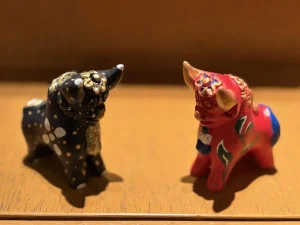
The Torito de Pucará is a traditional ceramic bull associated with the Andean region of southern Peru, particularly Puno.
You may notice pairs of these colorful bulls placed on the roofs of houses throughout Cusco, the Sacred Valley and other Andean communities. They are commonly connected with ideas of protection, prosperity, fertility and good fortune.
During a Torito de Pucará workshop, visitors normally learn about this cultural symbolism before decorating their own ceramic piece with colors, patterns and personal details.
You do not need specialized equipment. Most workshops provide the ceramic Torito, paints, brushes and other necessary materials.
However, we recommend bringing the following:
Wear clothes that allow you to sit and paint comfortably.
Although workshops are generally well organized, small drops of paint can happen, so it is better not to wear your most delicate clothing.
Temperatures in Cusco can change quickly, especially during the afternoon and evening.
Even when the day begins sunny, the temperature can become cooler once clouds arrive or the sun goes down. A lightweight jacket or sweater is useful throughout most of the year.
Painting sessions can last for a while, and staying hydrated is particularly important when traveling at altitude.
A reusable water bottle is a simple addition to your daypack.
Cusco sits at more than 3,300 meters above sea level, where sunlight can feel stronger than many visitors expect.
If your workshop includes walking outside before or afterward, sunscreen is strongly recommended.
Strong Andean sunlight can be uncomfortable, particularly around midday.
Sunglasses are useful if you plan to combine the workshop with sightseeing around Cusco.
The painting process is often one of the most enjoyable parts of the experience.
Taking a few photographs while your Torito changes from a simple ceramic figure into a personalized work of art is a good way to document the activity.
Just remember to keep your phone away from wet paint when you are working.
A compact backpack is usually enough for your personal belongings, including water, jacket, sunscreen and camera.
Avoid carrying unnecessary luggage, as the workshop itself does not normally require much equipment.
Depending on the workshop, additional ceramics, handmade products or souvenirs may be available for purchase.
Having a small amount of cash in Peruvian soles can be useful, particularly when buying directly from local artisans.
Usually, no.
A properly organized Torito de Pucará workshop generally provides the essential materials needed for the activity, such as:
This means travelers can arrive with very little preparation.
There is no formal dress code.
Choose practical clothing rather than dressing specifically for photographs. Comfortable pants, a T-shirt or long-sleeved shirt and walking shoes are normally enough.
If you are visiting during Cusco’s cooler months, particularly between approximately May and August, adding layers is useful.
The most important consideration is simple: wear something you will not worry about if a small amount of paint gets on it.
A Torito de Pucará workshop can be particularly enjoyable for families because the activity combines creativity with cultural learning.
Children can choose their own colors and designs while learning why the Torito appears so frequently in Andean homes.
Parents may want to bring:
The exact minimum age can depend on the workshop provider.
Although every workshop may be slightly different, the experience often follows a simple structure.
First, the instructor introduces the history and symbolism of the Torito de Pucará.
You then receive your ceramic piece and begin choosing colors and decorative patterns.
The instructor may demonstrate traditional designs, but you can normally personalize your Torito rather than copying a fixed model.
This is one of the most interesting parts of the activity: two travelers can begin with nearly identical ceramic figures and finish with completely different pieces.
You do not need to reproduce a traditional design exactly.
Many workshops encourage visitors to combine Andean-inspired patterns with their own ideas.
Some travelers use bright combinations of red, yellow, green and blue. Others prefer simpler geometric patterns or colors that have personal meaning.
If you want your Torito to feel more traditional, ask the artisan about the meaning of particular symbols and decorative elements before you begin painting.
Your finished Torito will probably become one of the more unusual souvenirs you take home from Peru, so transporting it carefully matters.
Before leaving the workshop, confirm that the paint is sufficiently dry.
If you are flying with the Torito, consider placing it in your carry-on luggage rather than inside a checked suitcase.
Wrap it with soft clothing or protective material and avoid placing heavy objects around it.
For international flights, ceramic handicrafts are normally much easier to protect when you keep control of the bag yourself.
Avoid scheduling the workshop immediately before an airport or train departure.
A relaxed workshop is much more enjoyable when you are not constantly checking the time, and your painted ceramic piece may also need some time to dry before transportation.
It can work particularly well as an afternoon activity after a lighter morning of sightseeing.
There is no reason to bring a large amount of equipment.
You normally will not need:
The experience is designed for travelers, including complete beginners.
Before leaving your hotel, check that you have:
The most memorable part of a Torito de Pucará workshop is often not the finished ceramic bull itself.
It is understanding why this small figure appears on rooftops throughout the Andes and discovering how a traditional object continues to be part of everyday Peruvian culture.
You leave with something you created yourself, but also with a better understanding of the symbolism, craftsmanship and traditions behind one of southern Peru’s most recognizable forms of folk art.
For travelers looking for a quieter cultural experience between archaeological sites, hikes and day tours, a Torito de Pucará workshop in Cusco can be an enjoyable way to spend a few hours while supporting local craftsmanship.
// Opcional: Carga sidebar.php